Showing posts with label History. Show all posts

Thursday, November 28, 2019

From Beowulf to Milton's Satan!

800 or so years in 16 or so weeks:
Literary Survey
and Vision-Quest (or so I hope)

Join the fun at CCSF in San Francisco

Monday, July 29, 2019

As Audience, As Witness


As I was getting coffee at the cafe this morning, I had a gentleman walk up to me and ask about the Bamboo Reef t-shirt I was wearing.  He wanted to know if the business were still in operation, and I named Monterey and SF as ongoing locations.  He then told me his father had been one of Bamboo Reef's three founders--with Al Giddings and Leroy French -- back in 1961.  We chatted briefly, me asking about his father's name (which I now can't recall, grrr), and then he moved on.

I'm guessing he wasn't a diver like his father, or at least not a local diver, or he would have known . . . but we didn't talk about any of that.

I like how the man wanted to connect with something his father had helped make -- and to say it out loud -- and I, random fellow that I am, was able to participate as audience, as witness.


Wednesday, June 12, 2019

Le Carre's "A Perfect Spy" is a Perfect Novel


Le Carre's A Perfect Spy is, I hazard to claim, a perfect novel.  It carries the adult thesis that the crucial shapings of character are emotional rather than rational, and it dramatizes such a range of humanity, such a range of response, in its pages.  I recently reread this novel -- while traveling in Germany, Austria, and Swizterland, very appropriately -- that I heartily endorse and recommend, and for some the trappings of espionage will be a feature, but I hope for others it will only be a mere distraction.


Le Carre's novel is both an excellent spy novel and a classic work of literature precisely because Le Carre is such a good watcher of humanity and such a good reporter of humane responses.  It's a thriller too.

Here's a passage that matters:

As for Pym, he was gazing on the glories of the kingdom he had dreamed of so long.  The German muse had no particular draw for him, then or later, for all his loud enthusiasm.  If she had been Chinese or Polish or Indian, it would have made no earthly odds.  The point was, she supplied Pym with the means, for the first time, to regard himself intellectually as a gentleman.  And for that Pym was eternally grateful to her.

As a first generation college student, I connect with this passage.  Studying English Literature at UC Berkeley enabled me to regard myself, intellectually, as a gentleman.  And that mattered.

Wednesday, March 27, 2019

"Because I Know, From Plato"


I have ground up hemlock and it releases a nose-wrinkling sour smell.  It also sparks a pain above your eyes and across the brain.  I have never known, though, whether this is psychosomatic.  Because I know, from Plato, what hemlock can do.

--Bettany Hughes,
The Hemlock Cup: 
Socrates, Athens and the Search for the Good Life


Wednesday, December 5, 2018

Comfort for a Sore Throat


A hot toddy and a good book:
The Fall of the Kings
by Ellen Kushner and Delia Sherman.

I think this is my third reading.

Thursday, May 3, 2018

Step Sideways Towards A Truth


I have always preferred Herodotus to Thucydides and Byron to Wordsworth.

That meant, that means, according to grad school criteria (don't you know), I am damned to frivolity, to the frivolous.

At least by association.

(Or, so they say.)

Terrible that I let old school judgments color my own thinking, my own self, now.
Hard to resist, I think.

My other response is to give in, to agree, via an essential insight:
ham-bone connected to the brain-bone.


Friday, July 24, 2015

The View From Cook's End

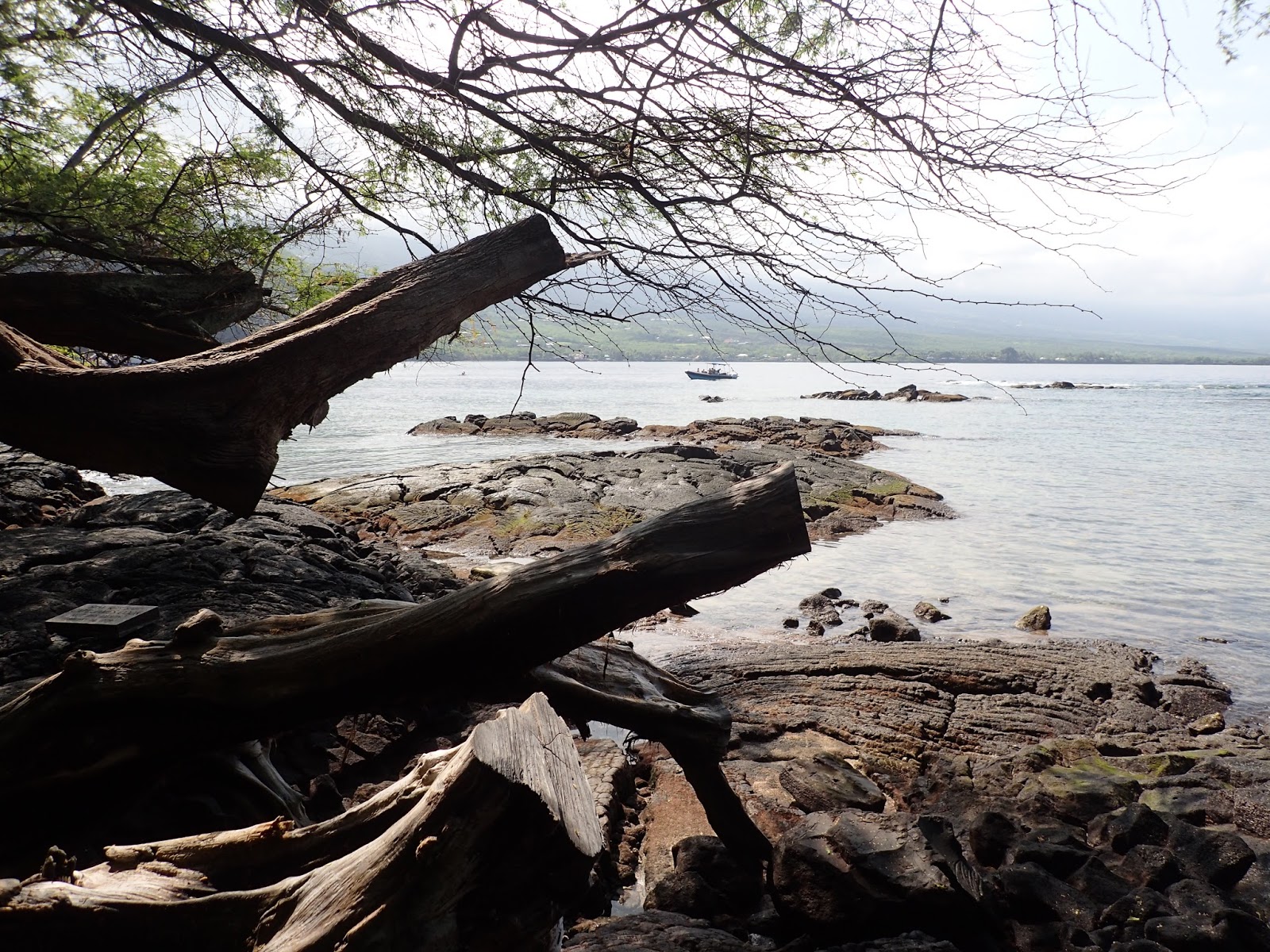
A gorgeous view from a sacred location, sacred to the ancient and modern Hawaiians.


The cross marks the spot where Captain Cook met his end, 
marking a different sort of sacred spot for certain Euro-descended people.

Also, according to our guide, Makai, that stone plaque came loose during a winter storm and had to be recovered before being lost to the waters.  An earlier bronze plaque commemorating Capt. Cook's life and death disappeared (salvaged, recycled) during WWII, I believe.

Sunday, June 29, 2014

Flying the Flag

I don't worry too much about fitting in, but a sense of community still feels good. Among the communities that have made me feel good, I have to rank the beachside parking lot full of divers fairly highly. I recall how my buddy Keith and I did our (old-school) diver training back in the late 70s and we went diving up and down Northern California, but we wouldn't put stickers on our cars or wear dive t-shirts until we felt we earned the right after a year or so. Then, we each put a modest diver-flag on our bumpers. (I think my dad gave me one that read "Think Deep.") And, we kept diving fairly frequently, at least for a few years before English grad school and law school distracted us. Nowadays, I like walking up the beach, in a soaking wetsuit, pulling that kayak with the rocket fins and weightbelt and other gear secured properly, getting and sharing the nods and smiles of like-minded souls in pursuit of salty experiences. I shoot my fish and creatures with a camera, but I still can talk abalone and spearfishing, and I like hearing those stories.

Monday, September 2, 2013

Seamus Heaney's "The Tollund Man"


THE TOLLUND MAN

I
Some day I will go to Aarhus
To see his peat-brown head,
The mild pods of his eye-lids,
His pointed skin cap.

In the flat country nearby
Where they dug him out,
His last gruel of winter seeds
Caked in his stomach,

Naked except for
The cap, noose and girdle,
I will stand a long time.
Bridegroom to the goddess,

She tightened her torc on him
And opened her fen,
Those dark juices working
Him to a saint's kept body,

Trove of the turfcutters'
Honeycombed workings.
Now his stained face
Reposes at Aarhus.

II
I could risk blasphemy,
Consecrate the cauldron bog
Our holy ground and pray
Him to make germinate

The scattered, ambushed
Flesh of labourers,
Stockinged corpses
Laid out in the farmyards,

Tell-tale skin and teeth
Flecking the sleepers
Of four young brothers, trailed
For miles along the lines.

III
Something of his sad freedom
As he rode the tumbril
Should come to me, driving,
Saying the names

Tollund, Grauballe, Nebelgard,
Watching the pointing hands
Of country people,
Not knowing their tongue.

Out here in Jutland
In the old man-killing parishes
I will feel lost,
Unhappy and at home.

-- Seamus Heaney,

from his volume of poetry Wintering Out,
Faber & Faber Ltd, London, 1972.


Bog Man: stoneware; clear glaze.

2009 note: "Just fooling in art class; found myself with this fellow in my hands. (Of course, after all those years in the peat bog, his nose would not be quite so strong.)"

Rest in peace, Mr. Heaney, and thank you for your art, your voice, your compassion.

Saturday, April 13, 2013

Batter Up! My Dad As A Young Man


R.I.P.  Dad.  The anniversary has rolled around once again.

My father was always a ball-player.  And, he has "Duckworth" written all over his face.

Monday, February 4, 2013

Keith: We Never Took Enough Photos


My best friend Keith in two unguarded moments: Kruse Ranch dive trip.

He hated photographs, hated sitting still long enough for a photo, hated posing.  I'd have to be sneaky to document our dive trips, our friendship, and since I was arrogant regarding the primacy of memory and the internal vision, I colluded with Keith.  I can't recall that he ever snapped a shot, though I think his children may remember the facts differently.  He would have told me, Matt, of course, I want to have keepsakes of my children.  (He loved his children fiercely.)

Memory Lane is a blurry avenue, don't you know?

We left home about midnight and drove the three or four hours up to our "secret spot" on the Sonoma Coast, talking all the while, solving the moral conundrums and practical puzzles of the day, crashing out after a few beers by the side of the road.  (We both had forgotten to bring a bottle opener, and consequently, we had to be creative with different parts of the Datsun or our dive knives to serve that need.)  I think there's a "No Camping" sign a few feet from where Keith is sleeping.  With the morning light -- though this trip we'd obviously overslept -- we'd gear up and harvest a few abalone.  I usually ended up driving homeward while Keith napped in the passenger seat.  (I sometimes railed at him for how he relied on me to keep him awake on the outward leg, but he snoozed on me, leaving me to my own devices, on the homeward leg, but he always failed to be impressed by my arguments.  As driver, I had command of the tape deck, and he knew I liked companionable solitude anyway.)

When would this trip have occurred?  Post-undergraduate.  Law school days for Keith?  Warehouse/driver days for me?  I'd have to do some homework.  Early or mid-80's?  If I think hard enough about that car, I can work out the year, I'm sure.

If I spent too much time with my instamatic taking photos of the tidepools, of the surf, of any of our group, he'd urge me to get done, as we needed to head home.  He usually had work or chores or something waiting for him, and I respected those responsibilities, yet it often seemed as if he just thought what I was doing was frivolous.

He claimed to hate these shots.  And yet I can recall one time he commented that I never bothered to share the photographs with him and the rest of the gang, if gang there happened to be that year.  I was surprised and hadn't shared due to my sense of his disinterest, or antagonism, or to the poor quality of the shots, hurried and taken from the hip, as it were.

I wish I had more of them.

I miss you, man.


Sunday, December 2, 2012

Thomas Gray's "The Fatal Sisters"


THE FATAL SISTERS

Now the storm begins to lower,
(Haste, the loom of Hell prepares!)
Iron-sleet of arrowy shower
Hurtles in the darkened air. 

Glittering lances are the loom,
Where the dusky warp we strain,
Weaving many a soldier's doom,
Orkney's woe and Randver's bane. 

See the grisly texture grow,
('Tis of human entrails made!)
And the weights that play below,
Each a gasping warrior's head. 

Shafts for shuttles, dipped in gore,
Shoot the trembling cords along.
Sword, that once a monarch bore,
Keep the tissue close and strong. 

Mista, black, terrific maid,
Sangrida, and Hilda, see,
Join the wayward work to aid;
'Tis the woof of victory. 

Ere the ruddy sun be set,
Pikes must shiver, javelins sing,
Blade with clattering buckler meet,
Hauberk crash, and helmet ring. 

(Weave the crimson web of war!)
Let us go, and let us fly
Where our friends the conflict share,
Where they triumph, where they die. 

As the paths of fate we tread,
Wading through the ensanguined field,
Gondula and Geira, spread
O'er the youthful king your shield. 

We the reins to slaughter give;
Ours to kill, and ours to spare;
Spite the dangers he shall live.
(Weave the crimson web of war!) 

They whom once the desert beach
Pent within its bleak domain,
Soon their ample sway shall stretch
O'er the plenty of the plain. 

Low the dauntless earl is laid,
Gored with many a gaping wound;
Fate demands a nobler head;
Soon a king shall bite the ground. 

Long his loss shall Eirin weep
Ne'er again his likeness see;
Long her strains in sorrow steep,
Strains of immortality! 

Horror covers all the heath;
Clouds of carnage blot the sun.
Sisters, weave the web of death;
Sisters, cease, the work is done. 

Hail the task, and hail the hands!
Songs of joy and triumph sing!
Joy to the victorious bands
Triumph to the younger king. 

Mortal, thou that hear'st the tale,
Learn the tenor of our song.
Scotland, through each winding vale
Far and wide the notes prolong. 

Sisters, hence with spurs of speed;
Each her thundering falchion wield;
Each bestride her sable steed.
Hurry, hurry to the field! 

--Thomas Gray

Friday, October 5, 2012

Memory's Echo


Amazon: sculpture mix; cobalt carbonate oxide.

Saturday, September 22, 2012

Dunnett's Macbeth: Thorfinn of Orkney -- A Favorite Passage

Here's a favorite passage from Dorothy Dunnett's King Hereafter, a novel about the historical Macbeth: Thorfinn the Mighty, Earl of Orkney, King of Scotia.  Frankly, Dunnett's King Hereafter is one of my Top Ten Novels of All Time, but that's an idiosyncratic list.  Still.

Here, we get a crucial insight into the "secret of [Thorfinn's] success", but even as Dunnett provides Thorkel Fostri's bitter assessment, she also provides Tuathal's reflections on what Thorkel says, making a simple statement complex in the best ways.  I end up appreciating the insight into the main character, even as I feel for Thorkel's frustration year after year.  (And yet Thorkel deserves some of that frustration . . . and if you've read the novel, I'll bet you'd agree.  "Year after year" refers both to Thorkel's relationship over time with Thorfinn and to my yearly rereadings.)  There are worthy ponderings possible here: about leadership, about problem-solving, and about reciprocity and the mysteries of connection and admiration.

I'm putting Dunnett's passage below the photo of knife and novel.  (The point of view, here, is that of Tuathal, Prior of St. Serf's, as the POV shifts throughout the novel, usefully so.)


Did [Earl Siward of York] regret his exile?  Had he envied Kalv, turning his coat so adroitly over and over, and at least buying back some years at Egge?

'Envy?  He despised Kalv.  Kalv was a fool,' Thorkel had said.  'There was only one man he envied.'

'He hated Thorfinn?  Always?  I suppose he must have done,' Tuathal had said, thinking aloud.  'Or the Lady Emma would never have risked making Siward her buffer between the rest of England and Scotia.  But then, what if Siward had tried to take over Scotia?'

'Twelve years ago?  Against Thorfinn's manpower, and his money, and his fleet?  Even with England and Denmark behind him,' had said Thorkel Fostri with scorn, 'I doubt if he would have got a levy over the Forth.  And England wouldn't have backed him.  Magnus had Norway then, remember, and half a foot in Orkney already through Thorfinn's nephew Rognvald.  England would rather have had Thorfinn in Scotia, I can tell you, than Siward or Norway.'

And that, thought Tuathal, was still true.  Despite Thorfinn's present weakness, it was still, thank God, true.  He had said, 'And Thorfinn?  He's used to dealing with princes these days.  Does he resent being forced to barter with someone . . . '

He had paused, having caught Eochaid's eye, to rephrase the question, but Thorkel Fostri's voice, at its most sardonic, had taken him up.  'Someone like me, from the barbarous north?  Haven't you noticed yet that Thorfinn is prouder of being Earl of Orkney than he is of ruling Scotia?  He fought for Orkney and won it, against men just like Siward.  His own kind.  He knows them too well to despise them.'

His own kind?  Thorfinn was three-quarters Celt.  They were not his own kind.  Tuathal had said, 'So it's just another negotiation?  Thorfinn neither likes nor dislikes Kalv's nephew?  I find it hard to believe.'

To which Thorkel Fostri had answered in a way he had not expected.  'When did you ever know whether Thorfinn likes or dislikes a man?  He takes them for what they are, and deals with them accordingly.  It's the secret of his success.  You don't fight the sea by getting angry at it, or persuade it to be kinder by loving it.'

The bitterness was plain to all to hear.  Eochaid had got up and left, and he, Tuathal, had asked only one or two questions more.

He was not embarrassed.  It merely appeared to him a paradox worth someone's attention: how a man such as Thorkel described could inspire what Thorkel undoubtedly felt for him.


Wednesday, September 15, 2010

Action Figure

Just call me Joe. You never know what will turn up in the garage. A piece of my childhood surfaced recently, though I am not sure how he survived the various moves and purges.
This fellow goes way way way back. He's outfitted in a jumpsuit, float vest, stocking cap, boots, and equipped with mask, fins, camera, pistol, flaregun, flashlight, maybe a knife. He has an inflatable raft too. This guy has been ready for some water adventure for about four full decades. I call that good training.


Sunday, June 27, 2010

Annotations: Dan Duane's Caught Inside

Note: As a sabbatical project back in Fall 2008, I produced an annotated bibliography of 129 non-fiction texts treating water and water-related topics, usually emphasizing marine biology or adventure. Dan Duane's Caught Inside is one of my favorites.