Showing posts with label Goddess. Show all posts
Showing posts with label Goddess. Show all posts
Tuesday, August 18, 2020
Saturday, November 5, 2016

Monday, June 20, 2016


Friday, April 25, 2014
Reprise: Moon Goddess


Mask: Moon Goddess.
Sculpture mix;
stormy blue and celadon/green over transparent brown glazing.
I miss the studio.

Sunday, October 6, 2013
Dreams and Shadows -- Robert Graves' "Theseus and Ariadne"

Amazon: sculpture mix; cobalt carbonate oxide.

THESEUS AND ARIADNE
High on his figured couch beyond the waves
He dreams, in dream recalling her set walk
Down paths of oyster-shell bordered with flowers,
Across the shadowy turf below the vines.
He sighs: "Deep sunk in my erroneous past
She haunts the ruins and the ravaged lawns."
Yet still unharmed it stands, the regal house
Crooked with age and overtopped by pines
Where first he wearied of her constancy.
And with a surer foot she goes than when
Dread of his hate was thunder in the air,
When the pines agonised with flaws of wind
And flowers glared up at her with frantic eyes.
Of him, now all is done, she never dreams
But calls a living blessing down upon
What he supposes rubble and rank grass;
Playing queen to nobler company.
--ROBERT GRAVES

Monday, September 2, 2013
Seamus Heaney's "The Tollund Man"

I
Some day I will go to Aarhus
To see his peat-brown head,
The mild pods of his eye-lids,
His pointed skin cap.
In the flat country nearby
Where they dug him out,
His last gruel of winter seeds
Caked in his stomach,
Naked except for
The cap, noose and girdle,
I will stand a long time.
Bridegroom to the goddess,
She tightened her torc on him
And opened her fen,
Those dark juices working
Him to a saint's kept body,
Trove of the turfcutters'
Honeycombed workings.
Now his stained face
Reposes at Aarhus.
II
I could risk blasphemy,
Consecrate the cauldron bog
Our holy ground and pray
Him to make germinate
The scattered, ambushed
Flesh of labourers,
Stockinged corpses
Laid out in the farmyards,
Tell-tale skin and teeth
Flecking the sleepers
Of four young brothers, trailed
For miles along the lines.
III
Something of his sad freedom
As he rode the tumbril
Should come to me, driving,
Saying the names
Tollund, Grauballe, Nebelgard,
Watching the pointing hands
Of country people,
Not knowing their tongue.
Out here in Jutland
In the old man-killing parishes
I will feel lost,
Unhappy and at home.
-- Seamus Heaney,
from his volume of poetry Wintering Out,
Faber & Faber Ltd, London, 1972.

Bog Man: stoneware; clear glaze.
2009 note: "Just fooling in art class; found myself with this fellow in my hands. (Of course, after all those years in the peat bog, his nose would not be quite so strong.)"
Rest in peace, Mr. Heaney, and thank you for your art, your voice, your compassion.
Saturday, August 17, 2013
Jack Spicer: Of Fools, Goddesses, Heroes, Oceans, Love, and Memory
ANY FOOL CAN GET INTO AN OCEAN
Any fool can get into an ocean
But it takes a Goddess
To get out of one.
What’s true of oceans is true, of course,
Of labyrinths and poems. When you start swimming
Through riptide of rhythms and the metaphor’s seaweed
You need to be a good swimmer or a born Goddess
To get back out of them
Look at the sea otters bobbing wildly
Out in the middle of the poem
They look so eager and peaceful playing out there where the
water hardly moves
You might get out through all the waves and rocks
Into the middle of the poem to touch them
But when you’ve tried the blessed water long
Enough to want to start backward
That’s when the fun starts
Unless you’re a poet or an otter or something supernatural
You’ll drown, dear. You’ll drown
Any Greek can get you into a labyrinth
But it takes a hero to get out of one
What’s true of labyrinths is true of course
Of love and memory. When you start remembering.
--Jack Spicer
(Thanks, JP, for the suggestion.)
Thursday, December 20, 2012


Friday, May 11, 2012
"Giving What I Have" : Peter Green, Translating the Argonautika, and the Enjoyment of Reading
Classicist Peter Green is an inspiring scholar, translator, and novelist. I've quoted from his excellent The Laughter of Aphrodite: A Novel About Sappho of Lesbos here, and now I'm returning to his translation of Apollonius of Rhodes' epic poem of Jason and the Argonauts. I picked up this book eleven years ago for my 40th birthday, and as my 51st approaches, it feels right to revisit a favorite tale of adventure and desire.
I'd like to quote Green on translating this epic poem as a "labor of love" and on formative experiences regarding scholarship and, more importantly, reading for enjoyment. I'm in Green's camp, quite obviously, and I have a deep attachment to tales of the heroic Greeks as well.

In his "Preface and Acknowledgements," Peter Green writes:
Working on the Argonautika has been for me very much a labor of love. At the age of seven I first encountered, and was fascinated by, the quest for the Golden Fleece in that brilliant volume by Andrew Lang, Tales of Troy and Greece, never yet surpassed as a retelling of ancient myth for young people.* Years later, reading Boswell's Life of Johnson, I came across this passage:
"And yet, (said I) people go through the world very well, and carry on the business of life to good advantage, without learning." Johnson: "Why, Sir, that may be true in cases where learning cannot possibly be of any use; for instance, this boy rows us as well without learning, as if he could sing the song of Orpheus to the Argonauts, who were the first sailors." He then called to the boy, "What would you give, my lad, to know about the Argonauts?" "Sir, (said the boy) I would give what I have."
The boy's words, then and even today, struck an emotional chord that hit me directly and physically, just as a certain high-frequency note drawn from a violin will shatter a wineglass. In one sense I have been giving what I have in pursuit of those bright, elusive, infinitely rewarding Sirens ever since. The anecdote seems to me the best justification ever put forward for a truly humane education.
This is, I know, quite hopelessly old-fashioned and romantic. Robert Graves somewhere recalls his dismay at the reply he got from an earnest student of English literature when he asked her what she enjoyed about Shakespeare's (I think) work. "I don't read to enjoy," she said, in withering reproof, "I read to evaluate." The absence of genuine pleasure is what makes too much literary criticism today an aridly sterile desert. Despite this I still retain my deep instinctive responses to great art and literature, though a quarter of a century's exposure to American academic critical trends has come as near to killing such reactions in me as anything could do. In that sense the present work may count as an act of calculated defiance, as well as an invitation to relish one of the Hellenic world's oldest and most deeply resonant myths, told by a master of his craft, who loved the sea, and ships, and the complexities of human nature, and let that passion irradiate everything he wrote.
--from The Argonautika: The Story of Jason and the Quest for the Golden Fleece by Apollonios Rhodios, Translated, with Introduction and Glossary By Peter Green,
University of California Press: Berkeley, Los Angeles, London, 1997: pages xii-xiii.

I'd almost forgotten Green's footnote to the passage above. Here it is:
*Lang, together with The Heroes of Asgard and several other highly formative texts, was put into my hands during the three years, form six to eight, that I spent at an English P.N.E.U. (Parents' National Educational Union) school, before being transferred to the less congenial rigors of prep and boarding schools. Most of the serious permanent passions of my later life (including the study of classics as a profession, and the absorption of world literature and music for the sheer fun of it) had their roots in my P.N.E.U. days. I did not get any remotely comparable stimulation and excitement until I returned to Cambridge after World War II as an elderly (I thought) I was twenty-three) ex-service undergraduate.
Wednesday, March 28, 2012
Robert Graves: Stones and a Goddess
The stones you have gathered, of diverse shapes,
Chosen from sea strand, lake strand, mountain gully:
Lay them all out on a basalt slab together
But allow intervals for light and air,
These being human souls; and reject any
With crumpled calceous edges and no feature
That awakes loving correspondence.
Start at this pair: blue flint, grey ironstone,
Which you ring around with close affinities
In every changeless colour, hatched, patched, plain--
Curve always answering curve, and angle, angle.
Gaps there may be, which next year or the next
Will fill to a marvel: never jog Time's arm,
Only narrow your eyes when you walk about
Lest they miss what is missing. The agreed intent
Of each consortium, whether of seven stones,
Or of nineteen, or thirty-three, or more,
Must be a circle, with firm edges outward,
Each various element aware of the sum.
THE BLACK GODDESS
Silence, words into foolishness fading,
Silence prolonged, of thought so secret
We hush the sheep-bells and the loud cicada.
And your black agate eyes, wide open, mirror
The released firebird beating his way
Down a whirled avenue of blues and yellows.
Should I not weep? Profuse the berries of love,
The speckled fish, the filberts and white ivy
Which you, with a half-smile, bestow
On your delectable broad land of promise
For me, who never before went gay in plumes.
--Robert Graves
Robert Graves, along with William Butler Yeats, is a favorite poet from the beginning and middle of the last century. Both poets share a mythic power, though their visions are individual and discrete from one another. Graves, even more than Yeats, is a poet of raw desire and of deep connection with the elements.
Sunday, January 29, 2012
Pieces of Luck
Or, Incense-Goddesses.

Originally, I put wooden skewers through each clay piece for support, but now that each piece is finished, those holes are handy for incense sticks.

Incense-Goddesses: sculpture mix; green or blue glazing, layered. Each piece was a 20-minute live model exercise.
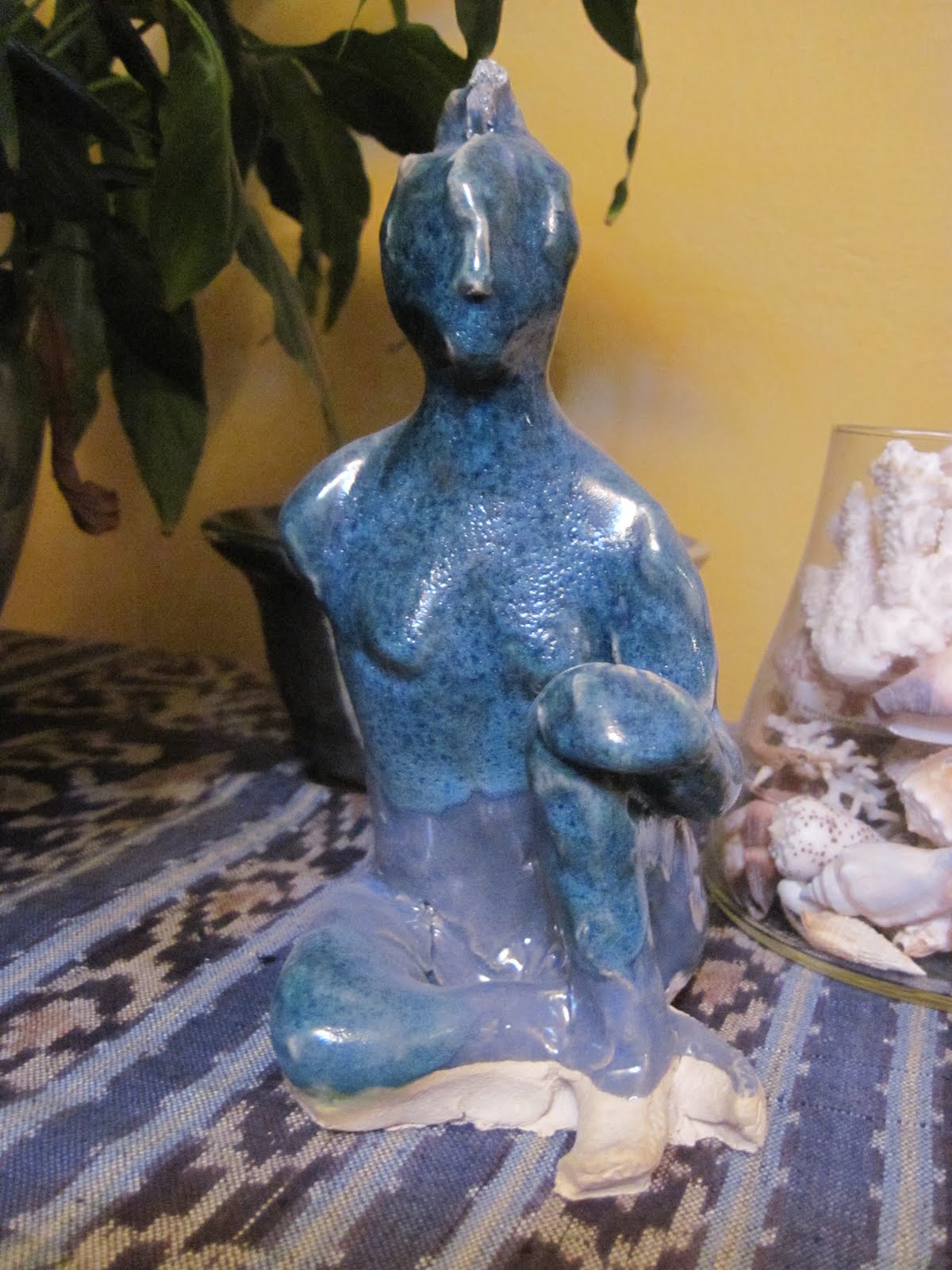
If you are interested in having such a figurine yourself, let me know. They are a bit rough, obviously, but no rougher than a lot of figurines I've seen in specialty stores.
If you want a custom incense-goddess (or god), if you are willing to model for your own figurine, contact me and we'll see how that could work. I'd get live practice, certainly, and you just might get a piece of sculpture that not only holds incense sticks, but that holds your own (rough) likeness, and I'd call that a piece of luck.
I have no idea how serious I am about such offers. I guess I'll decide if I get any actual responses.
Wednesday, November 10, 2010


Subscribe to:
Posts (Atom)