Showing posts with label Celtic. Show all posts

Thursday, December 29, 2016

TBT: "The Sea-God Sailing"

Throwback Thursday?  Here's a poem of mine from high school that I recently (re)discovered:

THE SEA-GOD SAILING

When the wind's a howling, red-eyed scourge--
The surf beats out a dismal dirge
     And the rigging hums with a dire tune--
     There comes a-racing through mist and gloom
The lord of sea and surge.

The winter sky is fraught with grey,
In frozen heaps the storm clouds lay.
     So fill with ale your carven mug,
     In hearty gulps drink down that slug,
As he glides into the bay.

Aye, drain that mug to the king of the sea,
Before whose prow the troubled waters flee.
     To Manannan, the Celtic one,
     Besides whose ship the dolphins run,
For the sea's true son is he.

And like the wilful, wind-swept waters wide,
Indomitable as the turning tide,
     Wild and daring as the untamed surge--
     Until the oceans very verge
His sturdy sloop doth ride.

While Neptune and his kin doth sleep--
Sung in their castles buried deep,
     Indolent in the languid seas,
     Lolling in the warm, southern breeze--
Manannan storms the ocean's briny keep.

For Manannan Mac Lir is he,
The warrior of the northern sea.
     With flaxen sail and ashen spar,
     The Celtic god doth make his war
With the legions of the sea.

In anger, the wayward sea attacks,
With swell and squall and ice that tracks.
     Yet closer to the wind he leads
     And braces the ocean's white-maned steeds,
And slides across their lathered backs.

Though the spray to ice in air doth turn,
And iron and flesh together coldly burn,
     He grips the tiller like a hearth,
     Through his frozen beard shines his mirth,
And strains at stem and stern.

Through the heart of a raging northern gale,
Pelted by the sling-stones of frosty hail,
     As to futile wrath turns the sea,
     Manannan, making his way with glee,
Tightens his grip and trims his sail.

In a stinging salt-spray haze he's whirled,
At him the wrath of waves is hurled--
     Over him they break, like soldiers on a wall,
     Above him the gulls, in brazen voices call--
And with a flag, his sail unfurled, he skims across the frozen world.

He turns his prow to the midnight land of sun and sea and sky,
And sails in the gleaming snow of the ice that will not die--
     Across the world's ridge, he slowly spreads his sails,
     And beaches his boat on the barren backs of whales,
And gulls about him fly.

As the wind, Manannan is free.
He sails across the sullen sea,
     And though the proud waters permit no track,
     Mac Lir, with a cloak from a leathern sack,
Is master there, aye master, for all eternity.

--Matthew Duckworth
from Unrecognized Poems of Literary Merit
by Mrs. Covell's A-P English Class
1978-1979.

--I just found this old volume in a box in my study, recently pulled out of the garage.
Juvenilia, by any other name . . . .

Wednesday, July 13, 2016

In the Footsteps of the Legions


On Hadrian's Wall.
I'd been looking forward to this moment for almost my whole life.

As a boy, in my daydreams, I would walk that wall as a Roman, guarding the border, guarding the Empire . . .
Or, also as that boy, daydreaming, I'd climb and cross that wall as a Celt or Pict, seeking to drive away the invaders . . . .

Friday, January 8, 2016

Friday, January 1, 2016

Ring: "Waves"


A good-luck ring, I'm hoping.

Classic artistry from the Irish metal-workers on Shattuck Avenue in Berkeley, CA.
You can find their fine work here.

For me, the wave-ring is also a wyrd-ring, the pattern of becoming, of winding and unwinding, that marks the Old English idea and practice of fate, of the world's workings, of past/present/future.

Check the rings and lines of age on my hand too.  I'm reminded of how trees show their life-lines.  Knotwork.  Or, there's a Bruce Sterling novel that I never liked much of a future dystopian universe in which wealthy people could live long, long lives in young and younger bodies, but their hands would give them away -- the signs of aging in the wrinkles and lines of their hands being resistant to the otherwise miraculous drugs to offset mere age -- would give them away, and as an older reader now, as an older man now, I see what he was getting at.

That's cool.  Slipping over the cusp of 2015 into 2016, I think about something the great surfer Fred van Dyke said --in an excellent documentary, David L. Brown's Surfing for Life -- "I'm getting older, and I gotta dig it."

Something like that.  And I am digging it.

(Talk to the hand, if you don't dig it too.)

Saturday, November 2, 2013

Vercingetorix: Two Views

Vercingetorix: 
sculpture mix; sea-foam glaze, too thinly applied.

Or, The Apple Man.

Sunday, October 27, 2013

New Mask: The Painted Man


The Painted Man (Math-theow): 
sculpture mix; denim, stormy blue, green, and transparent brown glazing, layered; leather strip.

Thursday, September 5, 2013

Something Other Than Repose

Aside:
note how the shiny black over the shino glazing results in that mottled/speckled glory.

Wednesday, August 14, 2013

Saturday, October 20, 2012

Charming


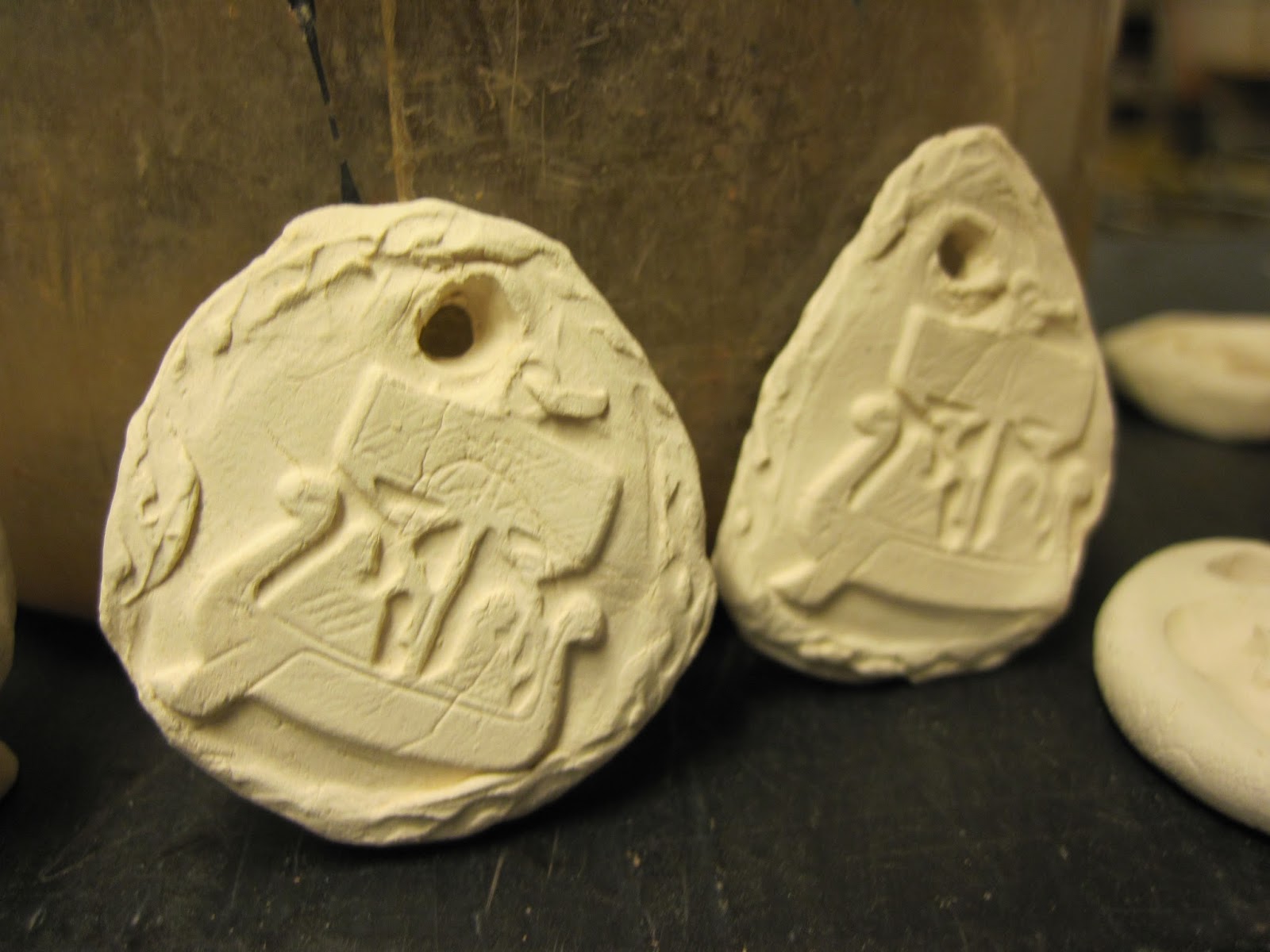
 Sculpture mix  charms and ornaments in progress.  The deer pattern is from a design by the wonderful Celtic artist Jen Delyth.  I have an ornament of hers that I am using to make patterns in clay for my own use and enjoyment.  Check out her art!

Tuesday, September 25, 2012

Pig, In Progress


Wet clay, the other day.

Saturday, September 22, 2012

Dunnett's Macbeth: Thorfinn of Orkney -- A Favorite Passage

Here's a favorite passage from Dorothy Dunnett's King Hereafter, a novel about the historical Macbeth: Thorfinn the Mighty, Earl of Orkney, King of Scotia.  Frankly, Dunnett's King Hereafter is one of my Top Ten Novels of All Time, but that's an idiosyncratic list.  Still.

Here, we get a crucial insight into the "secret of [Thorfinn's] success", but even as Dunnett provides Thorkel Fostri's bitter assessment, she also provides Tuathal's reflections on what Thorkel says, making a simple statement complex in the best ways.  I end up appreciating the insight into the main character, even as I feel for Thorkel's frustration year after year.  (And yet Thorkel deserves some of that frustration . . . and if you've read the novel, I'll bet you'd agree.  "Year after year" refers both to Thorkel's relationship over time with Thorfinn and to my yearly rereadings.)  There are worthy ponderings possible here: about leadership, about problem-solving, and about reciprocity and the mysteries of connection and admiration.

I'm putting Dunnett's passage below the photo of knife and novel.  (The point of view, here, is that of Tuathal, Prior of St. Serf's, as the POV shifts throughout the novel, usefully so.)


Did [Earl Siward of York] regret his exile?  Had he envied Kalv, turning his coat so adroitly over and over, and at least buying back some years at Egge?

'Envy?  He despised Kalv.  Kalv was a fool,' Thorkel had said.  'There was only one man he envied.'

'He hated Thorfinn?  Always?  I suppose he must have done,' Tuathal had said, thinking aloud.  'Or the Lady Emma would never have risked making Siward her buffer between the rest of England and Scotia.  But then, what if Siward had tried to take over Scotia?'

'Twelve years ago?  Against Thorfinn's manpower, and his money, and his fleet?  Even with England and Denmark behind him,' had said Thorkel Fostri with scorn, 'I doubt if he would have got a levy over the Forth.  And England wouldn't have backed him.  Magnus had Norway then, remember, and half a foot in Orkney already through Thorfinn's nephew Rognvald.  England would rather have had Thorfinn in Scotia, I can tell you, than Siward or Norway.'

And that, thought Tuathal, was still true.  Despite Thorfinn's present weakness, it was still, thank God, true.  He had said, 'And Thorfinn?  He's used to dealing with princes these days.  Does he resent being forced to barter with someone . . . '

He had paused, having caught Eochaid's eye, to rephrase the question, but Thorkel Fostri's voice, at its most sardonic, had taken him up.  'Someone like me, from the barbarous north?  Haven't you noticed yet that Thorfinn is prouder of being Earl of Orkney than he is of ruling Scotia?  He fought for Orkney and won it, against men just like Siward.  His own kind.  He knows them too well to despise them.'

His own kind?  Thorfinn was three-quarters Celt.  They were not his own kind.  Tuathal had said, 'So it's just another negotiation?  Thorfinn neither likes nor dislikes Kalv's nephew?  I find it hard to believe.'

To which Thorkel Fostri had answered in a way he had not expected.  'When did you ever know whether Thorfinn likes or dislikes a man?  He takes them for what they are, and deals with them accordingly.  It's the secret of his success.  You don't fight the sea by getting angry at it, or persuade it to be kinder by loving it.'

The bitterness was plain to all to hear.  Eochaid had got up and left, and he, Tuathal, had asked only one or two questions more.

He was not embarrassed.  It merely appeared to him a paradox worth someone's attention: how a man such as Thorkel described could inspire what Thorkel undoubtedly felt for him.


Thursday, September 20, 2012

Reprise: Fergus


Fergus: stoneware; brown glazing, layered; copper wire.
      --a Talking Head, as it were, in the Celtic tradition.

Sunday, September 9, 2012

A Celtic PIg


Young Boar: Navajo Wheel clay; brown glazing, layered.

Thursday, October 14, 2010

Must Be Dragons

Didn't St. Patrick banish all the snakes from Ireland?

So this Celtic design, borrowed from the Book of Kells, I believe, must be dragons. Or, are they really snakes?

Earth wisdom, earth power--either way. Good luck to the wearer.

In his Winter Count, which is where I found the following passage, Barry Lopez quotes Jorge Luis Borges on dragons from The Book of Imaginary Beings, a passage that's always stuck with me. Listen:

"We are as ignorant of the meaning of the dragon as we are of the meaning of the universe, but there is something in the dragon's image that appeals to the human imagination, and so we find the dragon in quite distinct places and times."

This dragon-buckle is the work of Peter O'Loughlin, the silversmith who crafted the three-dogs-running pendant I featured earlier this month, and you may find him in a booth on Telegraph Avenue near UC Berkeley. In fact, he's usually selling his fine pieces in that first block next to Bancroft Avenue.

Friday, October 8, 2010

Three Dogs Running


This is a favorite image, originally from the Book of Kells, as best I know.

This piece is from the hand of Peter O'Loughlin, silversmith, that I picked up years ago from his booth on Telegraph Avenue in Berkeley, CA.

I've read that the three-dogs-running symbolizes courage. I understand that; in the image, I see liveliness, perseverance, and no flinching. I wonder at letting-loose-the-dogs. I look at the pendant--at the photos now--and I smile, with the hint of a dog-tooth showing.

After I took the photos, I started reading around, pulling various books from the shelves, seeking just the right passage or passages to accompany the hounds.: W. B. Yeats' "On Baile's Strand," William Shakespeare's Macbeth, Seamus Heaney's translation of Beowulf, Marie Heaney's Over Nine Waves: A Book of Irish Legends, among others. (There's a John Montague poem that would fit best, but my volume of his collected poetry is on my desk at work just now.)


Cuchulain, of course, is a man-hound worth recalling, but here's a passage from Marie Heaney's "St. Patrick" that feels oddly fitting: no dogs, but also no flinching.

While Patrick was preaching in Munster, Aengus, the king of Cashel, became curious about the visitor and summoned him to his fort. Patrick preached the gospel and the king, believing in it, asked to be baptized. As Patrick blessed Aengus, the spike of his crozier went through the king's foot, but Aengus did not flinch. When the ceremony was over and Patrick saw the wound he had inflicted he was stricken with remorse.
"I didn't cry out or protest," Aengus explained, "for I thought the piercing was part of the ritual that I had to endure."

Heaney, Marie. Over Nine Waves: A Book of Irish Legends. Faber & Faber. London & Boston: 1995.

Monday, September 20, 2010

Passages: W. B. Yeats' Mythic Yearning

Here are two of my favorite poems by William Butler Yeats, early and particularly Celtic poems. The Irish poet strums the mythic harpstrings here, his melodies bright and piercing. I've always felt a bit haunted by Fergus' chariot and Niamh's calling.


WHO GOES WITH FERGUS?

Who will go drive with Fergus now,
And pierce the deep wood's woven shade,
And dance upon the level shore?
Young man, lift up your russet brow,
And lift your tender eyelids, maid,
And brood on hopes and fear no more.

And no more turn aside and brood
Upon love's bitter mystery;
For Fergus rules the brazen cars,
And rules the shadows of the wood,
And the white breast of the dim sea,
And all dishevelled wandering stars.


THE HOSTING OF THE SIDHE

The host is riding from Knocknarea
And over the grave of Clooth-na-bare;
Caoilte tossing his burning hair,
And Niamh calling Away, come away;
Empty your heart of its mortal dream.
The winds awaken, the leaves whirl round,
Our cheeks are pale, our hair is unbound,
Our breasts are heaving, our eyes are agleam,
Our arms are waving, our lips are apart;
And if any gaze on our rushing band,
We come between him and the deed of his hand,
We come between him and the hope of his heart.
The host is rushing 'twixt night and day,
And where is there hope or deed as fair?
Caoilte tossing his burning hair,
And Niamh calling Away, come away.

P.S. If you feel you need more, well, Yeats' poetry, prose, and dramas are easy to find. "The Stolen Child" is your best next step.

Saturday, September 18, 2010

The Blood Tells


"One of the most shocking characteristics of the Celts for Classical commentators was that they were--at least in battle--head-hunters. The warrior who decapitated his enemy had more than proof of victory: he was also possessing himself of the sacred and protective powers supposed to reside within the human head. Skulls were frequently positioned at the doors of Celtic temples to act as spiritual guardians. Gods were depicted with over-large heads, while especial importance was attached to the janiform head, because of its ability to look in both directions at once. A famous example from Roquepertuse in the south of France shows the human and the divine, the warrior and the war-god, gripped in the bill of a goose."

--A passage from The Celts: Sacred Symbols. Thames & Hudson, Ltd., London: 1975; reprinted 1996.

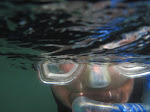
That's Fergus above, watching over the birdstand, a horned tripod, that I cobbled together recently. "Who will go with Fergus now?" Many birds, I hope, and may the spirits of all fly freely, here and hereafter.

Today would have been my father's 77th birthday, so I'm thinking of flights of fancy, of Otherworlds and other worlds (like one in which he would still be alive, and I could tell him about new frontage roads and shortcuts). I'll toast you, Dad, with a bit of Irish, though Mom would hardly approve. Here and hereafter.

P.S. Here's a shot of my father as a young man, maybe 30 or so. It's a photo of part of my favorite photo of the man; despite the age and condition of the photo itself, his spirit is clearly visible here.