Showing posts with label Heaney. Show all posts
Showing posts with label Heaney. Show all posts
Saturday, November 24, 2018
Tuesday, December 22, 2015
The Winding and Unwinding
THE WINDING AND UNWINDING
The shape of your thought
Entices me
Quite as much as
The thought of your shape.
Clay-minded,
Bloody-brained,
Fickle as a stick in water:
I swim towards you.
I reach for you
Again and again and again
In thought, in force,
Not withholding aught
Save what wyrd demands
From each of us.
The winding and unwinding
Of time and tide,
Again releasing,
Again embracing,
Tasting and chasing,
Like river-otters sliding
Down the sloped bank.
The winding and unwinding
Of time and tide:
The rounded lift and heft,
The nipple’s assertion,
The twinned-blood rising
Like the swift pull
Of the river’s pulse
And penetration --
Flowing,
Falling,
Following –-
That shared current
Streaming just past the shore,
Stranding us between
Just enough
And quite enough.
___
Coda:
Laughing lips sip --
Swallow -- another draft.
Glasses, glances,
Clash and chime,
Toasting the new year.
Harken to the hearty
Admonition:
Draft, not drift.
--Matthew Duckworth

Wednesday, January 1, 2014
Heaney: "Like Heroes in a Barrow"
IN GALLARUS ORATORY
You can still feel the community pack
This place: it’s like going into a turfstack,
A core of old dark walled up with stone
A yard thick. When you’re in it alone,
You might have dropped, a reduced creature,
To the heart of the globe. No worshipper
Would leap up to his God off this floor.
Founded there like heroes in a barrow,
They sought themselves in the eye of their King
Under the black weight of their own breathing.
And how he smiled on them as out they came,
The sea a censer and the grass a flame.
--Seamus Heaney
(Thank you, RA, for the reminder this first day of the year.)
Tuesday, December 24, 2013

Thursday, December 5, 2013
Seamus Heaney: "Imagine Being Kevin"
SAINT KEVIN AND THE BLACKBIRD
And then there was St Kevin and the blackbird.
The saint is kneeling, arms stretched out, inside
His cell, but the cell is narrow, so
One turned-up palm is out the window, stiff
As a crossbeam, when a blackbird lands
and lays in it and settles down to nest.
Kevin feels the warm eggs, the small breast, the tucked
Neat head and claws and, finding himself linked
Into the network of eternal life,
Is moved to pity: now he must hold his hand
Like a branch out in the sun and rain for weeks
Until the young are hatched and fledged and flown.
*
And since the whole thing’s imagined anyhow,
Imagine being Kevin. Which is he?
Self-forgetful or in agony all the time
From the neck on out down through his hurting forearms?
Are his fingers sleeping? Does he still feel his knees?
Or has the shut-eyed blank of underearth
Crept up through him? Is there distance in his head?
Alone and mirrored clear in love’s deep river,
‘To labour and not to seek reward,’ he prays,
A prayer his body makes entirely
For he has forgotten self, forgotten bird
And on the riverbank forgotten the river’s name.
--Seamus Heaney
Saturday, November 16, 2013
Seamus Heaney: The Boat-Funeral from "Beowulf"

Shield was still thriving when his time came
and he crossed over into the Lord's keeping.
His warrior band did what he bade them
when he laid down the law among the Danes:
they shouldered him out to the sea's flood,
the chief they revered who had long ruled them.
A ring-whorled prow rode in the harbour,
ice-clad, outbound, a craft for a prince.
They stretched their beloved lord in his boat,
laid out by the mast, amidships,
the great ring-giver. Far-fetched treasures
were piled upon him, and precious gear
I never heard before of a ship so well furbished
with battle tackle, bladed weapons
and coats of mail. The massed treasure
was loaded on top of him: it would travel far
on out into the ocean's sway.
They decked his body no less bountifully
with offerings than those first ones did
who cast him away when he was a child
and launched him alone out over the waves.
And they set a gold standard up
high above his head and let him drift
to wind and tide, bewailing him
and mourning their loss. No man can tell,
no wise man in hall or weathered veteran
knows for certain who salvaged that load.
-- translated by Seamus Heaney


Monday, September 2, 2013
Seamus Heaney's "The Tollund Man"

I
Some day I will go to Aarhus
To see his peat-brown head,
The mild pods of his eye-lids,
His pointed skin cap.
In the flat country nearby
Where they dug him out,
His last gruel of winter seeds
Caked in his stomach,
Naked except for
The cap, noose and girdle,
I will stand a long time.
Bridegroom to the goddess,
She tightened her torc on him
And opened her fen,
Those dark juices working
Him to a saint's kept body,
Trove of the turfcutters'
Honeycombed workings.
Now his stained face
Reposes at Aarhus.
II
I could risk blasphemy,
Consecrate the cauldron bog
Our holy ground and pray
Him to make germinate
The scattered, ambushed
Flesh of labourers,
Stockinged corpses
Laid out in the farmyards,
Tell-tale skin and teeth
Flecking the sleepers
Of four young brothers, trailed
For miles along the lines.
III
Something of his sad freedom
As he rode the tumbril
Should come to me, driving,
Saying the names
Tollund, Grauballe, Nebelgard,
Watching the pointing hands
Of country people,
Not knowing their tongue.
Out here in Jutland
In the old man-killing parishes
I will feel lost,
Unhappy and at home.
-- Seamus Heaney,
from his volume of poetry Wintering Out,
Faber & Faber Ltd, London, 1972.

Bog Man: stoneware; clear glaze.
2009 note: "Just fooling in art class; found myself with this fellow in my hands. (Of course, after all those years in the peat bog, his nose would not be quite so strong.)"
Rest in peace, Mr. Heaney, and thank you for your art, your voice, your compassion.
Tuesday, January 8, 2013
Study Session

"The labor we delight in physics pain."
--Macbeth from Macbeth (2.3.46)
I believe it's best to take that line out of context.
Wednesday, December 26, 2012
Heaney: Beowulf Takes His Trophy

from Seamus Heaney's translation of the Old English Beowulf, a favorite passage of mine. But then most of the poem qualifies as such.
A light appeared and the place brightened
the way the sky does when heaven's candle
is shining clearly. He inspected the vault:
with sword held high, its hilt raised
to guard and threaten, Hygelac's thane
scouted along the wall in Grendel's wake.
Now the weapon was to prove its worth.
The warrior determined to take revenge
for every gross act Grendel had committed --
and not only for that one occasion
when he'd come to slaughter the sleeping troops,
fifteen of Hrothgar's house-guards
surprised on their benches and ruthlessly devoured,
and as many again carried away,
a brutal plunder. Beowulf in his fury
now settled that score: he saw the monster
in his resting-place, war-weary and wrecked,
a lifeless corpse, a casualty
of the battle in Heorot. The body gaped
at the stroke dealt to it after death:
Beowulf cut the corpse's head off.
Immediately the counsellors keeping a lookout
with Hrothgar, watching the lake water,
saw a heave-up and surge of waves
and blood in the backwash. They bowed grey heads,
spoke in their sage, experienced way
about the good warrior, how they never again
expected to see that prince returning
in triumph to their king. It was clear to many
that the wolf of the deep had destroyed him forever.
The ninth hour of the day arrived.
The brave Shieldings abandoned the cliff-top
and the king went home; but sick at heart,
staring at the mere, the strangers held on.
They wished, without hope, to behold their lord,
Beowulf himself.
Meanwhile, the sword
began to wilt into gory icicles,
to slather and thaw. It was a wonderful thing,
the way it melted as ice melts
when the Father eases the fetters off the frost
and unravels the water-ropes, He who wields power
over time and tide: he is the true lord.
The Geat captain saw treasure in abundance
But carried no spoils from those quarters
except for the head and the inlaid sword-hilt
embossed with jewels; its blade had melted
and the scrollwork on it burnt, so scalding was the blood
of the poisonous fiend who had perished there.
Then away he swam, the one who had survived
the fall of his enemies, flailing to the surface.
The wide water, the waves and pools,
were no longer infested once the wandering fiend
let go of her life and this unreliable world.
The seafarers' leader made for land,
resolutely swimming, delighted with his prize,
the mighty load he was lugging to the surface.
His thanes advanced in a troop to meet him,
thanking God and taking great delight
in seeing their prince back safe and sound.
Quickly the hero's helmet and mail-shirt
were loosed and unlaced. The lake settled,
clouds darkened above the bloodshot depths.
Seamus Heaney, translator:
Beowulf: A New Translation,
Faber and Faber, Ltd: London, 1999:
pages 51-53.
Sunday, November 18, 2012
Seamus Heaney's "In The Attic"
IN THE ATTIC
1.
Like Jim Hawkins aloft in the crosstrees
Of Hispaniola, nothing underneath him
But still green water and clean bottom sand,
The ship aground, the canted mast far out
Above a seafloor where striped fish pass in shoals—
And when they’ve passed, the face of Israel Hands
That rose in the shrouds before Jim shot him dead
Appears to rise again . . . “But he was dead enough,”
The story says, “being both shot and drowned.”
2.
A birch tree planted twenty years ago
Comes between the Irish Sea and me
At the attic skylight, a man marooned
In his own loft, a boy
Shipshaped in the crow’s nest of a life,
Airbrushed to and fro, wind-drunk, braced
By all that’s thrumming up from keel to masthead,
Rubbing his eyes to believe them and this most
Buoyant, billowy, topgallant birch.
3.
Ghost-footing what was then the terra firma
Of hallway linoleum, Grandfather now appears
Above me just back from the matinée,
His voice awaver like the draft-prone screen
They’d set up in the Club Rooms earlier.
“And Isaac Hands,” he asks, “was Isaac in it?”
His memory of the name awaver, too,
His mistake perpetual, once and for all,
Like the single splash when Israel’s body fell.
4.
As I age and blank on names,
As my uncertainty on stairs
Is more and more the light-headedness
Of a cabin boy’s first time on the rigging,
As the memorable bottoms out
Into the irretrievable,
It’s not that I can’t imagine still
That slight untoward rupture and world-tilt
As a wind freshened and the anchor weighed.
--Seamus Heaney,
Human Chain,
Faber and Faber: London, 2010.
Saturday, October 27, 2012
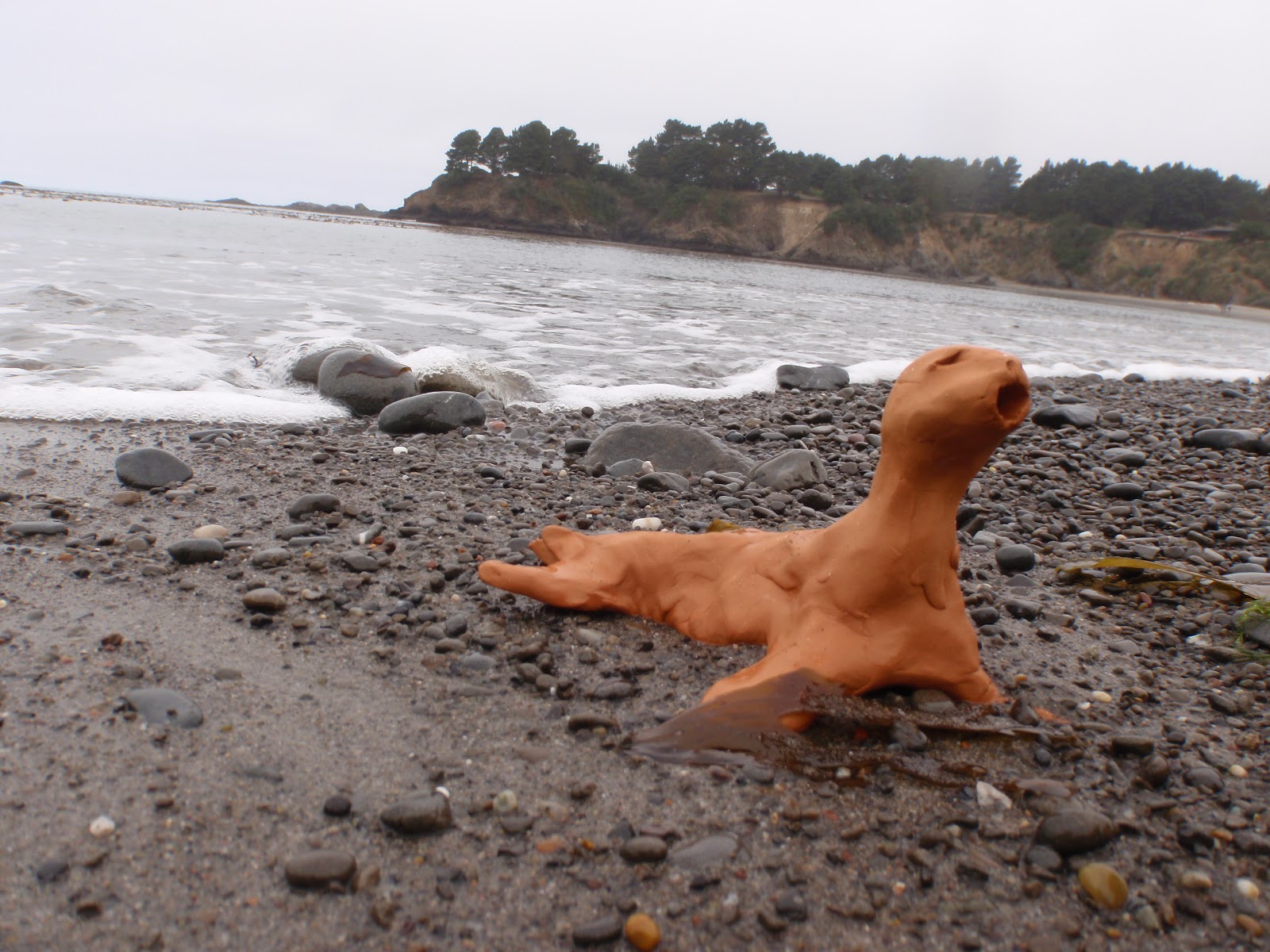
"The Music of the Seals"

The seals are very fond of music. Everywhere I went people told me that, but I was never fortunate enough to hear first hand the music that belongs to them. I believe there is music that remains privately in the minds of the country people of the West, but can only give here a few pieces that have found their way into print. I shall put first a ballad, "The Grey Selchie of Sule Skerrie," and, last, a few notes which were sung by a seal off the island of Skomer, Pembrokeshire, in 1946, and recorded there by Dr. Ludwig Koch. These two have moved me more than the others.
--from David Thomson's final chapter -- "The Music of the Seals" -- in his The People of the Sea: A Journey in Search of the Seal Legend.
Counterpoint Press: Washington, D.C.. 2000.
First published in 1954 by Turnstile Press Ltd, in Great Britain; revised editions in 1965 and 1980.
Counterpoint edition features an introduction by Seamus Heaney.
Sunday, September 23, 2012
Heaney's "Bone Dreams"

I
White bone found
on the grazing:
the rough, porous
language of touch
and its yellowing, ribbed
impression in the grass —
¬a small ship-burial.
As dead as stone,
flint-find, nugget
of chalk,
I touch it again,
I wind it in
the sling of mind
to pitch it at England
and follow its drop
to strange fields.
II
Bone-house:
a skeleton
in the tongue's
old dungeons.
I push back
through dictions,
Elizabethan canopies,
Norman devices,
the erotic mayflowers
of Provence
and the ivied Latins
of churchmen
to the scop's
twang, the iron
flash of consonants
cleaving the line.
In the coffered
riches of grammar
and declensions
I found bān-hūs,
its fire, benches,
wattle and rafters,
where the soul
fluttered a while
in the roofspace.
There was a small crock
for the brain,
and a cauldron
of generation
swung at the centre:
love-den, blood-holt,
dream-bower.
IV
Come back past
philology and kennings,
re-enter memory
where the bone's lair
is a love-nest
in the grass.
I hold my lady's head
like a crystal
and ossify myself
by gazing: I am screes
on her escarpments,
a chalk giant
carved upon her downs.
Soon my hands, on the sunken
fosse of her spine,
move towards the passes.
V
And we end up
cradling each other
between the lips
of an earthwork.
As I estimate
for pleasure
her knuckles' paving,
the turning stiles
of the elbows,
the vallum of her brow
and the long wicket
of collar-bone,
I have begun to pace
the Hadrian's Wall
of her shoulder,
dreaming of Maiden Castle.
VI
One morning in Devon
I found a dead mole
with the dew still beading it.
I had thought the mole
a big-boned coulter
but there it was,
small and cold
as the thick of a chisel.
I was told, ‘Blow,
blow back the fur on his head.
Those little points
were the eyes.
And feel the shoulders.’
touched small distant: Pennines,
a pelt of grass and grain
running south.
--Seamus Heaney

Poem from Seamus Heaney's North, Faber & Faber, London & Boston: 1975.
The clay pieces: Works in progress. Viking Coin ornament and Ship & Hammer: sculpture mix; green glaze, unfired. (We shall see how these pieces look after their firing.)
Saturday, November 12, 2011
Heaney's "Viking Dublin: Trial Pieces"

VIKING DUBLIN: TRIAL PIECES
I
It could be a jaw-bone
or a rib or a portion cut
from something sturdier:
anyhow, a smaller outline
was incised, a cage
or trellis to conjure in.
Like a child's tongue
following the toils
of his calligraphy,
like an eel swallowed
in a basket of eels,
the line amazes itself
eluding the hand
that fed it,
a bill in flight,
a swimming nostril.
II
There are trial pieces,
the craft's mystery
improvised on bone:
foliage, bestiaries,
interlacings elaborate
as the netted routes
of ancestry and trade.
That have to be
magnified on display
so that the nostril
is a migrant prow
sniffing the Liffey,
swanning it up to the ford,
dissembling itself
in antler combs, bone pins,
coins, weights, scale-pans.
III
Like a long sword
sheathed in its moisting
burial clays,
the keel stuck fast
in the slip of the bank,
its clinker-built hull
spined and plosive
as Dublin.
And now we reach in
for shards of the vertebrae,
the ribs of hurdle,
the mother-wet caches--
and for this trial piece
incised by a child,
a longship, a buoyant
migrant line.
IV
That enters my longhand,
turns cursive, unscarfing
a zoomorphic wake,
a worm of thought
I follow into the mud.
I am Hamlet the Dane,
skull-handler, parablist,
smeller of rot
in the state, infused
with its poisons,
pinioned by ghosts
and affections,
murders and pieties,
coming to consciousness
by jumping in graves,
dithering, blathering.
V
Come fly with me,
come sniff the wind
with the expertise
of the Vikings--
neighborly, scoretaking
killers, haggers
and hagglers, gombeen-men,
hoarders of grudge and gain.
With a butcher's aplomb
they spread out your lungs
and made you warm wings
for your shoulders.
Old fathers, be with us.
Old cunning assessors
of feuds and of sites
for ambush or town.
VI
'Did you ever hear tell,'
said Jimmy Farrell,
'of the skulls they have
in the city of Dublin?
White skulls and black skulls
and yellow skulls, and some
with full teeth, and some
haven't only but one,'
and compounded history
in the pan of 'an old Dane,
maybe, was drowned
in the Flood.'
My words lick around
cobbled quays, go hunting
lightly as pampooties
over the skull-capped ground.
--Seamus Heaney,
from North, 1975.
Sunday, October 16, 2011
"Woodnotes Wild"


 There are many intriguing trees on the Berkeley campus. I have my favorites.
I've always thought that such trees have spirits, and Nigel here just embodies that belief in a playful way.
Here's a favorite poem from Seamus Heaney about walking in the woods:
THE PLANTATION
Any point in that wood
Was a centre, birch trunks
Ghosting your bearings,
Improvising charmed rings
Wherever you stopped.
Though you walked a straight line,
It might be a circle you travelled
With toadstools and stumps
Always repeating themselves.
Or did you re-pass them?
Here were bleyberries quilting the floor,
The black char of a fire,
And having found them once
You were sure to find them again.
Someone had always been there
Though always you were alone.
Lovers, birdwatchers,
Campers, gipsies and tramps
Left some trace of their trades
Or their excrement.
Hedging the road so,
It invited all comers
To the hush and mush
Of its whispering treadmill,
Its limits defined,
So they thought from outside.
They must have been thankful
For the hum of the traffic
If they ventured in
Past the picnickers' belt
Or began to recall
Tales of fog on the mountains.
You had to come back
To learn how to lose yourself,
To be pilot and stray--witch,
Hansel and Gretel in one.
--Seamus Heaney
Saturday, September 24, 2011
Alter Ego and Friends: Poetry and Clay
 ALTER EGO
The boy from Uplyme with his smile
Who stands on cliff-tops staring down:
One stares as well. The sea is barren.
And the beach. But still he stares.
Branches of sloe and bullace
Cloud his dark, his idiot eyes.
Always he wears the vacant smile
Of happy mongoloids and kings.
One day he turned and spoke to me.
I'm John, he said. I like it here.
--John Fowles

 As boy, I thought myself a clever fellow

Inishboffin on a Sunday morning.
Sunlight, turfsmoke, seagulls, boatslip, diesel.
One by one we were being handed down
Into a boat that dipped and shilly-shallied
Scaresomely every time. We sat tight
On short cross-benches, in nervous twos and threes,
Obedient, newly close, nobody speaking
Except the boatman, as the gunwales sank
And seemed they might ship water any minute.
The sea was very calm but even so,
When the engine kicked and our ferryman
Swayed for balance, reaching for the tiller,
I panicked at the shiftiness and heft
Of the craft itself. What guaranteed us--
That quick response and buoyancy and swim--
Kept me in agony. All the time
As we went sailing evenly across
The deep, still, seeable-down-into water,
It was as if I looked from another boat
Sailing through air, far up, and could see
How riskily we fared into the morning,
And loved in vain our bare, bowed, numbered heads.
--Seamus Heaney, from "Seeing Things"
 As boy, I thought myself a clever fellow
And wished that others held the same opinion;
They took it up when my days grew more mellow,
And other minds acknowledged my dominion.
Now my sere fancy 'falls into the yellow
Leaf', and imagination droops her pinion;
And the sad truth which hovers o'er my desk
Turns what was once romantic to burlesque.
And if I laugh at any mortal thing,
'Tis that I may not weep; and if I weep,
'Tis that our nature cannot always bring
Itself to apathy, for we must steep
Our hearts first in the depths of Lethe's spring,
Ere what we least wish to behold will sleep.
Thetis baptized her mortal son in Styx;
A mortal mother would on Lethe fix.
--Lord Byron, from the fourth Canto of his Don Juan
Mateo: sculpture mix; selective denim glazing; scarf. Summer 2011.
The poetry was selected in the usual fashion, intuitively, as an unlikely set of verses that still seemed to fit together somehow. Or, the poetry was chosen by fitness, for contrast, and as proxy or emulation. I've referred to Heaney's anxieties while afloat here, and I'll repeat that I do not share such nervousness. I admire his writing, and Fowles', and Byron's, of course.
Thursday, September 15, 2011
Haunted By Lice: The Power of Suggestion
Here's a poem by Seamus Heaney that my mind can't quite let go of, and I take such grip to be a fine sign of quality and power in any writing. "Vision" is the seventh and final strand of "A Lough Neagh Sequence" from his 1969 volume Door Into The Dark.
I am struck by the "vision" of "hatched fears" resulting from, what, the childhood admonition to comb his hair, an admonition accompanied by an invocation of monstrous, fatal lice. How could the child not imagine the worst, no matter how well or how often he combed his hair. Words and images, particularly, woven into story have tremendous powers, if only to awaken our imaginations, our own dark envisionings.
The "jellied road" haunts my imagination, certainly.
7. VISION
Unless his hair was fine-combed,
The lice, they said, would gang up
Into a mealy rope
And drag him, small, dirty, doomed,
Down to the water. He was
Cautious then in riverbank
Fields. Thick as a birch trunk,
That cable flexed in the grass
Every time the wind passed. Years
Later in the same fields
He stood at night when eels
Moved through the grass like hatched fears
Towards the water. To stand
In one place as the field flowed
Past, a jellied road,
To watch the eels crossing land
Re-wound his world's live girdle.
Phosphorescent, sinewed slime
Continued at his feet. Time
Confirmed the horrid cable.
--Seamus Heaney
I want to echo what surfers say about prime conditions: Not a drop of water out of place, not a word out of place, not a single syllable gone awry. I take it that he drowned, finally, and probably such an end came from too much caution, too many cautionary tales, than from any simple clumsiness by the bankside.
Sunday, August 28, 2011
Seamus Heaney's "Reed Music"
GIFTS OF RAIN
I
Cloudburst and steady downpour now
for days.
Still mammal,
straw-footed on the mud,
he begins to sense weather
by his skin.
A nimble snout of flood
licks over stepping stones
and goes uprooting.
He fords
his life by soundings.
Soundings.
II.
A man wading lost fields
breaks the pane of flood:
a flower of mud-
water blooms up to his reflection
like a cut swaying
its red spoors through a basin.
His hands grub
where the spade has uncastled
sunken drills, an atlantis
he depends on. So
he is hooped to where he planted
and sky and ground
are running naturally among his arms
that grope the cropping land.
III.
When rains were gathering
there would be an all-night
roaring off the ford.
Their world-schooled ear
could monitor the usual
confabulations, the race
slabbering past the gable,
the Moyola harping on
its gravel beds:
all spouts by daylight
brimmed with their own airs
and overflowed each barrel
in long tresses.
I cock my ear
at an absence--
in the shared calling of blood
arrives my need
for antediluvian lore.
Soft voices of the dead
are whispering by the shore
that I would question
(and for my children's sake)
about crops rotted, river mud
glazing the baked clay floor.
IV.
The tawny guttural water
spells itself: Moyola
is its own score and consort,
bedding the locale
in the utterance,
reed music, an old chanter
breathing its mists
through vowels and history.
A swollen river,
a mating call of sound
rises to pleasure me, Dives,
hoarder of common ground.
--Seamus Heaney
from his volume Wintering Out (1972)
Note: I came upon this poem and its music of water, geography, and sensibility by chance last night. I was "reading around," picking up this volume and that, this poetry, that novel, the other bit of non-fiction, and so forth. I was thinking of the storm hitting the East Coast and the friends who live there, even as I was listening to Dougie Maclean's fine voice and compositions (The Essential Dougie Maclean, in this case).
This poem held me, so I typed up part of it. Let the poem linger in my mind overnight. Now, as I sit here, having typed up the whole of it, I'm reminded how often in the past, especially as an undergraduate and then graduate student, I would write out whole poems, type out whole poems, to get the writer's flow into my head. I used to do this with my own essays if I were working from draft to draft, writing out the polished opening paragraphs from that very first word to put me into the voice of the essay, to put me into the flow of thoughts and feelings and verbiage, the foliage of language, for continuity's sake.
I recommend this practice: write it out. Write out--however that makes sense to you--a poem (or short story!) from start to finish. Don't analyze as you write it out. Enter the flow of words as you would a river. Later, you'll be a better navigator of that river. With "Gifts of Rain," for example, only the "writing out" of this poem led me to notice the deliberate variations in versification, the shift in stanza-patterns from portion to portion. There's purposeful composition there, and listening for the music came in part because I allowed myself, made myself, pay attention stanza by stanza, line by line, word by word.
Maybe I should have noticed those things just from reading. Maybe. But I'd rather emphasize how the act of writing out this whole poem led to more and better than to play the blame game. Find a poem that tugs on you just a bit--not a favorite poem, no--and see what happens when you ride that river.
Thursday, December 9, 2010
Seamus Heaney's "Exposure"
EXPOSURE
It is December in Wicklow:
Alders dripping, birches
Inheriting the last light,
The ash tree cold to look at.
A comet that was lost
Should be visible at sunset,
Those million tons of light
Like a glimmer of haws and rose-hips,
And I sometimes see a falling star.
If I could come on meteorite!
Instead I walk through damp leaves,
Husks, the spent flukes of autumn,
Imagining a hero
On some muddy compound,
His gift like a slingstone
Whirled for the desperate.
How did I end up like this?
I often think of my friends;
Beautiful prismatic counselling
And the anvil brains of some who hate me
As I sit weighing and weighing
My responsible tristia.
For what? For the ear? For the people?
For what is said behind-backs?
Rain comes down through the alders,
Its low conducive voices
Mutter about let-downs and erosions
And yet each drop recalls
The diamond absolutes.
I am neither internee nor informer;
An inner emigre, grown long-haired
And thoughtful; a wood-kerne
Escaped from the massacre,
Taking protective colouring
From bole and bark, feeling
Every wind that blows;
Who, blowing up these sparks
For their meagre heat, have missed
The once-in-a-lifetime portent,
The comet's pulsing rose.
--Seamus Heaney
Wednesday, October 6, 2010
Passages: Heaney's "North"
I've got Dougie Maclean's "Mo Nighean Donn" playing from the Whitewash CD, and that seems a fitting background as I open up Seamus Heaney's North and share a favorite poem. Heaney is my favorite model of a poet whose symbolism is always grounded, always working concretely and figuratively, gaining strength from that constructive duality. Here, now, I just want to reread a memorable piece, not blather too much about it.
I returned to a long strand,
the hammered shod of a bay,
and found only the secular
powers of the Atlantic thundering.
I faced the unmagical
invitations of Iceland,
the pathetic colonies
of Greenland, and suddenly
those fabulous raiders,
those lying in Orkney and Dublin
measured against
their long swords rusting,
those in the solid
belly of stone ships,
those hacked and glinting
in the gravel of thawed streams
were ocean-deafened voices
warning me, lifted again
in violence and epiphany.
The longship's swimming tongue
was buoyant with hindsight--
it said 'Thor's hammer swung
to geography and trade,
thick-witted couplings and revenges,
the hatreds and behindbacks
of the althing, lies and women,
exhaustions nominated peace,
memory incubating the spilled blood.
It said, 'Lie down
in the word-hoard, burrow
the coil and gleam
of your furrowed brain.
Compose in darkness.
Expect aurora borealis
in the long foray
but not cascade of light.
Keep your eye clear
as the bleb of the icicle,
trust the feel of what nubbed treasure
your hands have known.'
--Seamus Heaney
North. Faber and Faber. London & Boston: 1975.
North is my single favorite volume of Heaney's verse, though Death of a Naturalist, Station Island, and Seeing Things all make claims upon me--as does Heaney's translation of Beowulf, though that's a different beast of mixed lineage and joy. His North pulls together my own preoccupations with the North Atlantic, with Celts and Vikings, with history and autobiography, bog people and ambition, with sagas and cauldrons and the cold salt sea.
(Heaney revises "North," this specific poem, slightly in his collected works of 1996: Opened Ground. He substitutes "curve" for "shod" in the second line; I'd been wondering if "hammered shod of a bay" was an Irishism or a metaphor, and I'd even devised an interpretation for "shod" as a noun, just in case. Isn't that what you do, too?)
Read "Exposure" next.
Sunday, September 12, 2010
Passages: Heaney's Practical Magic
 Seamus Heaney is one of my favorite poets, and his "The Diviner" is my second-favorite of his poems.
THE DIVINER
Cut from the green hedge a forked hazel stick
That he held tight by the arms of the V:
Circling the terrain, hunting the pluck
Of water, nervous, but professionally
Unfussed. The pluck came sharp as a sting.
The rod jerked with precise convulsions,
Spring water suddenly broadcasting
Through a green hazel its secret stations.
The bystanders would ask to have a try.
He handed them the rod without a word.
It lay dead in their grasp till, nonchalantly,
He gripped expectant wrists. The hazel stirred.
--Seamus Heaney
The mask: Hermes. Sculpture mix, raku-fired. The mask doesn't quite fit the poem--no y-shaped branches, no water springing forth--but there's a congruence of wood and magic in my choice of the illustration. And, Hermes and Heaney are both worthy guides.
Subscribe to:
Posts (Atom)