Showing posts with label Fowles. Show all posts

Wednesday, September 2, 2020

Gemini X 3 / 5 +9

Charting the passage of time, activities, and identity:
what I do.

There's a lot more humor and a lot less ego involved in the parade of profile pics; at least, that's the way I see it.  (Judge me, if you want, but I don't intend to lose sleep over the matter.)  I have written before of Rembrandt's many selfies and of the third-person would-be objective perspective of mirror-images offered in John Fowles' novel Daniel Martin, an old favorite.  

Tracking my age and how the lines on my face and how the gray or white hairs on my head accumulate can be a sport with different events.  Guessing where the next ache or sore muscle will appear is another such event.  I am not getting younger, right?  

But I am also still paddling and diving and reading around and pursuing other such richly-enlivening activities.  (Man alive, I miss the studio and clay.).   I like to keep track of all those activities I am fortunate enough to pursue -- and keep track of the different people I seem to be and have been: Diver Matt, Kayak Matt, Teacher Matt, Clay Matt, and so forth.  After a long day desk-bound, there's a uplifting joy in checking what I was doing, who I was, in times past.  Sometimes, checking the last trip to Mendocino, for example, can spur me to check the weather and start making plans for the next outing,, however long or far away.  And, if that planning proves merely mental, proves merely daydreaming, that's good too.  I return to the matter at hand at the desk a bit more energized, a bit more ready to dig in.  

What with the pandemic, remote teaching, and reaching 59, I have been feeling reflective.

As a Gemini, I am used to seeing the world and myself through a two-fold lens.  
Here are a few more recent examples.

THE PADDLER:

(A) stern and serious, working at it --


B) Having fun on the water -- salt salvation --


THE VINTAGE LOOK  /  BLACK & WHITE GAMES:

(A) Ducking down an alleyway  -- "Call me Ishmael."          (Thanks, Herman Melville.)


(B) A "Pirate" Looks Toward 60?          (Thanks, Jimmy Buffett)


FULL-FRONTAL (portrait-wise):

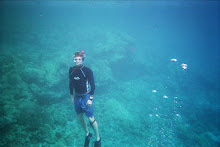
(A) Post-dive, unmasked: 
red from too much sun and the cold cold water; 
slightly saltdrunk --


(B)  Post-paddle, pandemic ready --


This last shot: that mask gets lots of smiles, lots of laughs, from children and adults alike.  

It's a sea lion mask, technically, but many kids think it's a dog--and why not? 
Sea lions bark too, don't they?
So, I oblige.


Any man who barks in public can't take himself too seriously.


Thursday, July 2, 2020

Monday, September 24, 2018

Thursday, June 16, 2016

Fool's Gold; Or, The Admonition


How good is the book in your head--if it isn't on the page?
What book?
I don't see a book.
In the head or in the heart?

Page, page, page--that's what matters.

Story of my life.

Read less; write more.
Keep on reading, but write more.
Get it down; revise it.
Do the thing that needs to be done.

Voices in my head.

I'd quote my father, but then I'd just be looking for pity or mercy or something.

Right now the book in my head is a mixture of Homer and Robert E. Howard, John Fowles and Robert Stone, edited by Hemingway. All of which ought to make very little sense at all.

Not on the page.
Doesn't count.

I picked up a new used copy of James Lee Burke's Heaven's Prisoners from Pegasus Downtown yesterday, and now the book falls open to the exact page I was looking for--the previous owner/reader had my same hang-ups, I'm guessing--page 262:

"But I had learned long ago that resolution by itself is not enough; we are what we do, not what we think and feel."

Ouch.

As one of my students once said when faced with this same passage: "No mercy."

Tuesday, July 22, 2014

Old School

"Someone . . . reading a book . . . ."
--the voice almost disbelieving, wistful--

Pt. Richmond passerby's observation as I sat at a sidewalk table drinking coffee and reading an old, worn, thick paperback this morning.

This is that book, but I wasn't drinking whiskey then.
Old Friends.

Sunday, September 16, 2012

Fowles: "Lightning Strikes"

"Truth is born as lightning strikes."  --Archilochos  (via Davenport)


TWO POEMS FROM JOHN FOWLES:


THE EXPERIENCE

You go down the right turnings
just as it says in the guide,
and it isn't there.

You turn up at the right room
at the right time,
in the right month and moonlight;
and it isn't there.

You discover the right grove,
you stand about on damp leaves.
A man on a tractor passes
and thinks you are mad.

You have the paper and the time,
you have the lot, 
and nothing comes.

And it comes
at the start of a busy day
as you shave in a hurry,
cog with no time.

The wind.  And you stand,
blinded till you are not blind.

--John Fowles


WITHIN TEN SECONDS

Within ten seconds
I knew I wanted to kiss your eyelids.
This is why I kept staring
Past you, as if to a cold horizon.
You were not boring me, as you thought.
I was looking to where you stood
Smelling of rain, with naked breasts.
Naked, defenceless, needing defence.
It was not as you thought,
You were piqued and moved away.
I was the one who by silence,
Staring, no move, moved away.

Where pine trees touch water.
I am
Men who tie themselves to masts.
You are
Sirens with delicate eyelids.
Penelope is white with lust.
Molpe, the deck has tears
And the rock has tears.
Even the sun has molten tears.

Meeting, never to meet again.

--John Fowles

Thursday, September 13, 2012

Fowles: "I Learned To Value What I Couldn’t, Over The Years, Forget"


   "As a student of French at Oxford, I read omnivorously, though much more out of ignorance than intelligence.  I had very little notion of my real tastes, having swallowed the then prevalent myth that only one’s teachers had a right to personal preferences.  This is not an approach I would attempt to sell to any student today, but it did have one advantage.  Likes and dislikes were eventually formed on a strictly pragmatic basis; I learned to value what I couldn’t, over the years, forget.  One such obstinate survivor was Alain-Fournier’s Le Grande Meaulnes.  A number of young thesis writers have now told me they can see no significant parallels between Le Grande Meaulnes and my own novel The Magus.  I must have severed the umbilical cord—the real connection requires such a metaphor—much more neatly than I supposed at the time; or perhaps modern academic criticism is blind to relationships that are far more emotional than structural."

John Fowles,
from “A Personal Note” to his translation of Marie de France’s “Eliduc”
in his collection of short stories The Ebony Tower, pages 109-110:

Saturday, September 24, 2011

Alter Ego and Friends: Poetry and Clay

ALTER EGO

The boy from Uplyme with his smile
Who stands on cliff-tops staring down:
One stares as well. The sea is barren.
And the beach. But still he stares.

Branches of sloe and bullace
Cloud his dark, his idiot eyes.
Always he wears the vacant smile
Of happy mongoloids and kings.

One day he turned and spoke to me.
I'm John, he said. I like it here.

--John Fowles


Inishboffin on a Sunday morning.
Sunlight, turfsmoke, seagulls, boatslip, diesel.
One by one we were being handed down
Into a boat that dipped and shilly-shallied
Scaresomely every time. We sat tight
On short cross-benches, in nervous twos and threes,
Obedient, newly close, nobody speaking
Except the boatman, as the gunwales sank
And seemed they might ship water any minute.
The sea was very calm but even so,
When the engine kicked and our ferryman
Swayed for balance, reaching for the tiller,
I panicked at the shiftiness and heft
Of the craft itself. What guaranteed us--
That quick response and buoyancy and swim--
Kept me in agony. All the time
As we went sailing evenly across
The deep, still, seeable-down-into water,
It was as if I looked from another boat
Sailing through air, far up, and could see
How riskily we fared into the morning,
And loved in vain our bare, bowed, numbered heads.

--Seamus Heaney, from "Seeing Things"

As boy, I thought myself a clever fellow
And wished that others held the same opinion;
They took it up when my days grew more mellow,
And other minds acknowledged my dominion.
Now my sere fancy 'falls into the yellow
Leaf', and imagination droops her pinion;
And the sad truth which hovers o'er my desk
Turns what was once romantic to burlesque.

And if I laugh at any mortal thing,
'Tis that I may not weep; and if I weep,
'Tis that our nature cannot always bring
Itself to apathy, for we must steep
Our hearts first in the depths of Lethe's spring,
Ere what we least wish to behold will sleep.
Thetis baptized her mortal son in Styx;
A mortal mother would on Lethe fix.

--Lord Byron, from the fourth Canto of his Don Juan


Mateo: sculpture mix; selective denim glazing; scarf. Summer 2011.

The poetry was selected in the usual fashion, intuitively, as an unlikely set of verses that still seemed to fit together somehow. Or, the poetry was chosen by fitness, for contrast, and as proxy or emulation. I've referred to Heaney's anxieties while afloat here, and I'll repeat that I do not share such nervousness. I admire his writing, and Fowles', and Byron's, of course.

Friday, August 26, 2011

Passages: Daniel Martin's Hyperactive Imagination

John Fowles' Daniel Martin is one of my absolute favorite novels. Here's one moment I like, a moment I recognize in myself, and such recognitions are surely one reason we read literature. I could quote Aristotle here, but I'd rather quote Fowles. Perhaps some of you recognize yourselves in this moment.


The meeting began to loom large. It was not that I couldn't imagine what might happen, be said and felt. As at so many potentially fraught junctures in my life I could invent too many variations, almost as if I lived the event to its full before its limited reality took place. All writing, private and mental, or public and literal, is an attempt to escape from the conditioned past and future. But the hyperactive imagination is as damaging a preparation for reality as it is useful in writing. I knew I wouldn't say the things I was already rehearsing; and couldn't stop rehearsing.

Friday, October 29, 2010

Don Quixote's Mirror

Approaching 50, I like to keep track. And the tracks are there to see.

They say, the lines on your face are the expression of spirit and experience, of choice and circumstance, whether of bliss or blunder--pluck or plunder--love, luck, or lucre. Perhaps, the etchings of duck-and-cover versus what-and-wonder. (Like Hamlet, "when the wind is southerly, I know a hawk from a handsaw"; I wonder which way the wind's blowing now.) I hope you can see that I smile a lot, usually; I feel lucky that way.

In what's probably my favorite novel--John Fowles' Daniel Martin--the main character keeps many, many mirrors on the walls of his Oxford bed-sit. The narrator offers two interpretations, not wholly mutually exclusive: first, the signs of vanity, invocations of Narcissus, the celebration of self; and, second, attempts to move from the first person to the third, from mere subjectivity to heightened objectivity. When I reflect on the many, many "profile pics" I'm accumulating, I prefer to think I'm echoing that latter impulse. I think this photo works, showing me as I am: a man of 49 and a bit more, still smiling, still exploring, still willing to tilt at a windmill or two.

Self-Portrait #49. With beret.