Showing posts with label Hubris. Show all posts

Friday, June 19, 2020

Reflections: 5 + 9


Reflections on Turning 59:

Sometimes I am arrogant enough to think my death will mean that no one will be reading books the way I do--and the world will suffer--and I mean that far less selfishly and less egotistically than that may sound.  Feel free to laugh.

I mean that I have read and have trained and have practiced to be a Reader, so I should be able to recognize and understand what is true and what is not true--and others will not have trained so long or so hard or so well as I have.

That's been my motivation as a teacher since 1990 (and even before, as a friend): to share, to guide, to model.

Reading well takes practice and guidance and more practice.

I think I have been a true reader since my early teens, and I have worked at it for decades and decades, trying to teach my own students to Read Like Readers, but more importantly to Read Like Writers.

I still need to write the books I want to write.

Not done yet.  That's the battle-cry.


Friday, August 31, 2018

Reflecting on Self (and Selfies)


This wasn't a selfie, but a driver's license.  A current conversation with a friend:

One old driver's license, I showed it to a very good friend and said, "Look at this. I look dead in the photo."

Old Friend said, "It takes ten years off you."

I said, "Ten years off dead--what's that?"

OF smiled, wryly.


(OF always keeps me down to earth.)

Sunday, July 8, 2018

Notes: My Back Hurts

I
Back spasms are no fun.  I don't even know exactly how I strained my back this time.  I didn't carry scuba tanks too far; I didn't lean over and lift a box of books and then twist to put it down somewhere else; I didn't even try to pick up the other kayak, which I know is too heavy for one person.  (I have, I must admit, been carting gear about, shifting book-boxes, and loading up the other kayak, but I haven't had the dramatic pull, that overstepping of muscle through negligence of mind.)

Still, I've had a sore back for days, and today the spasms started.  Really, from long walks in the wrong pair of shoes?  Or a 70-minute hike?  Or, more likely, from the years piling up?

I've applied heat, I've stretched, and now I'm trying ice: three cubes in a glass with Flor de Cana.

II
I certainly don't like pain, but sometimes these back spasms just crack me up.

I've always thought that muscle cramps carry with them a funny sort of pain (they hurt, but the twisting of the muscles seems ridiculous), but some of this morning's spasms seemed triggered by the slightest wrong move, almost by the thought of moving, and I keep having to laugh.

Gasp and grunt, yes, but also laugh.

(I didn't move, I swear; I only thought about moving!)

Saturday, December 16, 2017

Hubris, Desired


"Resolve me of all ambiguities."
--Marlowe's "Dr. Faustus"

--a line I had pinned to my bedroom door, so that I would see it each day upon waking and exiting, in undergraduate days.

Tuesday, September 13, 2016

McIlvanney: "The Language of My Living"

Here's a passage from one of William McIlvanney's novels that I've always liked.  The juxtaposition of humility and arrogance, the mix of what others think versus what the narrator knows, has stuck with me, has resonated over the years.  I recall giving this passage to a colleague, for I felt that the passage conveyed both his affect and his self-understanding, but he just smiled as he read, so I wasn't given a full commentary.  I relate and don't quite relate to what's voiced here, but it always resonates.

Here, read for yourself:

'Well,' she said.  'I'd better be going.'

I looked at her and nodded.  She smiled and pointed to the ground behind the cars.  There were tread-marks on the grass.

'Those,' she said.  'They'll always remind me of Scott.  Him and me here.  I wonder how long they'll last.  What is all this about for you really?  I mean.  What is it you're doing exactly?'

'I don't know exactly.  I suppose I'm trying to make my own peace with Scott's death.  I suppose this is how I do it.'

'How do I do it?'

She started suddenly to cry.

'Damn,' she said.  'Will you hold me one time for him?'

I crossed and held her.  It was a small, chaste ceremony of mutual loss.  Her hair in my face gave off a melancholy sweetness.  Clenched to her, I felt the tremors of her body, how the edifice of beauty was undermined from within with deep forebodings.  In the embrace I experienced our shared nature--so much questionable confidence containing so much undeniable panic.  That was me, too.  Some of my colleagues and bosses liked to say I was completely arrogant.  They misunderstood the language of my living.  Arrogance should be comparative.  Humility was total.  Faced with simplistic responses to life that tried to fit my living into themselves, I was arrogant.  I seemed to meet them every day and I knew I was more than they said I was.  But when I sat down inside myself in the darkness of a night, I knew nothing but my smallness.  I knew it now and shared it with hers.

--William McIlvanney,
Strange Loyalties,
A Harvest Book,
Harcourt Brace and Company,
1991

This is the third Laidlaw book, and the other two are worth looking for.  This one shifts the narration from third-person to first-person (and for excellent reasons).

Thursday, May 12, 2016

Rum Reflections


When I was in my teens, my 20s, and my 30s, I wanted to rescue people. When I was in my 40s, I wanted to rescue myself. At the edge of 55, I'm still committed to a little of both, but I am also fairly sure that the matter is largely out of my hands.

I'd like to help out, in any event, as the case may be.

Thursday, May 5, 2016

TBT: Water / Damage


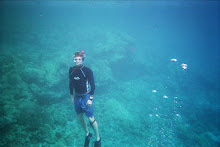
A 2008 shot, from Hawaii, and the water got into that disposable camera, but that's okay.

I'll never be that young again--and, hey, eight years ago is younger--but I yearn and aim to be in as good a shape as I was that year.  I swam and swam and swam that year.

Aiming to make the rest of 2016 a water-year.


Friday, January 29, 2016

Reflections on Autonomy and Literary Experience


1.   "Toward" or "towards":
I always figured that if I could get through 13.5 years of Berkeley higher ed without knowing the exact rule, then there must not be an exact rule and I would let euphony be my guide.

2.  Trying to teach the mix of discipline and independence -- necessary and resolute discipline in thought and knowledge, boneheaded and clear-eyed independence of thought and knowledge -- that I absorbed before, during, and after my years at UCB . . . that's hard.  I've modeled it as much as possible, but I still have not quite found a way.

I don't always live up to my model either, though I do try.

I sometimes think crucial key components include a repressive childhood, strong individualistic modeling (thanks, mom & dad), and lucky genetics (the boneheadedness, for example).  At other times, I think a devotion to the idea (and ideal) of literary apprenticeship is necessary.

Of course, in my main teaching duties, my focus is on awakening and honing the skills of critical reading, critical writing, and critical thinking, which is a different path than the literary one I referred to above.  Such awakening and honing is a joyous thing, too, by the way.

3.  What depressed me the most during my long years of graduate study was what seemed to me to be the suppression of the original text and, more so, the actual literary experience in favor of something decidedly secondary.  Ideally, and practically, such study enhances the ability to experience literature in the fullest sense -- and I give credit and thanks to certain professors and colleagues to this day for their part in the true way (or ways, for there are different paths to explore) -- but I also watched other professors and other colleagues who turned away from literary truth toward something -- or some things -- not so worthy . . . .

Saturday, December 28, 2013

Foolery and Rembrandt's Faint Echo


Friend:    Matt, you are absolutely the master of the selfie!

Self:    Well, that's not a thing to be proud of, entirely, but --hey-- Rembrandt created almost a hundred selfies, and he had to paint each one. My point is not that I'm a Rembrandt, but if such were good enough for him, it's golden for me. I'm the easiest model I have to work with, and I have fun with the lines, the shadows, and the (oft silly) scenes. Tomorrow, there'll probably be one with me in my new leather medieval English helmet. How can I resist?

Friend:   If I posted the ones I've tried taking, you'd see why yours are so good.  Looking forward to the helmet.

Self:    Oh, I delete so many. Oddly enough, the first few tend to be the best ones.


Aside: Watching myself age seems hardly the epitome of vanity.  The posting is a measure, a formality, a witnessing more than any sort of declaration.  Besides, who is watching?  This blog doesn't get that much traffic, frankly, and if my self-portraits bother anyone, well, they don't have to look, right?  In part, my natural diffidence has been encouraged to the point of stultification, or so it has seemed in the past, and here I'm countering that; in part, self-portraiture seems honest, an honest art, and this blog is my canvas, after all.  (Should I create a spectrum to chart Vanity/Hubris, Art/Artifice, Foolery/Foolishness?)  Finally, I also use this blog as a way of auditioning for further pursuits, attempting to woo the muses to help me with that novel, those short stories, or that documentary non-fiction; practice-sessions.  Clay feels freer than words do, and yet that doesn't feel quite right.  Posting images, self and non-self, is a way of seeing my way towards the words that matter, I am hoping.

I mean what I said above about lines and shadows and silliness and the easiest model to work with.

Also, if you look back upward at the first self-portrait I've provided by Rembrandt, will you not admire the work with lines and shadows and maybe a bit of silliness there too?  I admire so much of Rembrandt's work, and I hadn't appreciated that drawing until I posted it for this entry.  Witnessing comes in various forms, not all of them self-serving.

(I'm tempted to remake that last sentence into something metaphorical with a tree of many branches, but if I do, I just may end up hanging myself in effigy there, and I don't quite want to do that.)

Most times, I don't quite even look like myself.  Do you know what I mean?  That self in my head, that self I'm conjuring up and projecting from the images of earlier days, childhood and youth and what-have-you.  That's what I am tracking, keeping track of, witnessing.  The syntax of self over time and through time.  A quixotic quest, no doubt.  And one worthless to all but the wandering tracker.

Previously, I've reflected and quoted Fowles on the reflex toward self-representation, even excessive self-representation, as a move from subjectivity toward objectivity, from the first (and fallible) person toward the third (outsider) person, (which you may find in a link here in "Don Quixote's Mirror").

I find the grammar of self to be almost as amusing as the syntax of identity and authenticity, but that comment belongs to a separate blog entry at another time.

*Prof. Andrew Griffin taught me of Rembrandt's many self-representations in office-hour conversations in my undergraduate days.  His energy and his style have helped to shape my teaching style, among other things.  I owe him a debt I haven't yet repaid, and at this late date, I am not sure how.

The images in this entry are all photos of reproductions from and of Christopher Wright's Rembrandt: Self-Portraits, The Viking Press: New York, 1982.

Sunday, November 25, 2012

Marching Orders


William Shakespeare's Macbeth;
Mary Shelley's Frankenstein;
Oscar Wilde's The Importance of Being Earnest;
Guy de Maupassant's The Necklace and Other Short Stories;
Mark Strand and Eavan Boland's The Making of a Poem;
E. Annie Proulx's The Shipping News;
assorted stories and poems via handouts;
and some appropriate film clips.

English 1B: Spring 2013

Saturday, November 3, 2012

"You Too Are Mortal"

Wasn't that what the official anti-hubris clerk kept whispering into the Great Emperor Darius' ear?  Or was that Xerxes?  ("Remember the Greeks"?  "Give the Hellespont 300 lashes"?)***

More appropriately, The Humble Potter's Handiwork.  Or, Look Ma, Hands of Clay!

Ugly pot.

I let this one dry too much before trying to trim it, and then I failed to secure it properly to the wheel so that it went flying off during that belated attempt at trimming, though I did catch it on the bounce. You can see stoneware clay improperly mixed with this Navajo wheel /stoneware hybrid at the rim, a failed stamp on the side, and that odd, flawed bottom.

I did manage to put a decent foot (that you can't see). The glazing will be a crucial step.

Just a run of the mill off-piece, truth to tell.  I like to try to save such pieces too.


***A reliable source nudges me towards the Romans and the triumph as the source of the memento mori. 

(I thank EHS and trust the correction -- of course, of course -- but I also continue to resist checking, despite how easy that would be in this day and this age.  There's a perverse pleasure in quoting or citing from memory.)

Thursday, November 1, 2012

Byron: "Cunning In Mine Overthrow"


   If my inheritance of storms hath been
   In other elements, and on the rocks
   Of perils, overlook’d or unforeseen,
   I have sustain’d my share of worldly shocks,
   The fault was mine; nor do I seek to screen
   My errors with defensive paradox;
   I have been cunning in mine overthrow,
The careful pilot of my proper woe

   Mine were my faults, and mine be their reward.
   My whole life was a contest, since the day
   That gave me being, gave me that which marr’d
   The gift—a fate, or will, that walk’d astray;
   And I at times have found the struggle hard,
   And thought of shaking off my bonds of clay:
   But now I fain would for a time survive,
If but to see what next can well arrive.

   Kingdoms and empires in my little day
   I have outliv’d, and yet I am not old;
   And when I look on this, the petty spray
   Of my own years of trouble, which have roll’d 
   Like a wild bay of breakers, melts away:
   Something—I know not what—does still uphold
   A spirit of slight patience; not in vain,
Even for its own sake, do we purchase pain.

--Lord Byron, 
from the "Epistle [To Augusta],
composed in 1816 
(in exile, as it were)

Monday, September 3, 2012

Fall Begins


 Tumbler (Pictish): sculpture mix; pit-fired
. . . years and years ago on Ocean Beach.

Live model: 20-minute gestural exercise.

Monday, July 23, 2012

"My Aim Is True": Novel Navigation?


Or, By Bluff and Blunder?
Or, Compassion As Compass?
Or, Pin The Tale On The Donkey?

I'll stop with the subtitles, the alternative guides, and move to my central concern.  Here are three quotations that I've probably offered before, but the last few days I've found them resonating alongside a certain ambition to craft a full-length narrative of mystery and adventure.

1.  "But I had learned long ago that resolution by itself is not enough; we are what we do, not what we think and feel."
--James Lee Burke, "Heaven's Prisoners"

Here I am quoting from memory, but this is a quotation that sticks with me, that offers a rather pitiless ideal, which draws me in even as I want to bring or find more compassion than those words offer. "Resolution" in the first part of the sentence definitely means "completion" or "finishing," not merely "deciding upon" or "resolving to do." I think this quotation will help me to set up the conflicts in the "novel" I'm attempting to outline/frame.

2.  Let's listen to my second-favorite ancient Greek poet:


I over-reached
And another
Bears the bother.

--Archilochos
trans. Davenport

I take that short poetic fragment with ruefulness, with regret in the tone, not triumph, though I can see the psychology that would exult in that way. I can see such, but save me and all of us from such, I say.


3.  And the last of the triad, for now:

“I've learned that people will forget what you said, people will forget what you did, but people will never forget how you made them feel.”
--Maya Angelou


Fourth?  Frankly, on reflection, I can see how all three of the quotations above spiral around each other, twining thematically into one threefold strand, and so further sayings may be called for.  Somehow, the supposed opening line of my absolute favorite ancient Greek poet's lost comic-epic also horns in . . . .

"He knew many things, and all of them badly."
Homer, from his lost Margites . . . .


I'm quoting from memory again here, but I think you can see I don't plan to tell a tale overburdened by seriousness.  And a fallible, flawed, but well-meaning character?  Who wouldn't like a bit of that?  I mean, aren't we constructed in that way ourselves, however we may aspire and resolve to do better?

And, that fourth selection just may be another way to say "Pin the tale on the donkey."