Showing posts with label Burke. Show all posts
Showing posts with label Burke. Show all posts
Thursday, June 16, 2016
Fool's Gold; Or, The Admonition
How good is the book in your head--if it isn't on the page?
What book?
I don't see a book.
In the head or in the heart?
Page, page, page--that's what matters.
Story of my life.
Read less; write more.
Keep on reading, but write more.
Get it down; revise it.
Do the thing that needs to be done.
Voices in my head.
I'd quote my father, but then I'd just be looking for pity or mercy or something.
Right now the book in my head is a mixture of Homer and Robert E. Howard, John Fowles and Robert Stone, edited by Hemingway. All of which ought to make very little sense at all.
Not on the page.
Doesn't count.
I picked up a new used copy of James Lee Burke's Heaven's Prisoners from Pegasus Downtown yesterday, and now the book falls open to the exact page I was looking for--the previous owner/reader had my same hang-ups, I'm guessing--page 262:
"But I had learned long ago that resolution by itself is not enough; we are what we do, not what we think and feel."
Ouch.
As one of my students once said when faced with this same passage: "No mercy."

Friday, April 15, 2016
Whiskey Friday
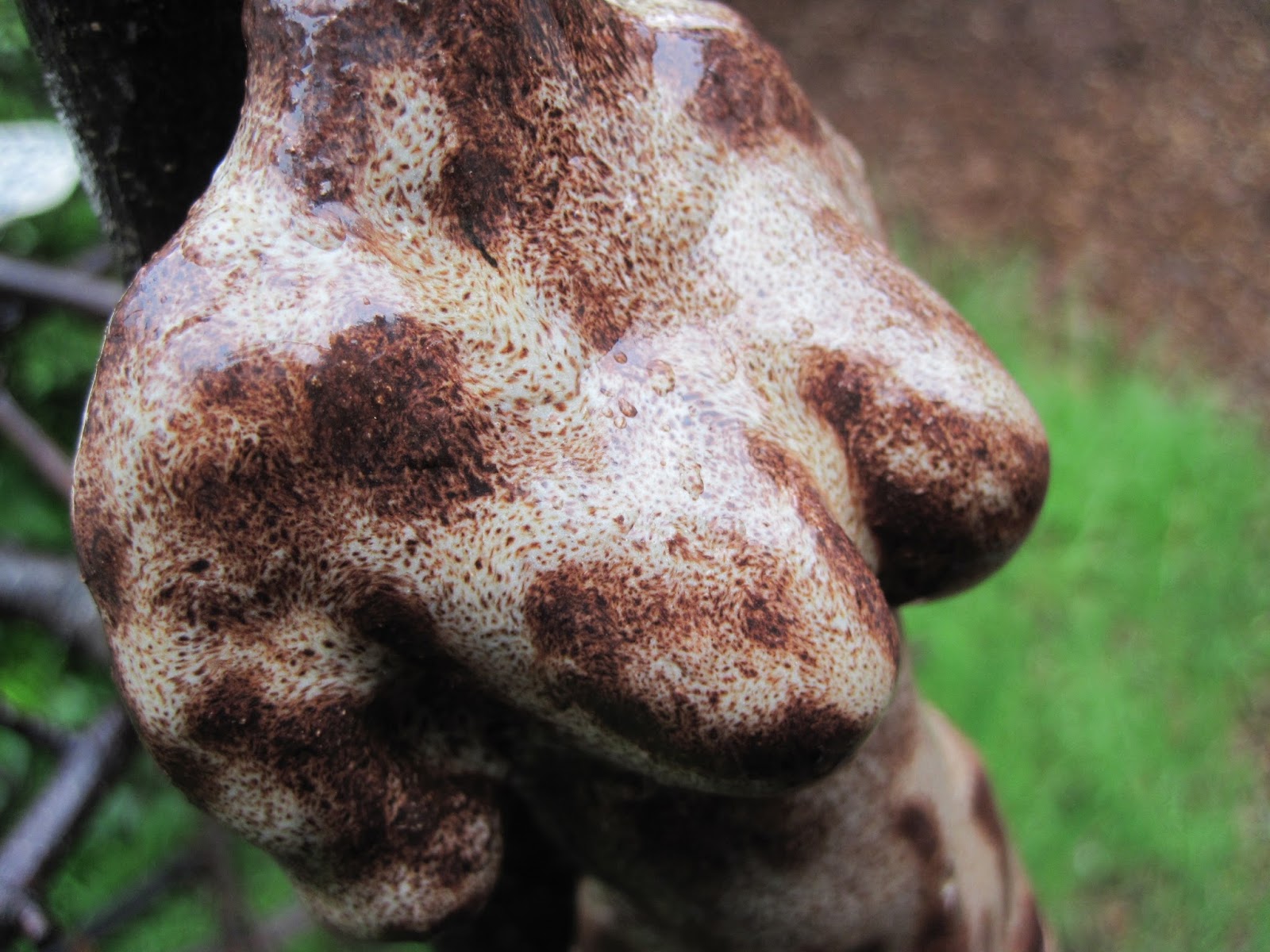
Body English:
sculpture mix; transparent brown and shino glazing.
20-minute exercise.
Tuesday, March 29, 2016
Body English: Musings on the Beautiful and Sublime
Let's quote Edmund Burke on "Gradual Variation":
BUT as perfectly beautiful bodies are not composed of angular parts, so their parts never continue long in the same right line. They vary their direction every moment, and they change under the eye by a deviation continually carrying on, but for whose beginning or end you will find it difficult to ascertain a point. The view of a beautiful bird will illustrate this observation. Here we see the head increasing insensibly to the middle, from whence it lessens gradually until it mixes with the neck; the neck loses itself in larger swell, which continues to the middle of the body, when the whole decreases again to the tail; the tail takes a new direction; but it soon varies its new course: it blends again with the other parts; and the line is perpetually changing, above, below, upon every side. In this description I have before me the idea of a dove; it agrees very well with most of the conditions of beauty. It is smooth and downy; its parts are (to use that expression) melted into one another; you are presented with no sudden protuberance through the whole, and yet the whole is continually changing.
Observe that part of a beautiful woman where she is perhaps the most beautiful, about the neck and breasts; the smoothness; the softness; the easy and insensible swell; the variety of the surface, which is never for the smallest space the same; the deceitful maze, through which the unsteady eye slides giddily, without knowing where to fix or whither it is carried. Is not this a demonstration of that change of surface, continual, and yet hardly perceptible at any point, which forms one of the great constituents of beauty?
Selections from A Philosophical Inquiry into the Origin of Our ideas of the Sublime and Beautiful.
-- from Part II: Section XV, in particular
Edmund Burke, 1757.
Monday, July 23, 2012
"My Aim Is True": Novel Navigation?
Or, By Bluff and Blunder?
Or, Compassion As Compass?
Or, Pin The Tale On The Donkey?
I'll stop with the subtitles, the alternative guides, and move to my central concern. Here are three quotations that I've probably offered before, but the last few days I've found them resonating alongside a certain ambition to craft a full-length narrative of mystery and adventure.
1. "But I had learned long ago that resolution by itself is not enough; we are what we do, not what we think and feel."
--James Lee Burke, "Heaven's Prisoners"
Here I am quoting from memory, but this is a quotation that sticks with me, that offers a rather pitiless ideal, which draws me in even as I want to bring or find more compassion than those words offer. "Resolution" in the first part of the sentence definitely means "completion" or "finishing," not merely "deciding upon" or "resolving to do." I think this quotation will help me to set up the conflicts in the "novel" I'm attempting to outline/frame.
2. Let's listen to my second-favorite ancient Greek poet:
I over-reached
And another
Bears the bother.
--Archilochos
trans. Davenport
I take that short poetic fragment with ruefulness, with regret in the tone, not triumph, though I can see the psychology that would exult in that way. I can see such, but save me and all of us from such, I say.
3. And the last of the triad, for now:
“I've learned that people will forget what you said, people will forget what you did, but people will never forget how you made them feel.”
--Maya Angelou

Fourth? Frankly, on reflection, I can see how all three of the quotations above spiral around each other, twining thematically into one threefold strand, and so further sayings may be called for. Somehow, the supposed opening line of my absolute favorite ancient Greek poet's lost comic-epic also horns in . . . .
"He knew many things, and all of them badly."
Homer, from his lost Margites . . . .
I'm quoting from memory again here, but I think you can see I don't plan to tell a tale overburdened by seriousness. And a fallible, flawed, but well-meaning character? Who wouldn't like a bit of that? I mean, aren't we constructed in that way ourselves, however we may aspire and resolve to do better?
And, that fourth selection just may be another way to say "Pin the tale on the donkey."
Saturday, September 24, 2011
Passages: Charon's Steamboat
"During the firefight, I saw a steamboat down by the mouth of the river."
"You mean a floating casino?"
"That's not what it was. I've seen it before. On Bayou Teche."
"I don't know if I want to hear this."
"I thought that was where I was going. I thought they were waiting for me."
"Who?"
"The people on board."
"Don't talk like that."
"You're the best, Cletus."
"No, we're the best. One is no good without the other. The Bobbsey Twins from Homicide had one agenda only. We make the dirtbags want to crawl back in their mothers' wombs. We're gonna hunt down the cleaners or whatever they are and salt their hides and nail them to the barn door."
"You've already said it for both of us. It's only rock and roll."
"That because I was ninety-proof. You don't have permission to die." He grabbed my shirt. "You hearing me on this?"
"I was just telling you what I saw. Who else am I going to tell?"
I cupped my hand on the back of his neck as we walked to the car. I could feel the hardness in his tendons and the heat and oil of his skin. I could feel his heartbeat and the fury and mire of his blood in his veins, and in his intelligent green eyes I could see the misty shine that my words would not make go away.
--James Lee Burke, from The Glass Rainbow.
Dave Robicheaux and Clete Purcell's friendship is one of the glories of Burke's novels featuring these two characters.
Subscribe to:
Posts (Atom)