Showing posts with label Helmet. Show all posts
Showing posts with label Helmet. Show all posts
Saturday, April 28, 2018
Sunday, March 22, 2015

Wednesday, January 8, 2014
Pictish Warrior?


Wednesday, January 1, 2014
Crossley-Holland: An Anglo-Saxon Riddle

A woman, young and lovely, often locked me
in a chest; she took me out at times,
lifted me with fair hands and gave me
to her loyal lord, fulfilling his desire.
Then he stuck his head well inside me,
pushed it upwards into the smallest part.
It was my fate to be filled with something
coarse if that person who possessed me
was virile enough. Now guess my name.
--translated by Kevin Crossley-Holland

The Exeter Book Riddles, translated by Kevin Crossley-Holland,
Penguin Books, ______.
Friday, January 4, 2013
Mateo: Three Faces (Naked, Hoplite, Diver)

Mateo in Morning Light.
As with living humans, that light can show nakedly the signs and emblems of age.
I think I did a fair job of capturing some of me at fifty, though in other ways this piece is a younger me and/or not me quite at all. (If that's confusing, that's the Gemini coming through.)
Piece sculpted in a Self-Portrait Class: Summer 2011.
I've posted shots of this figure in the past on this blog.
Hit the "Mateo" label-link below to see the other shots and commentary, if you'd like.

Mateo as Hoplite / Greek Warrior.
I use the helmet as a visual aid, seriously and/or humorously, when teaching Homer's epics or any of the Greek tragedies.

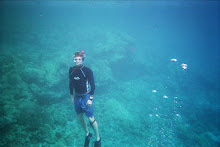
Mateo: Free Diver.
That's an old mask from the '80s. Note the side ports for greater range of vision while diving.
This particular mask I picked up and gave to my father to encourage him to swim laps. He didn't like the feel of standard swim goggles, so I suggested such a mask. When he didn't pick one up for himself, I made a gift of this one. I don't think he ever used it more than once or twice, at best.
Mateo: sculpture mix; denim glazing, poured over and mostly wiped off.
For the record, I'm not crazy about the end results here, but making this piece -- the largest single clay piece I've ever made -- has taught me much, not least about envisioning outcomes and artistic control. The pallor is slightly disturbing, and the shininess of the blue seems just a bit too much. I am not sure what I had expected or imagined when I glazed the piece. And yet, Mateo strikes me as a very undersea fellow, as a merfolk stand-in, which seems quite suitable too.
Thursday, January 3, 2013
Montague's "Psychic Surgery"
PSYCHIC SURGERY
There are times when
one should be able
to pluck off one's head
like a dented or worn
helmet, straight from
the nape and collarbone
and place it firmly down
in the bed of a flowing stream
of clear, clean, cold water
coursing and spuming through
the sour and stale compartments
of the brain, dulled eardrums,
bleared eyesockets, benumbed
nostrils, barely open,
and then set it back again
on the base of the shoulders:
well tamped down, of course,
the laved skin and mouth,
the marble of the eyes
rinsed and ready
for love, for prophecy.
--John Montague
(an Irish poet, another Irish poet, that I admire)
Saturday, March 24, 2012
Not That Nisus
In the ninth book of his Aeneid, the Roman poet tells the tale of two friends, Nisus and Euryalus, who volunteer to deliver a message from the besieged main camp of the Trojans to Prince Aeneas himself, exploring and seeking allies in the Italian countryside. Aeneas' son Ascanius entrusts the two friends to find his father, their commander, and attest to the peril facing the camp. Unfortunately, the two Trojans are distracted from their mission by bloodlust and the lure of glory, and they stop to slaughter some sleeping Italian warriors. The younger Euryalus is seized after the moonlight gleaming off the helmet he'd taken for a prize gives him away, though Nisus has gotten free and could continue on his mission. He does not continue, but returns, wanting to free his younger friend. Nisus throws a spear at one of the warriors holding Euryalus, killing the man, but the Italian leader kills Euryalus in retaliation. (What else was likely?) Tormented by the death of Euryalus, Nisus then rushes in suicidally. The Italians cut him down and take both Trojans' heads as trophies.
Virgil calls forth Homer's very successful night-foray by Odysseus and Diomedes, catching the spy Dolon and slaughtering Rhesus and his company in their sleep, from The Iliad, and he recasts that episode into a fairly obvious fiasco with sentimental and sentimentally ridiculous overtones. Euryalus' mother's speech about the loss of her son and the brutality of war is moving, but the men are still dead. Later readers and writers have appreciated the martyrdom of the two Trojans, casting this episode as sentimentally heroic. Others have seen this episode as Virgil's clear commentary on Homeric pride and selfishness, on Greek "glory", in contrast to the more Roman virtue of honorable duty: Nisus and Euryalus acting as stand-ins for, say, Achilles and Patroclus. Virgil, being Virgil, all is possible, at once. To me, the effect of the episode is complex, morally and emotionally, more complex than I can easily explain. (I may attempt to better this treatment in a future blog entry.)

I've always been drawn to a key question that Nisus raises, which I offer in the English translation of Robert Fitzgerald: "This urge to action, do the gods instil it, / Or is each man's desire a god to him, / Euryalus?" What is the source of motivation? Of desire? And, where does it come from? Is it an external force or purely internal, however we dress it or explain it to ourselves? "This urge to action": the older I've gotten, the more complex my sense of motivation and drive. And yet often what drives us is simple, dress it up as we like. Still, for every action, the riddle of motivation, and only each one of us can truly understand the internal or external forces involved. That's my comforting--sometimes discomforting--fiction, anyway.
For some odd reason, I've always wondered What If Nisus Had Not Died Beside His Friend? What if Nisus survived the ill-conceived, luckless night-foray? Would he be haunted by his friend? Would he be haunted by guilt and remorse?
Back in the mid-90's, I started making notes for stories involving this Nisus-who-survives, casting him as a fugitive moving through southern Italy and the Greek isles to return to Troy, an exile masquerading as a fisherman and a sponge-diver. In my imagination, he gets caught up in Odysseus' scheme to salvage Greek ships sunken in storm on the way home laden with Trojan gold and other treasures. Does Odysseus realize that Nisus is a Trojan, a blood enemy, and if he does, does he care?
Back then, I also wrote the following poem, which I recently rediscovered.

NOT THAT NISUS
"I thought you were dead,"
The old ghost said,
The familiar boy with the helm
Too great for his head.
His arms so unsteady--
Yet his voice readily refrained--
"That you'd fallen with me,
That your devotion I'd gained."
"But I'm not that Nisus,"
The clay-gray dreamer denied.
"Not that epic figure, that hero--
If I were, I'd have died.
When you fell to the foe
Like the rose to the plow,
That Nisus was striving--
Scything Fortune knows how."
"I'll return with the night,"
Swore the young warrior at dawn.
But old Nisus had known
That he'd not slumber long
Without the bronze forms of fright
Cast into shadows of shame:
Marked by the might
Still sculpting his name.
--Matt Duckworth

Subscribe to:
Posts (Atom)