Showing posts with label Names. Show all posts

Friday, August 23, 2019

Entitled


"Now that I see your full name, I have to say this:
'Matthew Duckworth . . .
. . . Earl of Sandwich.'"

--clerk at the hardware store


Wednesday, May 16, 2018

Sobriquet

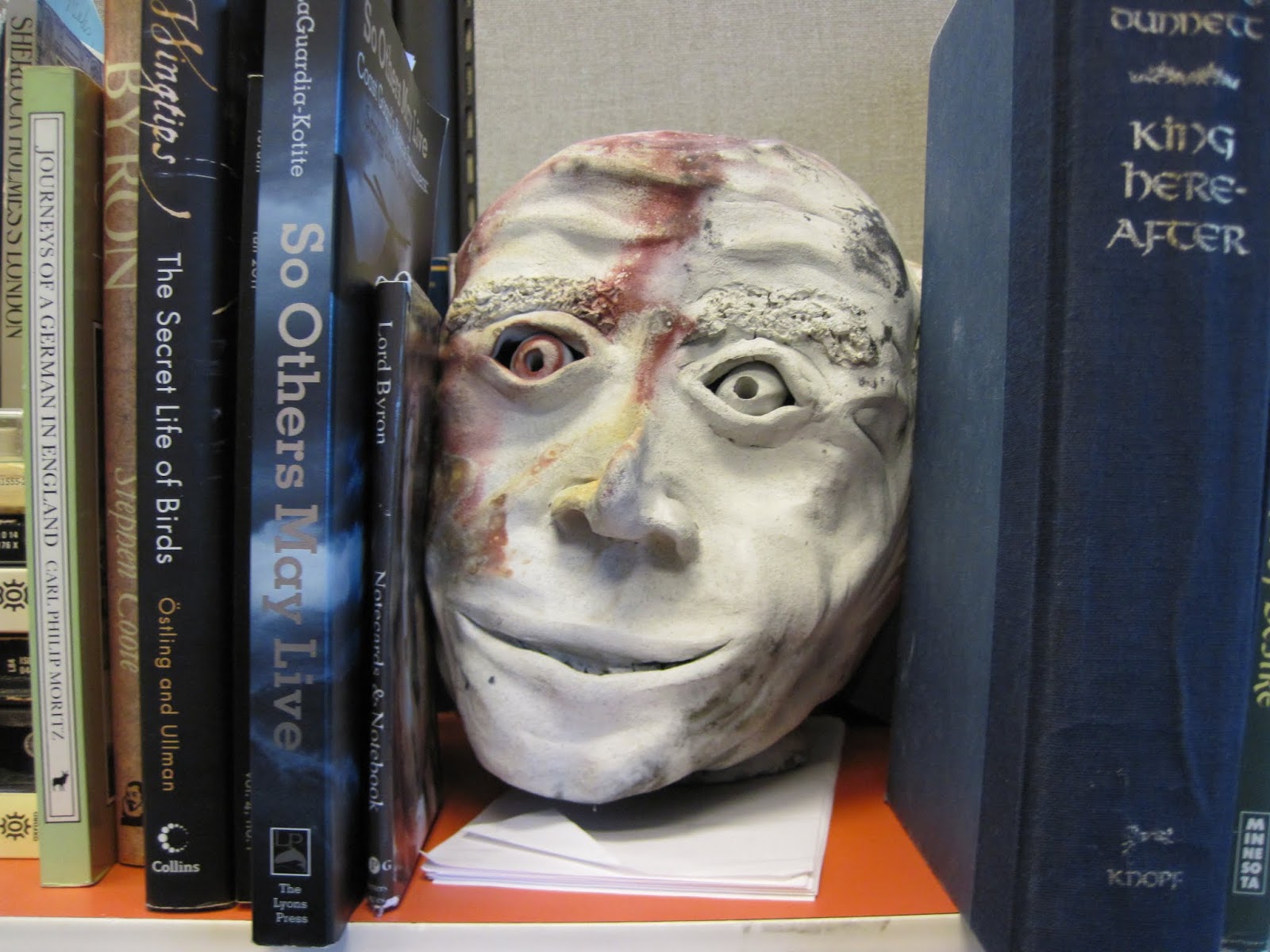
"Hey, hey, Teach.  What's with the clay-head?"
--Not-my-student asking about the prop for Macbeth class today.

Second favorite event after the baby duck on campus.  

Since this was the last day of regular classes and I will be suffering from not-teaching soon, I liked hearing the sobriquet.


Julius, Post-Ides: sculpture mix, pit-fired on Ocean Beach, SF, CA.

Sunday, June 15, 2014

Metrical Reflection


Two trochees and a spondee: my full name.

Can you tell that I'm bored with hanging around being ill and just "resting"?


Monday, July 9, 2012

Sleep-Talker: Wet Clay


Merlin in the Tree:  sculpture mix, still wet.

I'll probably change the name of the mask by the time I finish forming, firing, and glazing the piece.  I often do.  And, sometimes, I don't really know the piece's name, the art's essence, until I've taken it from the studio and sat with it for a while, or placed it in a tidepool or the shorebreak.  Often, the piece is a vessel for moods and conceits that are forming and evolving along with the work itself.

That's a talking mask, for sure, but then I'm a bit of a talker too.


Wednesday, May 23, 2012

Sam Hamill's "The Gift of Tongues," the Generous Spirit, and PIracy


THE GIFT OF TONGUES


Everything I steal, I give away.
Once, in pines almost as tall as these,
same crescent moon sliding gently by,
I sat curled on my knees, smoking with a friend,
sipping tea, swapping Coyote tales and lies. 


He said something to me
about words, that each is a name,
and that every name is God's. I who have
no god sat in the vast emptiness silent
as I could be. A way that can be named

is not the way. Each word reflects
the Spirit which can't be named. Each word
a gift, its value in exact proportion
to the spirit in which it is given.
Thus spoken, these words I give 


by way of Lao Tzu's old Chinese, stolen
by a humble thief twenty-five centuries later.
The Word is only evidence of the real:
in the Hopi tongue, there is no whale;
and, in American English, no Fourth World. 

--Sam Hamill ~


"The Gift of Tongues," for me, voices a certain generosity of spirit that I admire, a certain spiritual perspective or dilemma that I sometimes inhabit.

Hamill's poem also speaks to the linkages of appropriation and use that ought to be infused with that sense of generosity in ways that parallel, say, Gary Snyder in his poem "Axe Handles" and in his life as well.

Hamill's poem came up in a conversation with a friend about piracy, Internet and media piracy in context, but generally piracy vs. theft and piracy vs. copying.  I quoted the above poem's opening line--"Everything I steal, I give away"--to highlight what I feel is the proper generous spirit of Internet sharing, say, or of classroom teaching.  Give credit where credit is due,  certainly, and encourage everyone to seek out the originals in whatever format, whatever venue.  (I quote Shakespeare or Byron in part to foster an interest in, a curiosity about, such writers.)

Piracy lacks such a generous spirit, despite all the attractive emblems of the piratical.

"Take what you can." 
"And give nothing back."
--those sentiments belong at best in a Hollywood fantasy, not the real world.

And while I love those lines in the moment of watching that first Pirates of the Caribbean film,  I think part of the charm of such costumed and indulgent selfishness comes from context, as ever.  These are down-and-out, though irrepressible ne'er-do-wells--Captain Jack Sparrow and his first mate, Mr. Gibbs--and such voicing of the pirate's code is as much fantasy-projection for them as it is for most of us in the audience.  The lines would have a much different flavor being spoken by Wall Street bankers and brokers, suited up but ties loosened, perhaps, with whiskeys in hand.


Sam Hamill, Destination Zero: Poems 1970-1995, 
White Pine Press: Fredonia, New York, 1995.


(Thanks to MR for the conversation.)

The poster presented at the top is self-expressive, a wonderful promotional tool and work of art for a worthy anthology from an excellent publishing house: Copper Canyon Press.  In that particular anthology I first encounted Hamill's poem quoted above, though I have just reread and presented the poem from Hamill's volume Destination Zero.

Saturday, March 24, 2012

Not That Nisus

In the ninth book of his Aeneid, the Roman poet tells the tale of two friends, Nisus and Euryalus, who volunteer to deliver a message from the besieged main camp of the Trojans to Prince Aeneas himself, exploring and seeking allies in the Italian countryside. Aeneas' son Ascanius entrusts the two friends to find his father, their commander, and attest to the peril facing the camp. Unfortunately, the two Trojans are distracted from their mission by bloodlust and the lure of glory, and they stop to slaughter some sleeping Italian warriors. The younger Euryalus is seized after the moonlight gleaming off the helmet he'd taken for a prize gives him away, though Nisus has gotten free and could continue on his mission. He does not continue, but returns, wanting to free his younger friend. Nisus throws a spear at one of the warriors holding Euryalus, killing the man, but the Italian leader kills Euryalus in retaliation. (What else was likely?) Tormented by the death of Euryalus, Nisus then rushes in suicidally. The Italians cut him down and take both Trojans' heads as trophies.

Virgil calls forth Homer's very successful night-foray by Odysseus and Diomedes, catching the spy Dolon and slaughtering Rhesus and his company in their sleep, from The Iliad, and he recasts that episode into a fairly obvious fiasco with sentimental and sentimentally ridiculous overtones. Euryalus' mother's speech about the loss of her son and the brutality of war is moving, but the men are still dead. Later readers and writers have appreciated the martyrdom of the two Trojans, casting this episode as sentimentally heroic. Others have seen this episode as Virgil's clear commentary on Homeric pride and selfishness, on Greek "glory", in contrast to the more Roman virtue of honorable duty: Nisus and Euryalus acting as stand-ins for, say, Achilles and Patroclus. Virgil, being Virgil, all is possible, at once. To me, the effect of the episode is complex, morally and emotionally, more complex than I can easily explain. (I may attempt to better this treatment in a future blog entry.)


I've always been drawn to a key question that Nisus raises, which I offer in the English translation of Robert Fitzgerald: "This urge to action, do the gods instil it, / Or is each man's desire a god to him, / Euryalus?" What is the source of motivation? Of desire? And, where does it come from? Is it an external force or purely internal, however we dress it or explain it to ourselves? "This urge to action": the older I've gotten, the more complex my sense of motivation and drive. And yet often what drives us is simple, dress it up as we like. Still, for every action, the riddle of motivation, and only each one of us can truly understand the internal or external forces involved. That's my comforting--sometimes discomforting--fiction, anyway.

For some odd reason, I've always wondered What If Nisus Had Not Died Beside His Friend? What if Nisus survived the ill-conceived, luckless night-foray? Would he be haunted by his friend? Would he be haunted by guilt and remorse?

Back in the mid-90's, I started making notes for stories involving this Nisus-who-survives, casting him as a fugitive moving through southern Italy and the Greek isles to return to Troy, an exile masquerading as a fisherman and a sponge-diver. In my imagination, he gets caught up in Odysseus' scheme to salvage Greek ships sunken in storm on the way home laden with Trojan gold and other treasures. Does Odysseus realize that Nisus is a Trojan, a blood enemy, and if he does, does he care?

Back then, I also wrote the following poem, which I recently rediscovered.


NOT THAT NISUS

"I thought you were dead,"
The old ghost said,
The familiar boy with the helm
Too great for his head.
His arms so unsteady--
Yet his voice readily refrained--
"That you'd fallen with me,
That your devotion I'd gained."

"But I'm not that Nisus,"
The clay-gray dreamer denied.
"Not that epic figure, that hero--
If I were, I'd have died.
When you fell to the foe
Like the rose to the plow,
That Nisus was striving--
Scything Fortune knows how."

"I'll return with the night,"
Swore the young warrior at dawn.
But old Nisus had known
That he'd not slumber long
Without the bronze forms of fright
Cast into shadows of shame:
Marked by the might
Still sculpting his name.

--Matt Duckworth