Showing posts with label Quest. Show all posts

Saturday, September 25, 2021

Saturday, July 11, 2020

Thursday, May 28, 2020

What's-the-Story?


Story: characters in action in a setting through time.

That's how I process everything.

Give me a poem, any poem, and I look for the story in the lines, behind the lines, and/or after the lines. Give me a photo, and where some see a static tablieau, I see dynamism, before-and-after, presence-and-absence. Give me a problem, personal or societal, and I look for the story in the same way.

On the upside, I look for motivation and context and nuance. On the downside, some people think I am wasting my--or their--time with this approach, with my concern for accuracy and understanding of plot, POV, and narrative shading.

I'll be 59 soon, but that mostly means I've had a lot of practice with stories and story-telling; I think I am (still) in tune most of the time. Yet I know I may be wrong in my emphasis in certain circumstances and with certain texts, and that encourages me to be humble, which is always good.

Still, what's the story is my favorite question.

Thursday, April 9, 2020

Seeking, Sought


Navarro Beach:
February 15, 2016

Tuesday, October 10, 2017

The Betweens


The betweens.
What I tend to teach.
Each to each.


Byronic Opposition


Byron's expressions of the heroic saliently focused on opposition figures--the Trojan view, Priam's sons, a Turkish infidel and his sons, a cripple--to express that heroism, a thought I'd misplaced from back in the days I was working on that dissertation.

(How odd, especially given that my intended and partially-unexamined title read "With a Trojan's Eye."  I knew Byron was more cosmopolitan, more liberal, of mind and heart than many have given him credit for, but I wasn't quite digesting all that I'd been consuming, reading hugely as I was, and so . . . .)

Friday, September 29, 2017

Dear Lord Byron . . . Postscript


Friend:  What was it? Do you know now?

Me:  I wanted to be able to say that I knew what Byron thought and felt and meant in any given moment and any given text, but since I didn't mean to write the next biography all of that did not serve me well. I failed to digest much of what I was consuming and I didn't know how to stop except by teaching other people.

Me:  Though, you know, there were times when I did know. But that was mysticism and not academically allowed.

Friend: Matt, so the obsession was mastery--and you achieved it, just not in the exact way you envisioned.

Me:  Mastery is an illusion, but I once believed in that illusion.


Tuesday, June 6, 2017

The Clay Waits


The clay waits
Life-mask
Death-mask
The sculptor can't decide
Drawing ragged breaths
This broken morning
Fixing memory in pieces
Mixing temerity with mortality
. . . .
The clay waits.

There was a crooked man
Who climbed a crooked hill
Who had been a broken child
Bound to a broken will . . . .
. . . .
Pottery unfired
Bowls unthrown . . .
The clay waits.

There is a frayed man
On a frayed course . . .
. . . .
Threadbare nerves
Nightmare curves
Vertiginous horse
Sweltering source
Fevered fear
Galloping near . . .
. . . .
The frayed man wakes . . .

The clay wakes.

--MD

slightly revised: 7/8/18
and again: 3/21/20
and again: 4/13/20

Thursday, December 29, 2016

TBT: "The Sea-God Sailing"

Throwback Thursday?  Here's a poem of mine from high school that I recently (re)discovered:

THE SEA-GOD SAILING

When the wind's a howling, red-eyed scourge--
The surf beats out a dismal dirge
     And the rigging hums with a dire tune--
     There comes a-racing through mist and gloom
The lord of sea and surge.

The winter sky is fraught with grey,
In frozen heaps the storm clouds lay.
     So fill with ale your carven mug,
     In hearty gulps drink down that slug,
As he glides into the bay.

Aye, drain that mug to the king of the sea,
Before whose prow the troubled waters flee.
     To Manannan, the Celtic one,
     Besides whose ship the dolphins run,
For the sea's true son is he.

And like the wilful, wind-swept waters wide,
Indomitable as the turning tide,
     Wild and daring as the untamed surge--
     Until the oceans very verge
His sturdy sloop doth ride.

While Neptune and his kin doth sleep--
Sung in their castles buried deep,
     Indolent in the languid seas,
     Lolling in the warm, southern breeze--
Manannan storms the ocean's briny keep.

For Manannan Mac Lir is he,
The warrior of the northern sea.
     With flaxen sail and ashen spar,
     The Celtic god doth make his war
With the legions of the sea.

In anger, the wayward sea attacks,
With swell and squall and ice that tracks.
     Yet closer to the wind he leads
     And braces the ocean's white-maned steeds,
And slides across their lathered backs.

Though the spray to ice in air doth turn,
And iron and flesh together coldly burn,
     He grips the tiller like a hearth,
     Through his frozen beard shines his mirth,
And strains at stem and stern.

Through the heart of a raging northern gale,
Pelted by the sling-stones of frosty hail,
     As to futile wrath turns the sea,
     Manannan, making his way with glee,
Tightens his grip and trims his sail.

In a stinging salt-spray haze he's whirled,
At him the wrath of waves is hurled--
     Over him they break, like soldiers on a wall,
     Above him the gulls, in brazen voices call--
And with a flag, his sail unfurled, he skims across the frozen world.

He turns his prow to the midnight land of sun and sea and sky,
And sails in the gleaming snow of the ice that will not die--
     Across the world's ridge, he slowly spreads his sails,
     And beaches his boat on the barren backs of whales,
And gulls about him fly.

As the wind, Manannan is free.
He sails across the sullen sea,
     And though the proud waters permit no track,
     Mac Lir, with a cloak from a leathern sack,
Is master there, aye master, for all eternity.

--Matthew Duckworth
from Unrecognized Poems of Literary Merit
by Mrs. Covell's A-P English Class
1978-1979.

--I just found this old volume in a box in my study, recently pulled out of the garage.
Juvenilia, by any other name . . . .

Wednesday, December 14, 2016

What I Have Learned

English 1B: two questions.

How does X serve the story?
And, what does the story serve?

English 1A?
Shift "story" to "argument".

Tuesday, August 9, 2016

Curious Yellow

Shift the horizon out of true and there's a different sort of truth available, I think.


Here: paddling past Monterey harbor and breakwater with the town in the background as well--though a bit of swell makes that view slightly kiltered.


Shift from one horizon to another, and you'll make another sort of truth available too.

--I'm the kiltered one with this shot, though that is the true view while paddling, the horizon at a slight slant.  If you are lucky, kayaking (and swimming) will leave you feeling that rocking-swaying-surging in your soul and bones, proprioceptively, long after the sea-session ends, even unto bedtime.  If you are really lucky, you'll wake with such sea-legs.

Get kiltered: not a bad motto these days . . . .

Friday, October 25, 2013

The Journey

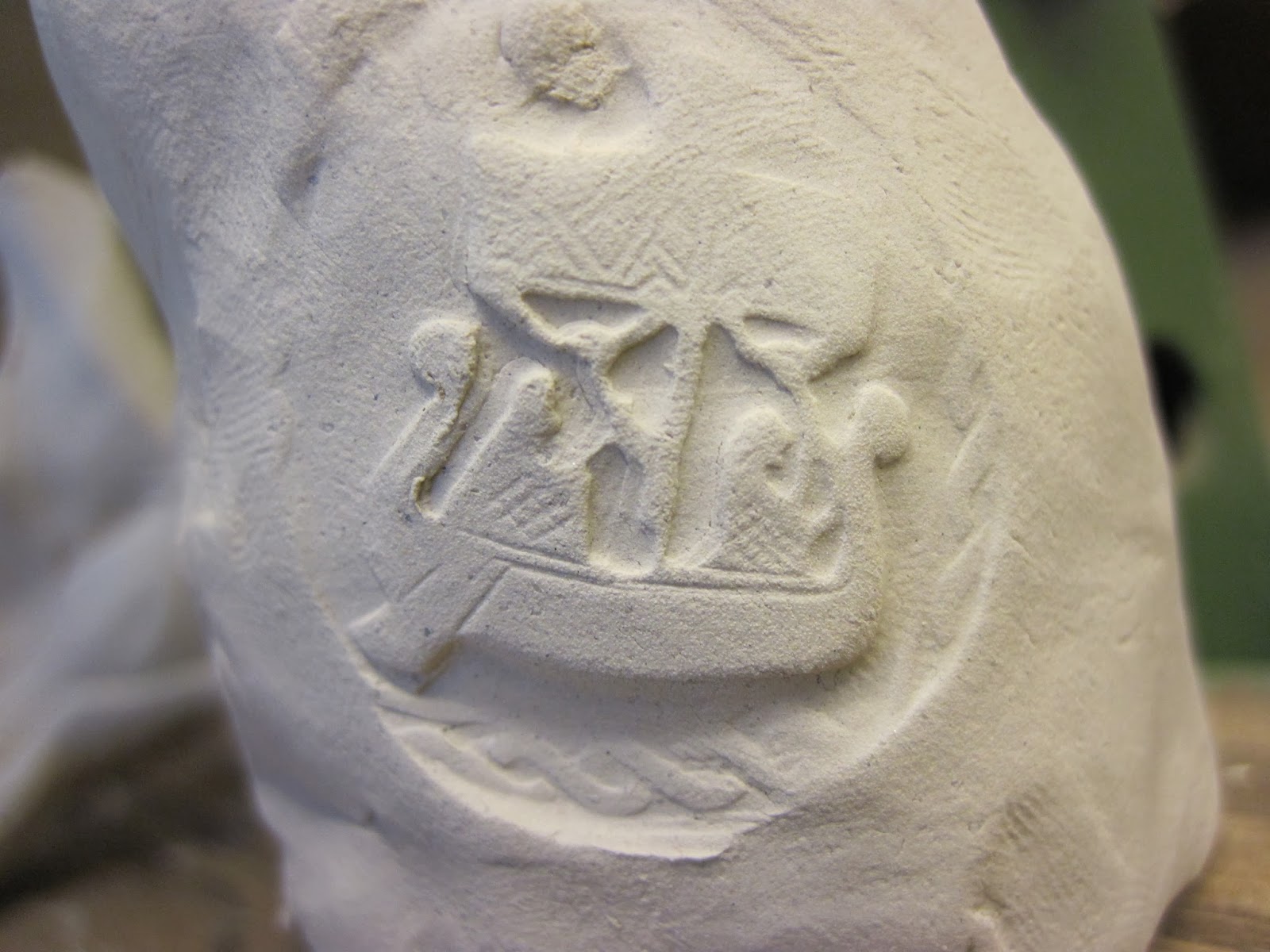
Sculpture mix, unfired.

I am yearning for kelp.

Sunday, July 21, 2013

Horse Sense


Painted Pony: 
sculpture mix;
transparent brown and Robby's Red glazing.

Monday, July 8, 2013

Fishing Trip

Monterey Bay, fisherman off Cannery Row.

Monday, November 12, 2012

Barry Lopez: "River Notes" and Questing


I have been crippled by my age, by what I have known, as well as by my youth, by what I have yet to learn, in all these inquiries.  It has taken me years, which might have been spent (by someone else) seeking something greater, in some other place.  I have sought only you.  Enough.  I wish to know you, and you will not speak.  

--Barry Lopez,
from River Notes: The Dance of Herons

I can't say enough how much this slim volume mattered, how much it made complex, made even more emotional and even more intricately verbal my relationship with nature and story, when I first discovered River Notes in Moe's Books of Berkeley, CA, so long ago in 1980.

On this recent rereading -- and River Notes is a book I reread more or less each year, haphazardly, piece by piece over all the months of the year -- I realized how much his chapter "The Salmon" prepared me for the art and artistry of Andy Goldsworthy and for so many of my own efforts in clay amidst sea and creek.

I've witnessed this writer giving a talk and reading one of his stories at least once --"The Mappist," at the Donna Seager Gallery in San Rafael -- and I took this rather intimate opportunity (such a small venue, a somewhat select gathering) to thank Barry Lopez for his body of work.  I'm glad I overcame my natural diffidence to do so.

The passage above spoke to me when I was a mere youth, not even 20, and speaks to me now, a bit over 50.  I like the appositive defining of age in terms of knowing, in terms of what we don't understand and of what we do, as well as the sad, even bitter tone.  Loss breathes through the passage, through most of the book, and Lopez's voicing of that theme, that truth, caught my ear, and the ear of my soul (if you will), even if I didn't--perhaps, still don't--truly understand wherein that sense of loss resides, takes form.  Recently, I have read an interview with Barry Lopez in which he reveals that the writing of River Notes, though a sequence of fictional narratives, was deeply informed by the death of his mother.

The book takes us from the seaside, the mouth of the river, upstream until we reach the headwaters, the source.  The last chapter, be warned, is entitled "Drought."  I'll hold off saying more, for I'd rather awaken curiosity and intimate mystery.  I have taught two chapters in particular a dozen times, I think: "The Bend" and "The Rapids."  Here's another passage from "The Salmon":

There is never, he reflected, a moment of certainty, only the illusion.   And as he worked among the rocks in the middle of the river he thought on this deeply, so deeply that had his movements not been automatic he would have fallen off the rocks and into the river and been borne away.

In the summer light, even with the coolness of the water welling up around him in the air, thinking was all he was capable of; and this distraction left him exhausted and unbalanced so that at the end of the day the physical exhaustion he felt was something he lowered himself into, as into a hot bath.  He pondered gentleness often.  And he tried to pry (hefting the stones, conscious of the resonance between the idea in his mind and the work of his hands) into mysteries which remained as implacable as the faces of the stones.


Thank you, again, Barry Holstun Lopez.

River Notes: The Dance of Herons
A Bard Book / Avon Books: New York,  November, 1980.

Voyage-charm: sculpture mix; floating blue glazing; matte finish.   

Saturday, October 6, 2012

Thursday, September 8, 2011

"Hail Muse, Etc.": Poems as Prompts II

Here are a few of the poems I have in mind for that introduction to how poetry works. Read aloud, of course, and with appropriate emotion and emphasis. (It's a little like karaoke, but better.)


EPIGRAM. Engraved on the Collar of a Dog
Which I Gave to His Royal Highness

I am his Highness’ dog at Kew:
Pray tell me sir, whose dog are you?
--Alexander Pope (1737)
(Kew= one of the royal palaces)


IN A STATION OF THE METRO
The apparition of these faces in the crowd;
Petals on a wet, black bough.
--Ezra Pound (1916)


YOU FIT INTO ME
you fit into me
like a hook into an eye

a fish hook
an open eye
--Margaret Atwood (1971)


CONQUEROR
Huge leaps. Epic soarings of the head.
He glowed within, without. Born to conquer.

“You look fragile,” she said.
--Brendan Kenneally (1999)


THIS LIVING HAND
This living hand, now warm and capable
Of earnest grasping, would, if it were cold
And in the icy silence of the tomb,
So haunt thy days and chill thy dreaming nights
That thou would wish thine own heart dry of blood
So in my veins red life might stream again,
And thou be conscience-calmed. See here it is—
I hold it towards you.
--John Keats (1820)


MARKS
My husband give me an A
for last night’s supper,
an incomplete for my ironing,
a B plus in bed.
My son says that I am average,
an average mother, but if
I put my mind to it
I could improve.
My daughter believes
in Pass/Fail and tells me
I pass. Wait ‘til they learn
I’m dropping out.
--Linda Pastan (1978)


I'm also considering getting into how poetry works by using and abusing some pieces from various rock & roll songs:

Love is a rose, but you better not pick it;
It only grows when it’s on the vine.
A handful of thorns and you’ll know you've missed it:
Lose your love when you say the word “mine.”
--Neil Young

She calls me baby
She calls everybody baby
It’s a lonely old night
Ain’t they all?
--John Mellencamp

When I said that I was lying I might have been lying.
--Elvis Costello

“What is your destiny?” the policewoman said.
--Elvis Costello


And finally . . .

I light your cigarettes
I bring you apples from the vine
How quickly you forget
I run the bath and pour the wine
I bring you everything that floats into your mind

But you don’t’ bring me anything but down . . . .
--Sheryl Crow


P.S. I'll probably only have 30 minutes to spare for this "introduction," so I'm just going to do what I can with what feels best in the moment. I may start from the last of these pieces and work upwards, emphasizing voice, characters, and the dramatic situations that are unfolding. (And, actually, I have another two or three pages of handouts, just in case I need them. Frankly, I'm hoping to start some conversations that will continue beyond the official meetings . . . . Oh, and do apples even grow on vines? Sheryl Crow, c'mon. A favorite mistake? I enjoy your music, but how can I believe the speaker of "Anything But Down"?)