Showing posts with label Notes. Show all posts

Saturday, May 23, 2020

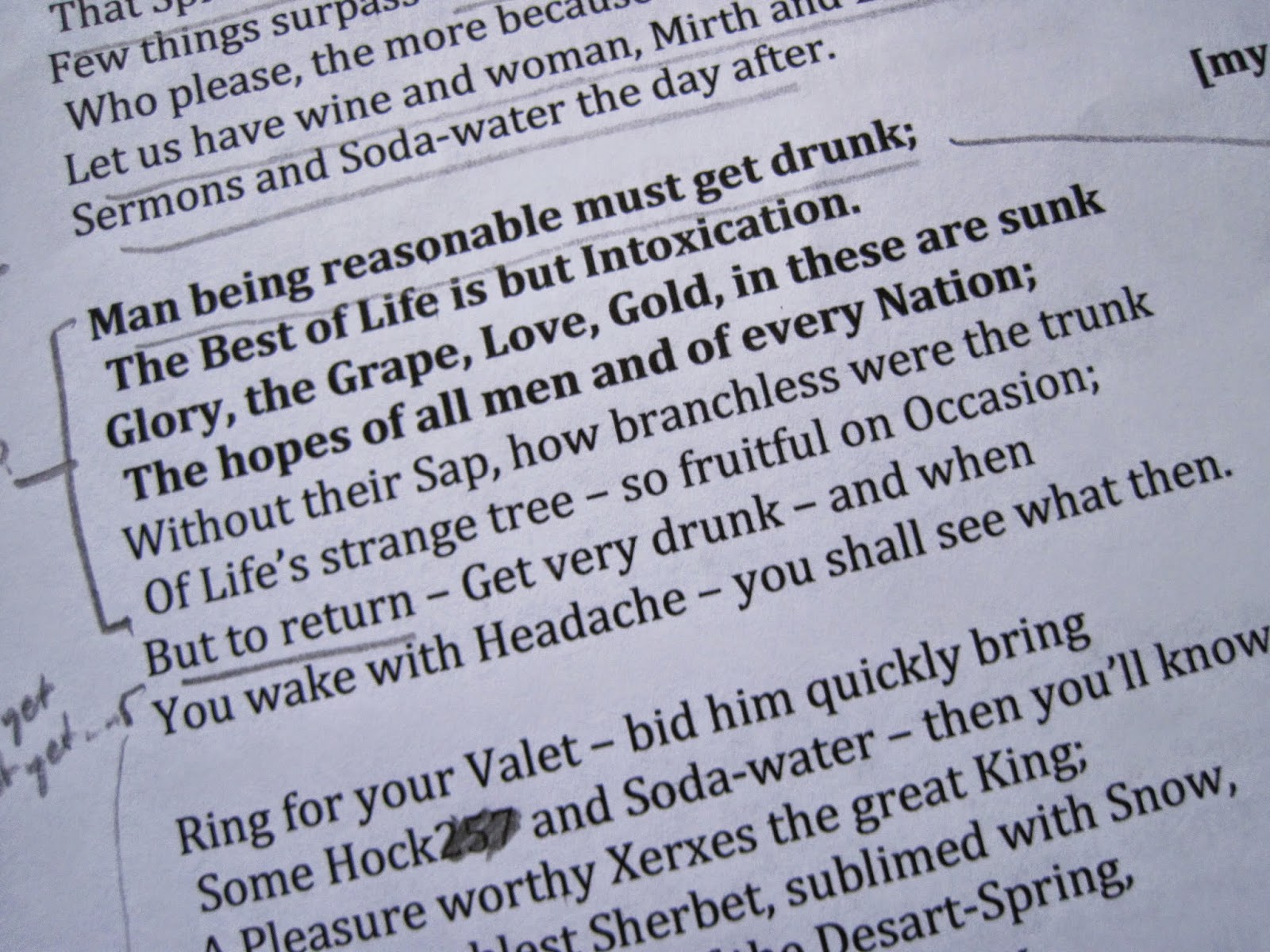
Epic Ambitions: "Notes From a Bottle Found on the Beach at Carmel"


Three or four times in the past, I have read around in this poetic labyrinth from Evan S. Connell, first published in 1962, and I have often enjoyed following the lines of thought a few steps or, plunging further, have gotten lost. I am going to attempt reading straight through, which may or may not be the proper path.

I first looked at the book purely because I was born in Carmel, CA, and am taken with message-bottles found on beaches and such. The poetry led me to purchase the volume--which is either a work of genius or a trickster's hoard of bits and pieces. Either may prove compelling.

I can't tell yet how many different narrative voices or personae Connell is utilizing; certainly, while some "notes" are in the first-person, many are in the third-, and the overall narrative voice is Legion.  The interwoven narratives involve multiple historical periods or moments.  Exploration, geography, history, mystery, divinity, humanity, life, death, loss--coins--philosophy, alchemy, heresy, punishment, fear, greed--coins--exhilaration, awe: these are the key words I'm noting on the endpapers as I work my way into this literary place, this world-out-of-a-bottle.

Here is one passage that caught my eye:

Some say the tuna swims around the world
searching for a better life because he is not at home
in the sea. It may be we have met, this obsessed fish
and I, somewhere beyond the Pillars of Heracles.

(I love the use of "Pillars of Heracles" for the antique feeling, like reading an L. Sprague de Camp novel about the ancient world from my youth.  Even more, I love the "obsessed fish / and I".  This is an idiosyncratic choice of quotation, but that's also one joy of not being in the classroom, of being off-duty: I can please myself--and be reminded that the individual response matters, that the social or communal or universal responses grow from the responsible, attentive individual ones.)

And here is a passage I have found particularly compelling:

We know of Saint Dionysius
that when his head had been chopped. from his body
he picked it up and carried it;
and walked to the place where he wanted to be buried.
To what prayer will you listen, if not to this?

Off-duty, as it were, I retreat to the poetic and intuitive, if only for the sustenance to shoulder the burdens of teaching once more. (But not only "if only", you know?). The power of that last line in the passage: "To what prayer will you listen, if not to this?"  How is the foregoing a prayer?  How could it not be, on reflection and assertion?  The power and movement of art and the mind of the reader, in this case.  This is a book made up of a thousand poetic fragments, possibly more, and reading these pieces requires mental ordering, assessing, connecting--requires a willingness to suspend knowledge, even comprehension, in the moment for the sake of an emerging pattern.  The process is certainly immersive; the experience can feel overwhelming, a drowning, or feel more positive, upwelling and fulfilling.

Reading the first forty or fifty pages in order so far, attuned to resonance and pattern-making, has led to a familiar reflection.  I can not-know exactly what something means and yet know that something carries meaning, is pregnant with meaning, and standing as a witness feels true and useful. Many of my students take their cues from pop culture and expect meaning to be delivered, upon demand, and to be consumed. So often, however, meaning must be discovered, must be explored, may be missed or mislaid, may be sweated out, must be uncovered--partially, gradually--and may or must be resisted.  Grist for the mill of the mind.

I don't fully know how to teach the absolute sneakiness of art, but I try, I try, I try.

Epic ambitions--Connell's, mine; writer's, reader's--afoot.

Sunday, August 5, 2018

Notebook: Dive Thoughts

1.    Scribble, scribble, Mr. Gibbon:
A box of saltines,
Two cans of sardines,
And a bottle of Irish:
I feel ready.

2.  Wearing the 20-pound weightbelt
three hours straight diving and paddling
may have been a mistake--I realized,
as the first muscle spasms started in my back,
40 minutes out from Moody's in Mendocino--
but every diver knows, whether weightbelt or tank,
it's lighter if you never take it off.

3.  Why do I keep putting
these clay pieces underwater?
I don't quite know,
but I do and I do.

4.  See photos.


5.  Maybe free diving wasn't such a good idea with this temporary crown in my mouth.

Sunday, November 15, 2015

Late-Night Medley


Frost-giant (head):
soldate clay;
abalone glazing.

Wednesday, August 6, 2014

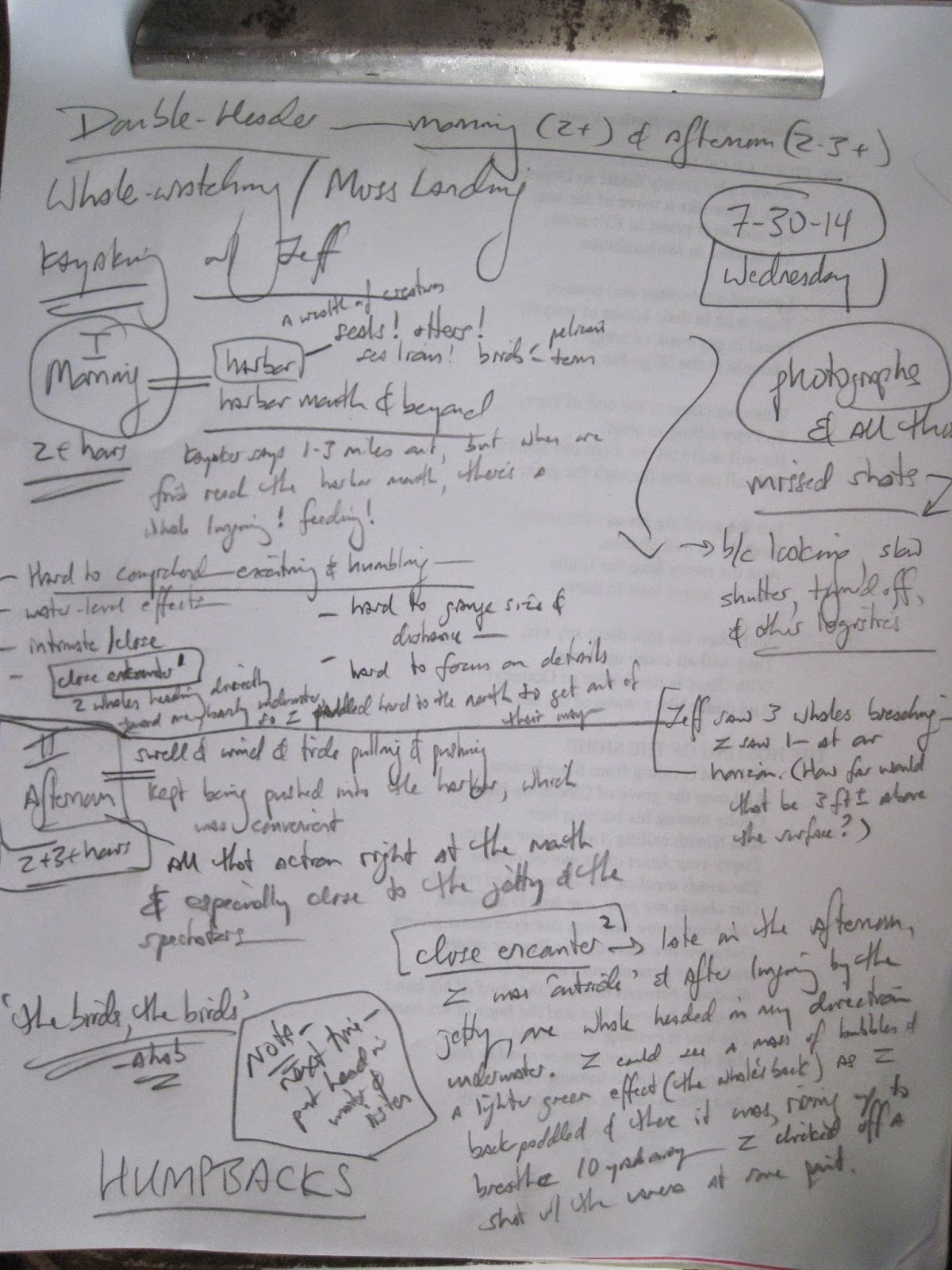
Notebook: Whale-Watching / Kayaking


1.  I will have to set aside the camera a bit more deliberately to engage my whole sight and other senses.    Next time around.  The camera itself, turning it on, fussing with zooming and focusing, really narrows the experience.  I love having the shots to document and to spark memories, but I want to look and see more fully in the moment.

2.  The experience really was rooted in wet neoprene, in the seat of the wetsuit, in the motion of the swell under the kayak, in the lifting and the dropping and the shifting and the pulling and the pushing.  On the afternoon of the 30th, the tug was back into the harbor, but the swell was rising and the wind had created chop, so there was a constant motion -- up down thisway thatway-- that the morning had lacked, had been so flat and calm.  I love the water movement, and the sit-on-top is so well-crafted to ride such movements.  Even now, two days later, if I just sit and unfocus, I am moving in my mind with residual body sense-memories.  A lovely sensation to me.

3.  Then, besides the emphatic floating quality, the sounds!  So many birds flying, shrieking, calling, ker-plunking into the water after the anchovies.  Pelicans and terns and murres and cormorants and classic gulls.  Terns and pelicans out with us, mostly.  Then, the barking of sea lions in the distance, the splashing of seals nearby, the crunching-lunching of otters.  The chatter of humans: excited, agitated, inane.  "HOLY SHIT" were the first words out of one fellow's mouth, as he rounded the small point to leave the harbor only to be faced with a lunging whale.  (That fellow was off his game, more nervous than his date, and he shadowed JP and me off and on, nervously.  Still, such caution in such a situation is no bad thing, and his date may have been more water-savvy -- or simply oblivious -- than he was.)  The whales' spouting, blowing, and splashing.  Occasionally, the power station would let out great blasts of steam that would mimic the whale spouts--and would confuse me, for a moment, as I looked for that other whale.  The water made the most noise and the most noises, lapping and slapping and splashing and crashing along and onto the jetty, the kayak, the whales, itself.

Monday, November 12, 2012

Barry Lopez: "River Notes" and Questing


I have been crippled by my age, by what I have known, as well as by my youth, by what I have yet to learn, in all these inquiries.  It has taken me years, which might have been spent (by someone else) seeking something greater, in some other place.  I have sought only you.  Enough.  I wish to know you, and you will not speak.  

--Barry Lopez,
from River Notes: The Dance of Herons

I can't say enough how much this slim volume mattered, how much it made complex, made even more emotional and even more intricately verbal my relationship with nature and story, when I first discovered River Notes in Moe's Books of Berkeley, CA, so long ago in 1980.

On this recent rereading -- and River Notes is a book I reread more or less each year, haphazardly, piece by piece over all the months of the year -- I realized how much his chapter "The Salmon" prepared me for the art and artistry of Andy Goldsworthy and for so many of my own efforts in clay amidst sea and creek.

I've witnessed this writer giving a talk and reading one of his stories at least once --"The Mappist," at the Donna Seager Gallery in San Rafael -- and I took this rather intimate opportunity (such a small venue, a somewhat select gathering) to thank Barry Lopez for his body of work.  I'm glad I overcame my natural diffidence to do so.

The passage above spoke to me when I was a mere youth, not even 20, and speaks to me now, a bit over 50.  I like the appositive defining of age in terms of knowing, in terms of what we don't understand and of what we do, as well as the sad, even bitter tone.  Loss breathes through the passage, through most of the book, and Lopez's voicing of that theme, that truth, caught my ear, and the ear of my soul (if you will), even if I didn't--perhaps, still don't--truly understand wherein that sense of loss resides, takes form.  Recently, I have read an interview with Barry Lopez in which he reveals that the writing of River Notes, though a sequence of fictional narratives, was deeply informed by the death of his mother.

The book takes us from the seaside, the mouth of the river, upstream until we reach the headwaters, the source.  The last chapter, be warned, is entitled "Drought."  I'll hold off saying more, for I'd rather awaken curiosity and intimate mystery.  I have taught two chapters in particular a dozen times, I think: "The Bend" and "The Rapids."  Here's another passage from "The Salmon":

There is never, he reflected, a moment of certainty, only the illusion.   And as he worked among the rocks in the middle of the river he thought on this deeply, so deeply that had his movements not been automatic he would have fallen off the rocks and into the river and been borne away.

In the summer light, even with the coolness of the water welling up around him in the air, thinking was all he was capable of; and this distraction left him exhausted and unbalanced so that at the end of the day the physical exhaustion he felt was something he lowered himself into, as into a hot bath.  He pondered gentleness often.  And he tried to pry (hefting the stones, conscious of the resonance between the idea in his mind and the work of his hands) into mysteries which remained as implacable as the faces of the stones.


Thank you, again, Barry Holstun Lopez.

River Notes: The Dance of Herons
A Bard Book / Avon Books: New York,  November, 1980.

Voyage-charm: sculpture mix; floating blue glazing; matte finish.   

Saturday, June 2, 2012

Postcard: A Desktop View


Office art, tools, toys, and memory bottles and jars.

You've heard of comfort food; here, I offer comfort clutter.

Can you spot the red devil-duck?

Oh, and that bit of string is left over from the English 1B final exam in which tying and properly labeling a knot from Proulx's "The Shipping News" earned extra credit. Closed book, of course.