Literature and the Aquatic Environment: Study and Exploration
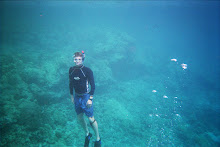
My time away from the classroom--filling my days with words, water, and clay--has been a great success. I am healthier, wiser, more skilled, and more committed to bringing all that I can to the classroom. This past semester on sabbatical has been full of activities, in and out of doors: reading and rereading, of course; attending marine biology lectures and learning proper organism identifications; refining my skills as a diver; kayaking up and down the coast; beachcombing and aquarium-browsing; counting and measuring abalone and other organisms in scuba field trips with the Biology 32 class as scientific method-acting; diving alongside more experienced divers, talking with them, reaping the rewards of their observations and know-how.
Also, I've dug into my local history with Sir Francis Drake's 1579 summer visit to the Marin coast, exploring all the probable sites for his landing and repairing of his ship, using my kayak to check out Drake's Bay, Drake's Estero, Bolinas Lagoon, and so forth. Time on the water and at the water’s edge always brings me closer to the creatures and the environment, brings the pages of the history books and marine biology guides to life. I have missed the classroom, but I have relished the opportunity to improve myself and future courses.
In addition to the more obvious aquatic activities and research, I enrolled in sculpture classes during my sabbatical, exercising that other side of the brain, working with models and imagination, not only aiming at improving my accuracy and expressiveness with the clay, but also aiming at that greater awareness of the student experience. Teachers, standing at the front of the room, often forget what it means and what it takes to be a student. By putting myself in the position of the learner, I remind myself what good teaching, good direction, really means. I think both the crafting with clay and the reflecting on the teacher/student dynamic will prove fruitful as I continue to hone my own self, my own practices, as a teacher.
My first Sabbatical Report offered an annotated bibliography of 129 nonfiction texts associated with marine biology, oceanography, history, fisheries and fisheries management, oceanic exploration and survival, and aquatic sports: swimming, diving, and surfing, often with an emphasis on the California Coast. For the second part of the sabbatical project, I had originally proposed creating a course outline for an English elective: Literature and the Aquatic Environment. (I envisioned parallel courses with elemental unification and focus: Earth, Air, and Fire to go with my Water focus. I have colleagues who would love to teach “Literature and the Desert Environment” and “Literature and the Urban Environment,” actually.) When I started digging further into developing an elective for my specialized field of study, I realized some rethinking was called for.
While the first Sabbatical Report emphasized the “Literature,” the second Sabbatical Report emphasizes “the Aquatic Environment” and offers a summary of my work and explorations during the Fall 2009 semester on behalf of improving my teaching of English nonfiction courses. When I reflect on the past semester, on the past year and a half of the full sabbatical, I can’t help but recollect a passage written by John Steinbeck’s friend Edward Ricketts in the masterful Between Pacific Tides. Ricketts describes how tough marine snails have to be to survive in the “Uppermost Horizon” of the surf zone, and he shares how the quality or quantity of toughness in the snail was something learned accidentally, by inadvertent experimentation followed by appropriate observation. Consider:
We once subjected a specimen to a shorter but even more severe test; we fed it to a sea anemone (Metridium). There was no intention, however, of testing Littorina’s endurance; we merely wished to feed the anemone something to keep it alive in captivity, and assumed that its powerful digestive juices would circumvent the difficulty of the shell. The anemone swallowed the snail promptly, and our expectation was that in due time the empty shell would be disgorged. But it was an intact and healthy Littorina that emerged, like Jonah, after a residence of from 12 to 20 hours in the anemone’s stomach. When first discovered, the disgorged snail was lying on the bottom of the dish, and since it must have been in some doubt as to just where it was, its shell was still tightly closed. When it was picked up for examination, however, it showed signs of life; and after being returned to the dish, it crawled away at its liveliest pace. It had apparently suffered no harm whatever, but its shell was beautifully cleaned and polished. (19)
Has my shell been cleaned and polished? No, that’s not the parallel I want to draw, though some of the conditions diving the Sonoma and Mendocino County coasts can be quite trying. I’ve had to learn how to wedge myself into rocky, spiny crevices in order to count and measure abalone in a fierce surge. Or, diving Pt. Lobos in December may be brutally cold topside, changing out of wet gear in a freezing wind, but this past December’s outing proved mild and enjoyable, though the visibility underwater hardly made creature counting easy.
Ricketts ended up with a very precise appreciation for the protective qualities of the snail’s operculum through the accidental experiment, and that sharing of the learning process has always resonated for me. Learn by doing; make experiments, yes, but stay attuned to what really happens: those are the lessons I took to heart. Ricketts was focused on feeding the anemone, but he learned about the anemone and about the snail by responding to what actually happened. The “experiment” evolved, and this sabbatical project of mine has evolved too. Quite frankly, I had read at least one hundred books beyond the 129 annotated in my first Sabbatical Report and I had spent so much time reading and reflecting that I was quite ready for some fieldwork.