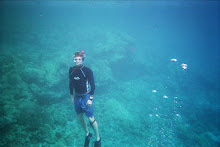
The other night, I had one of my recurring dreams that I have a secret office at Berkeley, usually a closet of a space that locks, which somehow is always overlooked, and I just work there or ruminate there or drink there. I only have the dream once or twice a year, but I've visited that office off and on for, oh, 20 years now.
(Back in the early 1990's, for a few scattered semesters, I had solo-access to a quite nice office in Wheeler Hall due to the kindness of my dissertation director, but the dream-office is never quite that space, not usually quite that nice either.)
In this latest episode, the usual closet-office had morphed into a suite that I (a not-quite-me -- you know: dreams) . . . that I was squatting in, only to get busted out when a new hire showed up expecting to inhabit the place. She was not very happy about yours-truly, and as I was throwing books and clothes and gear into a rollie, I woke up.
I wonder if that's my last visit to campus.
Showing posts with label Exile. Show all posts
Showing posts with label Exile. Show all posts
Tuesday, September 22, 2015
Saturday, December 21, 2013
Recommended Reading: Nicola Griffith's "Hild"


Friday, December 20, 2013
"The Wanderer": Burton Raffel Translates From The Old English
THE WANDERER
This lonely traveller longs for grace,
For the mercy of God; grief hangs on
His heart and follows the frost-cold foam
He cuts in the sea, sailing endlessly,
Aimlessly, in exile. Fate has opened
A single port: memory. He sees
His kinsmen slaughtered again, and cries:
“I’ve drunk too many lonely dawns,
Grey with mourning. Once there were men
To whom my heart could hurry, hot
With open longing. They’re long since dead.
My heart has closed on itself, quietly
Learning that silence is noble and sorrow
Nothing that speech can cure. Sadness
Has never driven sadness off;
Fate blows hardest on a bleeding heart.
So those who thirst for glory smother
Secret weakness and longing, neither
Weep nor sigh nor listen to the sickness
In their souls. So I, lost and homeless,
Forced to flee the darkness that fell
On the earth and my lord.
Leaving everything,
Weary with winter I wandered out
On the frozen waves, hoping to find
A place, a people, a lord to replace
My lost ones. No one knew me, now,
No one offered comfort, allowed
Me feasting or joy. How cruel a journey
I’ve traveled, sharing my bread with sorrow
Alone, an exile in every land,
Could only be told by telling my footsteps.
For who can hear: “friendless and poor,”
And know what I’ve known since the long cheerful nights
When, young and yearning, with my lord I yet feasted
Most welcome of all. That warmth is dead.
He only knows who needs his lord
As I do, eager or long-missing aid;
He only knows who never sleeps
Without the deepest dreams of longing.
Sometimes it seems I see my lord,
Kiss and embrace him, bend my hands
And head to his knee, kneeling as though
He still sat enthroned, ruling his thanes.
And I open my eyes, embracing the air,
And I see the brown sea-billows heave,
See the sea-birds bathe, spreading
Their white-feathered wings, watch the frost
And the hail and the snow. And heavy in heart
I long for my lord, alone and unloved.
Sometimes it seems I see my kin
And greet them gladly, give them welcome,
The best of friends. They fade away,
Swimming soundlessly out of sight,
Leaving nothing.
How loathsome become
The frozen waves to a weary heart.
In this brief world I cannot wonder
That my mind is set on melancholy,
Because I never forget the fate
Of men, robbed of their riches, suddenly
Looted by death—the doom of earth,
Sent to us all by every rising
Sun. Wisdom is slow, and comes
But late. He who has it is patient;
He cannot be hasty to hate or speak,
He must be bold and yet not blind,
Nor ever too craven, complacent, or covetous,
Nor ready to gloat before he wins glory.
The man’s a fool who flings his boasts
Hotly to the heavens, heeding his spleen
And not the better boldness of knowledge.
What knowing man knows not the ghostly,
Waste-like end of worldly wealth:
See, already the wreckage is there,
The wind-swept walls stand far and wide,
The storm-beaten blocks besmeared with frost,
The mead-halls crumbled, the monarchs thrown down
And stripped of their pleasures. The proudest of warriors
Now lie by the wall: some of them war
Destroyed; some the monstrous sea-bird
Bore over the ocean; to some the old wolf
Dealt out death; and for some dejected
Followers fashioned an earth-cave coffin.
Thus the Maker of men lays waste
This earth, crushing our callow mirth.
And the work of old giants stands withered and still.”
He who these ruins rightly sees,
And deeply considers this dark twisted life,
Who sagely remembers the endless slaughters
Of a bloody past, is bound to proclaim:
“Where is the war-steed? Where is the warrior?
Where is his war-lord?
Where now the feasting-places?
Where now the mead-hall pleasures?
Alas, bright cup! Alas, brave knight!
Alas, you glorious princes! All gone,
Lost in the night, as you never had lived.
And all that survives you a serpentine wall,
Wondrously high, worked in strange ways.
Mighty spears have slain these men,
Greedy weapons have framed their fate.
These rocky slopes are beaten by storms,
This earth pinned down by driving snow,
By the horror of winter, smothering warmth
In the shadows of night. And the north angrily
Hurls its hailstorms at our helpless heads.
Everything earthly is evilly born,
Firmly clutched by a fickle Fate.
Fortune vanishes, friendship vanishes,
Man is fleeting, woman is fleeting,
And all this earth rolls into emptiness.”
So says the sage in his heart, sitting alone with
His thought.
It's good to guard your faith, nor let your grief come forth
Until it cannot call for help, nor help but heed
The path you've placed before it. It's good to find your grace
In God, the heavenly rock where rests our every hope.
--translated by Burton Raffel,
borrowed from Beowulf and Related Readings,
McDougall Littell; Evanston, Illinois; 1998.
Monday, April 9, 2012
Mermaid in Exile


 One of the first half-dozen mermaids I've made. Sculpture mix; blue, green, and grey glazing.
 I considered cleaning the dust off her, but held off. That's her fate, garage-bound. I dream of attaching her to a wharf piling and seeing if barnacles and other intertidal creatures would bond with her, but I haven't followed through on the vision.
Aside from that broken trident, she's all one hunk of clay, hair included, pulled into shape less from a sense of greater structural integrity (which she has), but more from a lack of knowledge (at the time) of how to sculpt and put together figures. All of my pieces back then were made from one hunk of clay in whatever time it took to give the figure a shape, often quite rough, before the clay became too dry, too stiff, too worked over.
She's definitely mannish, but that's how she looks. She's a warrior of the sea. I like fierceness, the Amazon face, and I like strong noses in general, anyway.
She doesn't have a name. Or, she's never gifted me with her name.
Perhaps she's too far from the water to speak such an intimacy.
Subscribe to:
Posts (Atom)