Showing posts with label Greeks. Show all posts
Showing posts with label Greeks. Show all posts
Tuesday, August 18, 2020
Tuesday, April 16, 2019

Wednesday, March 27, 2019
"Because I Know, From Plato"
I have ground up hemlock and it releases a nose-wrinkling sour smell. It also sparks a pain above your eyes and across the brain. I have never known, though, whether this is psychosomatic. Because I know, from Plato, what hemlock can do.
--Bettany Hughes,
The Hemlock Cup:
Socrates, Athens and the Search for the Good Life


Saturday, June 2, 2018
Homer's Iliad: Anti-Indoctrination
Reading Homer’s Iliad is anti-indoctrination. Is Homer praising war and heroism or questioning their value? Is Homer advocating for the gods or calling faith in Zeus and his family into question? Is Achilles or Hector the true heroic model? Both? Neither?
Aside from the urgent questioning, we are given urgent empathy as well. The Trojans, the putative enemies, are not the Other, but they are brothers and mothers, fathers and sisters. All are mortal, and wrath is understandable, but not entirely justifiable in action and effect.
Read Homer’s Iliad and be mortal in the best sense.

Thursday, October 26, 2017
What Archilochos Said
"Greet insolence with outrage."
----------Archilochos,
one of those--his--fragments in Guy Davenport's translation from the Classical Greek.
What Archilochos Said:
four words that have worked well in class, provoking good discussions of diction, denotation, connotation, and character study.
So much in four words. Just think of what's said, what's signaled, with that choice of "greet" instead of "meet" or "match" or "return".
I must admit I have a qualm or two about the violence in the lines, but then we--our spirits, the collective consciousness--do need rousing in these times.

Tuesday, June 14, 2016
"When the Ancients Speak"
In a lecture given at Oxford, Wilamowitz said: 'To make the ancients speak, we must feed them with our own blood.' When the ancients speak, they do not merely tell us about themselves. They tell us about us. They do that in every case in which they can be made to speak, because they tell us who we are. That is, of course, the most general point of our attempts to make them speak. They can tell us not just who we are, but who we are not: they can denounce the falsity or the partiality or the limitations of our images of ourselves. I believe they can do this for our ideas of human agency, responsibility, regret, and necessity, among others.
--Bernard Williams
from Shame and Necessity (pages 19-20)
Here's the link to the book itself from UC Press.
Sunday, March 3, 2013

Friday, January 4, 2013
Mateo: Three Faces (Naked, Hoplite, Diver)

Mateo in Morning Light.
As with living humans, that light can show nakedly the signs and emblems of age.
I think I did a fair job of capturing some of me at fifty, though in other ways this piece is a younger me and/or not me quite at all. (If that's confusing, that's the Gemini coming through.)
Piece sculpted in a Self-Portrait Class: Summer 2011.
I've posted shots of this figure in the past on this blog.
Hit the "Mateo" label-link below to see the other shots and commentary, if you'd like.

Mateo as Hoplite / Greek Warrior.
I use the helmet as a visual aid, seriously and/or humorously, when teaching Homer's epics or any of the Greek tragedies.

Mateo: Free Diver.
That's an old mask from the '80s. Note the side ports for greater range of vision while diving.
This particular mask I picked up and gave to my father to encourage him to swim laps. He didn't like the feel of standard swim goggles, so I suggested such a mask. When he didn't pick one up for himself, I made a gift of this one. I don't think he ever used it more than once or twice, at best.
Mateo: sculpture mix; denim glazing, poured over and mostly wiped off.
For the record, I'm not crazy about the end results here, but making this piece -- the largest single clay piece I've ever made -- has taught me much, not least about envisioning outcomes and artistic control. The pallor is slightly disturbing, and the shininess of the blue seems just a bit too much. I am not sure what I had expected or imagined when I glazed the piece. And yet, Mateo strikes me as a very undersea fellow, as a merfolk stand-in, which seems quite suitable too.
Saturday, November 3, 2012
"You Too Are Mortal"

More appropriately, The Humble Potter's Handiwork. Or, Look Ma, Hands of Clay!
Ugly pot.
I let this one dry too much before trying to trim it, and then I failed to secure it properly to the wheel so that it went flying off during that belated attempt at trimming, though I did catch it on the bounce. You can see stoneware clay improperly mixed with this Navajo wheel /stoneware hybrid at the rim, a failed stamp on the side, and that odd, flawed bottom.
I did manage to put a decent foot (that you can't see). The glazing will be a crucial step.
Just a run of the mill off-piece, truth to tell. I like to try to save such pieces too.
***A reliable source nudges me towards the Romans and the triumph as the source of the memento mori.
(I thank EHS and trust the correction -- of course, of course -- but I also continue to resist checking, despite how easy that would be in this day and this age. There's a perverse pleasure in quoting or citing from memory.)
Tuesday, August 7, 2012
"Kindness Flows": More From Archilochos

In time of shame,
Can you spare me the evil?
Kindness flows both ways.
Woman, woman,
Why do you keep me here,
Why this road, of all,
And why do you care at all?
----------
How many times,
How many times,
On the gray sea,
The sea combed
By the wind
Like a wilderness
Of woman's hair,
Have we longed,
Lost in nostalgia,
For the sweetness
Of homecoming.
----------
There's nothing now
We can't expect to happen!
Anything at all, you can bet,
Is ready to jump out at us.
No need to wonder over it.
Father Zeus has turned
Noon to night, blotting out
The sunshine utterly,
Putting cold terror
At the back of the throat.
Let's believe all we hear.
Even that dolphins and cows
Change place, porpoises and goats,
Rams booming along in the offing,
Mackerel nibbing in the hill pastures.
I wouldn't be surprised,
I wouldn't be surprised.
--Archilochos
from Guy Davenport's 7 Greeks: Translations,
A New Directions Book: New York, 1995.
Illustration: outtake from the previous blog entry: "Water Bowl".
Saturday, June 30, 2012
Fragments From Bacchylides
Though Honor shifts to any shape,
And man's skills cannot be told,
One outranks them all: the mind
Discretion moves to what's at hand.
----------
Yet resilient Theseus
Did not flinch:
Poising tall
On the planked deck,
He dived an arc
To his welcome warm
In the sea's glades.
Minos, bit to the quick . . . .
----------
Works of the gods are wonders
Seaworthy men confirm.
----------
This for the last time:
Profit can crush
Profoundest minds.
----------
One writer picks another's brains--
Call it tradition:
Taking the gates of a new song
Is no small job.
----------
One criterion, one approach
Leads on to man's success:
The soul that sees out
Life in self-delight.
Who hounds his wits
At the heels of crowding cares
And pummels his mind with what's to come,
Drives dead work through the days and nights . . . .
Throttle your heart with sorrow,
All the gladness dies.
----------
. . . when she curves that smooth arm,
And flicks some wine at the saucers--
Just with a neat turn of her wrist--
Our flute-girl serves her bachelors.
----------
Never underhand,
The words that Wisdom
Resonates in man.
----------
The gifts of the Muses,
Goals of a hard campaign,
Do not surrender
To all who handle arms.
----------
*Bacchylides was a Greek poet of the fifth century B.C. You can find these fragments and more with an appropriate scholarly treatment in . . .
Bacchylides, Complete Poems,
Translated, with a Note to the New Edition, by Robert Fagles,
With a Foreward by Sir Maurice Bowra,
Introduction and Notes by Adam M. Parry,
Yale University Press: New Haven & London,
1998.
 Hektor: sculpture mix, pit-fired.
(The red is from kelp-wrappings before I put the piece into the pit, I'm fairly sure.)
And man's skills cannot be told,
One outranks them all: the mind
Discretion moves to what's at hand.
----------
Yet resilient Theseus
Did not flinch:
Poising tall
On the planked deck,
He dived an arc
To his welcome warm
In the sea's glades.
Minos, bit to the quick . . . .
----------
Works of the gods are wonders
Seaworthy men confirm.
----------
This for the last time:
Profit can crush
Profoundest minds.
----------
One writer picks another's brains--
Call it tradition:
Taking the gates of a new song
Is no small job.
----------
One criterion, one approach
Leads on to man's success:
The soul that sees out
Life in self-delight.
Who hounds his wits
At the heels of crowding cares
And pummels his mind with what's to come,
Drives dead work through the days and nights . . . .
Throttle your heart with sorrow,
All the gladness dies.
----------
. . . when she curves that smooth arm,
And flicks some wine at the saucers--
Just with a neat turn of her wrist--
Our flute-girl serves her bachelors.
----------
Never underhand,
The words that Wisdom
Resonates in man.
----------
The gifts of the Muses,
Goals of a hard campaign,
Do not surrender
To all who handle arms.
----------
*Bacchylides was a Greek poet of the fifth century B.C. You can find these fragments and more with an appropriate scholarly treatment in . . .
Bacchylides, Complete Poems,
Translated, with a Note to the New Edition, by Robert Fagles,
With a Foreward by Sir Maurice Bowra,
Introduction and Notes by Adam M. Parry,
Yale University Press: New Haven & London,
1998.

(The red is from kelp-wrappings before I put the piece into the pit, I'm fairly sure.)
Thursday, June 28, 2012
"The Wake Of The Rudder": Seferis' Argonauts
IV. ARGONAUTS
And for the soul
If it is to know itself
It is into a soul
That it must look.
The stranger and enemy, we have seen him in the mirror.
They were good lads, the comrades. They did not grumble
Because of weariness or because of thirst or because of frost.
They had the manner of trees and the manner of waves
That accept the wind and the rain,
Accept the night and the sun,
And in the midst of change they do not change.
They were good lads. Day after day with downcast eyes,
When we passed the desert island with the Arabian figs,
Towards the setting of the sun, beyond the cape
Of dogs that howl.
If it is to know itself, they used to say,
It is into a soul it must look, they used to say.
And the oars beat on the gold of the sea
In the middle of sunset.
Many the capes we passed, many the islands, the sea
Which brings the other sea, sea-gulls and seals.
There were times wheen unfortunate women with lamentations
Cried out for their children gone,
And others with wild faces looked for Great-Alexander
And glories sunken in the depths of Asia.
We anchored by shores steeped in nocturnal perfumes
Among the singing of birds, waters that left on the hands
The recollection of a great good fortune.
But there was never an end to the journeys.
Their souls became one with the oars and the rowlocks,
With the severe figurehead at the prow,
With the wake of the rudder,
With the water that fractured the image of their faces.
One after another the comrades died
With downcast eyes. Their oars
Indicate the places where they sleep on the shore.
There is none to remember them, and the word is Justice.
--George Seferis,
From "Mythistorema"
George Seferis, Poems: Translated from the Greek by Rex Warner,
Little, Brown and Company: Boston and Toronto, 1964

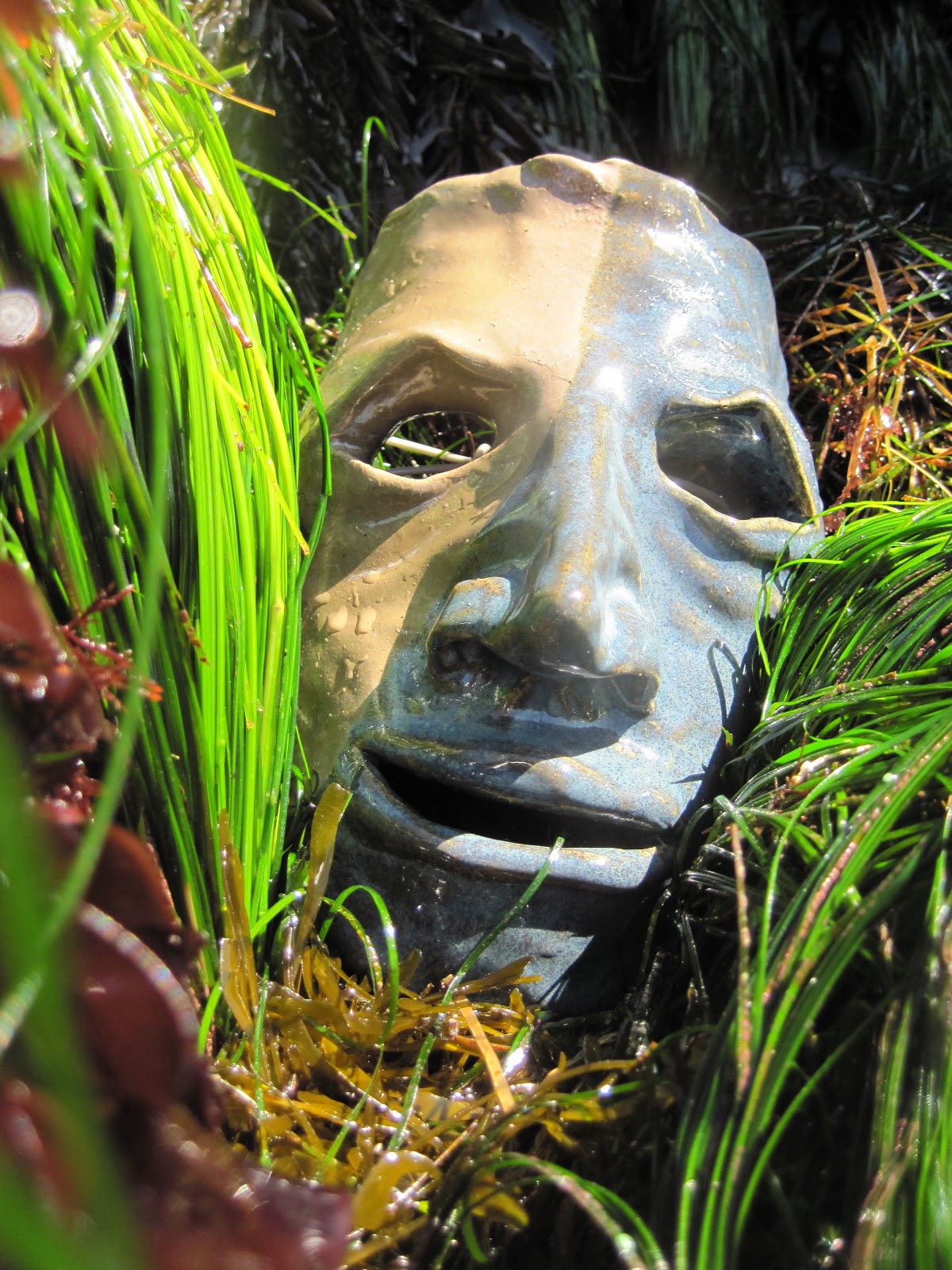
Mask: Triton, sculpture mix, tan and blue glazing, layered.
In the poem above, the voice would seem to be that of Jason, captain of the Argo, leader of these Argonauts. What roles can we see here? What relationships between this captain and this crew? And what of the final epitaph? Or, is that last line only comprehensible in terms of the opening reflections on soul?
Dramatic monologues, after all, offer skewed and resonant visions dependent upon the character and experience of the speaker in the moment of speaking. Where are you, Jason? When are you? Has Medea killed your children yet for the mistakes you (will) make? Have you lost your gamble for kingship again? Have you been looking into the mirror too long? Why "we", really?
And where is Medea in all this? But that and she may belong to another poem, another musing.
Friday, June 1, 2012
Sunday, May 6, 2012
MUSE
Across the pale stillness
of water keel-carven, these lovely eyes of desire
drag the ship to her doom.
--Simonides of Ceos
(translated by Richmond Lattimore)
-- I like the description, the phrasing and the images themselves, but I also like the paradox. The water is calm, and yet the ship goes to its doom.
All for love, or desire, which isn't the same thing, is it? --

(TV screen-shot from John Stockwell's Into the Blue.)
Somehow, this juxtaposition is working for me, though perhaps an eye-to-eye shot of Sophia Loren would work well too: Boy On A Dolphin.
Sunday, April 22, 2012
Archilochos: Grains of Salt
Three Pieces from Archilochos, the ancient Greek poet, translated by Guy Davenport:
With ships so trim and narrow,
Ropes fast and sails full,
I ask of the gods that
Our comrades have a wind too,
That they meet neither tall wave
Nor reef.
All fortune be with them.

Let us hide the sea-king's gifts,
The wrecked dead Poseidon brings.

Their lives
Held in the arms
Of the waves.
--Archilochos
from Guy Davenport's 7 Greeks,
A New Directions Book: New York, 1995.
(I've posted shots of this sculpture in the past here.)
Saturday, March 24, 2012
Not That Nisus
In the ninth book of his Aeneid, the Roman poet tells the tale of two friends, Nisus and Euryalus, who volunteer to deliver a message from the besieged main camp of the Trojans to Prince Aeneas himself, exploring and seeking allies in the Italian countryside. Aeneas' son Ascanius entrusts the two friends to find his father, their commander, and attest to the peril facing the camp. Unfortunately, the two Trojans are distracted from their mission by bloodlust and the lure of glory, and they stop to slaughter some sleeping Italian warriors. The younger Euryalus is seized after the moonlight gleaming off the helmet he'd taken for a prize gives him away, though Nisus has gotten free and could continue on his mission. He does not continue, but returns, wanting to free his younger friend. Nisus throws a spear at one of the warriors holding Euryalus, killing the man, but the Italian leader kills Euryalus in retaliation. (What else was likely?) Tormented by the death of Euryalus, Nisus then rushes in suicidally. The Italians cut him down and take both Trojans' heads as trophies.
Virgil calls forth Homer's very successful night-foray by Odysseus and Diomedes, catching the spy Dolon and slaughtering Rhesus and his company in their sleep, from The Iliad, and he recasts that episode into a fairly obvious fiasco with sentimental and sentimentally ridiculous overtones. Euryalus' mother's speech about the loss of her son and the brutality of war is moving, but the men are still dead. Later readers and writers have appreciated the martyrdom of the two Trojans, casting this episode as sentimentally heroic. Others have seen this episode as Virgil's clear commentary on Homeric pride and selfishness, on Greek "glory", in contrast to the more Roman virtue of honorable duty: Nisus and Euryalus acting as stand-ins for, say, Achilles and Patroclus. Virgil, being Virgil, all is possible, at once. To me, the effect of the episode is complex, morally and emotionally, more complex than I can easily explain. (I may attempt to better this treatment in a future blog entry.)

I've always been drawn to a key question that Nisus raises, which I offer in the English translation of Robert Fitzgerald: "This urge to action, do the gods instil it, / Or is each man's desire a god to him, / Euryalus?" What is the source of motivation? Of desire? And, where does it come from? Is it an external force or purely internal, however we dress it or explain it to ourselves? "This urge to action": the older I've gotten, the more complex my sense of motivation and drive. And yet often what drives us is simple, dress it up as we like. Still, for every action, the riddle of motivation, and only each one of us can truly understand the internal or external forces involved. That's my comforting--sometimes discomforting--fiction, anyway.
For some odd reason, I've always wondered What If Nisus Had Not Died Beside His Friend? What if Nisus survived the ill-conceived, luckless night-foray? Would he be haunted by his friend? Would he be haunted by guilt and remorse?
Back in the mid-90's, I started making notes for stories involving this Nisus-who-survives, casting him as a fugitive moving through southern Italy and the Greek isles to return to Troy, an exile masquerading as a fisherman and a sponge-diver. In my imagination, he gets caught up in Odysseus' scheme to salvage Greek ships sunken in storm on the way home laden with Trojan gold and other treasures. Does Odysseus realize that Nisus is a Trojan, a blood enemy, and if he does, does he care?
Back then, I also wrote the following poem, which I recently rediscovered.

NOT THAT NISUS
"I thought you were dead,"
The old ghost said,
The familiar boy with the helm
Too great for his head.
His arms so unsteady--
Yet his voice readily refrained--
"That you'd fallen with me,
That your devotion I'd gained."
"But I'm not that Nisus,"
The clay-gray dreamer denied.
"Not that epic figure, that hero--
If I were, I'd have died.
When you fell to the foe
Like the rose to the plow,
That Nisus was striving--
Scything Fortune knows how."
"I'll return with the night,"
Swore the young warrior at dawn.
But old Nisus had known
That he'd not slumber long
Without the bronze forms of fright
Cast into shadows of shame:
Marked by the might
Still sculpting his name.
--Matt Duckworth

Saturday, May 14, 2011
Green's Sappho: Imagination and Desire

It is easy to forget, also, how large a part of any poet's emotional life is conducted in the mind and the imagination --so much more real, for him, than the world of physical appearances, so tangible that he will slide at will from the real to the imaginary until, in the end, there is no clear frontier between them. The passions which stirred me were embodied in this secret world, this dream-dominion of pure, silver-clear, crystalline adoration, so that my creative imagination could dwell on some loved face or body and, in fantasy, find fulfillment there without disturbing the delicate balance of unknowing which governed my conscious thoughts. I burned, yet the fire was contained, transmuted. As I grew older, inevitably, the perilous frontier between desire and knowledge became less distinct; this was the time of nightmare, of knowing-and-not-knowing, when, waking, I closed my eyes deliberately to what my mind understood, but refused to accept. It is not hard to understand, now, that state of latent, unexplored desire which had so instantaneous and devastating effect on Chloe.
--from Peter Green's excellent novel on Sappho: The Laughter of Aphrodite.
Subscribe to:
Posts (Atom)