Showing posts with label Sublime. Show all posts

Thursday, August 9, 2018

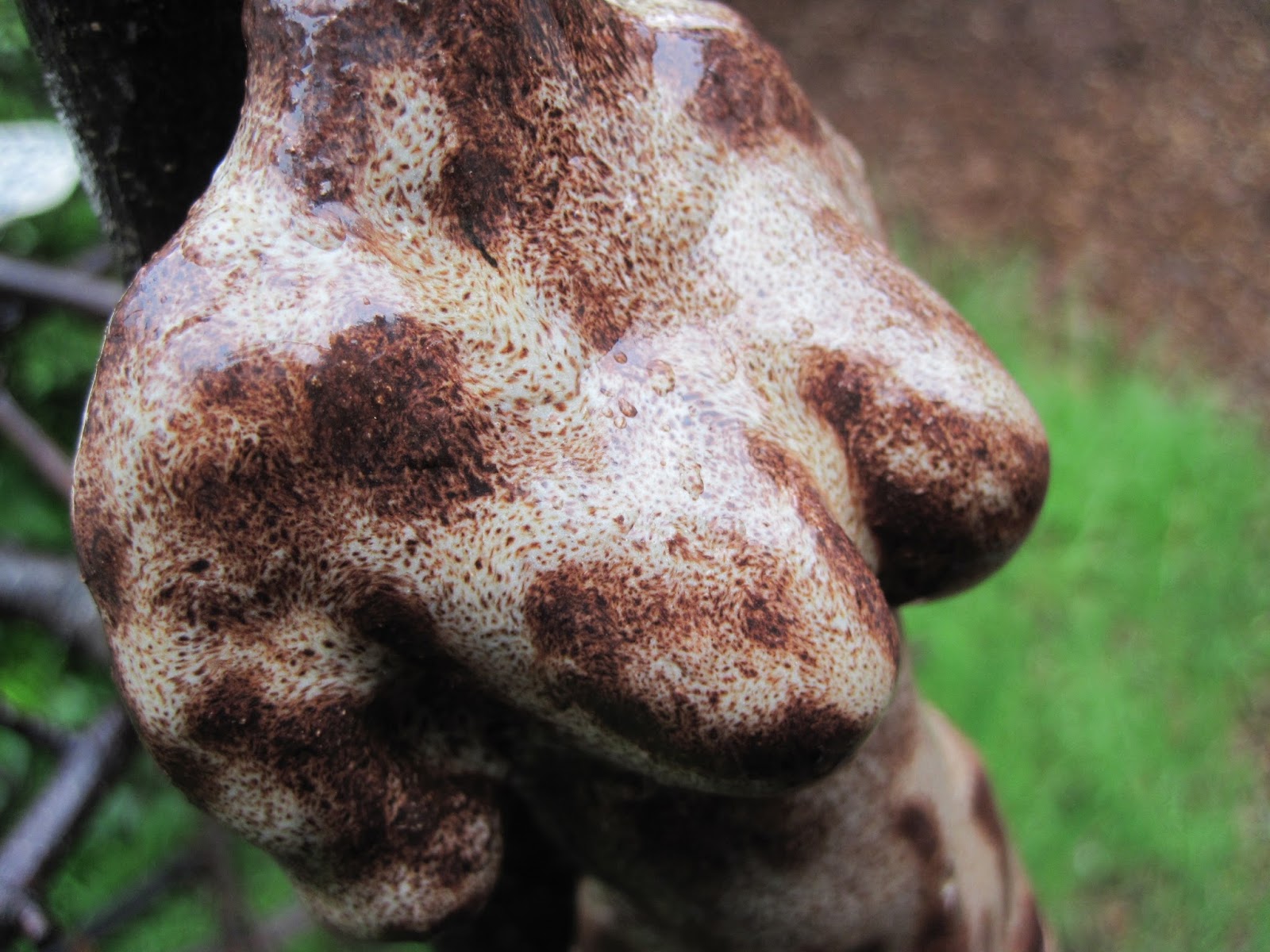
Mask on a Mollusk: Musings


Friend:  'Splain, please.

Me:      I don't know if I can.  

I like putting my clay--pottery and sculpture--out in nature, especially water--and taking photos, aiming to capture something evocative or expressive.  Sometimes I have very specific artistic goals; sometimes I'm goofing or experimenting.  The results have ranged from the silly to the sublime--as you can see if you examine the many such shots I've included in this blog--and sometimes I've wanted the silly or the sublime, depending on mood and interest.  My main approach is intuitive.

("The Door" or "The Drowned Man" series are among the most successful postings, I think.)

Art involves expression and exploration, and these pieces allow me to experiment.  My recent "Frog-Man II" captures loss and longing, I'd argue, in the juxtaposition of the situation I placed my sculpture in, that natural setting ten feet beneath the surface, with the specific features and expression I'd sculpted into that particular clay-face, that specific clay-head.

I think about displacement.  Artist Jay Trinidad wrote to me about how art works:

"Art works by displacing.  I think displacement is an essential element.  It needs to pitch you out of your own experience."

JT works more ethically, more in the veins of social justice and sheer beauty, than I do, but one element of my work would have to be displacement, surprising you with the clay, the worked clay, in the natural settings.  Perhaps that surprise catches you -- makes your footing just a bit uneven, makes you laugh at the absurdity or boneheadedness of what I do --catches you enough to slip inside, to spur or spark a reaction or a recognition in the face of oddity or silliness or some deeper emotion.  Sometimes, my pieces are illustrative, meant to tell a story, sure, but also to highlight the natural environment, and my clay contribution would subside in terms of attention.  Other times, I am seeking an emotional recognition.  Many of my pieces are sad, I think, for grief is one of the deepest feelings I know.  Others are enhanced, made better, by the watery environment.  A bowl in a stream is just clay in water, but it is also, perhaps, an offering to beauty, to the muses.  A mask on a mollusk is a slightly different offering.

And there are nine muses, each with a different temper and temperment.

I try to please each and every one of them.


Visage:
Silverstone clay;
Oribe & Abalone glazes;
leather cord--
and assorted kelp forest denizens.


Friday, April 15, 2016

Whiskey Friday


Or, The Devil Is In The Details

Body English:
sculpture mix; transparent brown and shino glazing.
20-minute exercise.

Tuesday, March 29, 2016

Body English: Musings on the Beautiful and Sublime


Let's quote Edmund Burke on "Gradual Variation":

BUT as perfectly beautiful bodies are not composed of angular parts, so their parts never continue long in the same right line.  They vary their direction every moment, and they change under the eye by a deviation continually carrying on, but for whose beginning or end you will find it difficult to ascertain a point. The view of a beautiful bird will illustrate this observation. Here we see the head increasing insensibly to the middle, from whence it lessens gradually until it mixes with the neck; the neck loses itself in larger swell, which continues to the middle of the body, when the whole decreases again to the tail; the tail takes a new direction; but it soon varies its new course: it blends again with the other parts; and the line is perpetually changing, above, below, upon every side.  In this description I have before me the idea of a dove; it agrees very well with most of the conditions of beauty. It is smooth and downy; its parts are (to use that expression) melted into one another; you are presented with no sudden protuberance through the whole, and yet the whole is continually changing. 

Observe that part of a beautiful woman where she is perhaps the most beautiful, about the neck and breasts; the smoothness; the softness; the easy and insensible swell; the variety of the surface, which is never for the smallest space the same; the deceitful maze, through which the unsteady eye slides giddily, without knowing where to fix or whither it is carried. Is not this a demonstration of that change of surface, continual, and yet hardly perceptible at any point, which forms one of the great constituents of beauty? 


Selections from A Philosophical Inquiry into the Origin of Our ideas of the Sublime and Beautiful.
-- from Part II: Section XV, in particular

Edmund Burke, 1757.

Sunday, December 7, 2014

Tennyson: "The Kraken" and "Sonnet"

Two sonnets from Tennyson:

THE KRAKEN
Below the thunders of the upper deep;
Far, far beneath in the abysmal sea,
His ancient, dreamless, uninvaded sleep
The Kraken sleepeth: faintest sunlights flee
About his shadowy sides: above him swell
Huge sponges of millennial growth and height;
And far away into the sickly light,
From many a wondrous grot and secret cell
Unnumbered and enormous polypi
Winnow with giant arms the slumbering green.
There hath he lain for ages and will lie
Battening upon huge sea-worms in his sleep,
Until the latter fire shall heat the deep;
Then once by man and angels to be seen,
In roaring he shall rise and on the surface die.
          --Tennyson


SONNET
She took the dappled partridge flecked with blood,
And in her hand the drooping pheasant bare,
And by his feet she held the woolly hare,
And like a master painting where she stood,
Looked some new goddess of an English wood.
Nor could I find an imperfection there,
Nor blame the wanton act that showed so fair--
To me whatever freak she plays is good.
Hers is the fairest Life that breathes with breath,
And their still plumes and azure eyelids closed
Made quiet Death so beautiful to see
That Death lent grace to Life and Life to Death
And in one image Life and Death reposed,
To make my love an Immortality.
          --Tennyson

I've always been intrigued by these two poems.   The first offers an apocalyptic vision of a mythic undersea beast that ends only in destruction.  A poem of natural wonder, of marine sublimity, ends in an expression of revelatory faith at the end of times.  Rapturous, for sure.  The second is, to my mind, a moving still-life, intriguing in itself, and yet the title emphasizes form, emphasizes the dynamic relationship of a very English, very constrained poetic structure and the seemingly unpoetic (that is, seemingly unself-conscious) scene it describes via that structure.  

I mean, "Sonnet" is obviously self-conscious, but not obviously self-conscious about its own structure.  What do I mean?  I may be making too much of the title being poetically self-reflexive.  

What would Emily Bronte or her Heathcliff say about such a poem?