Showing posts with label Romantic. Show all posts
Wednesday, May 7, 2014
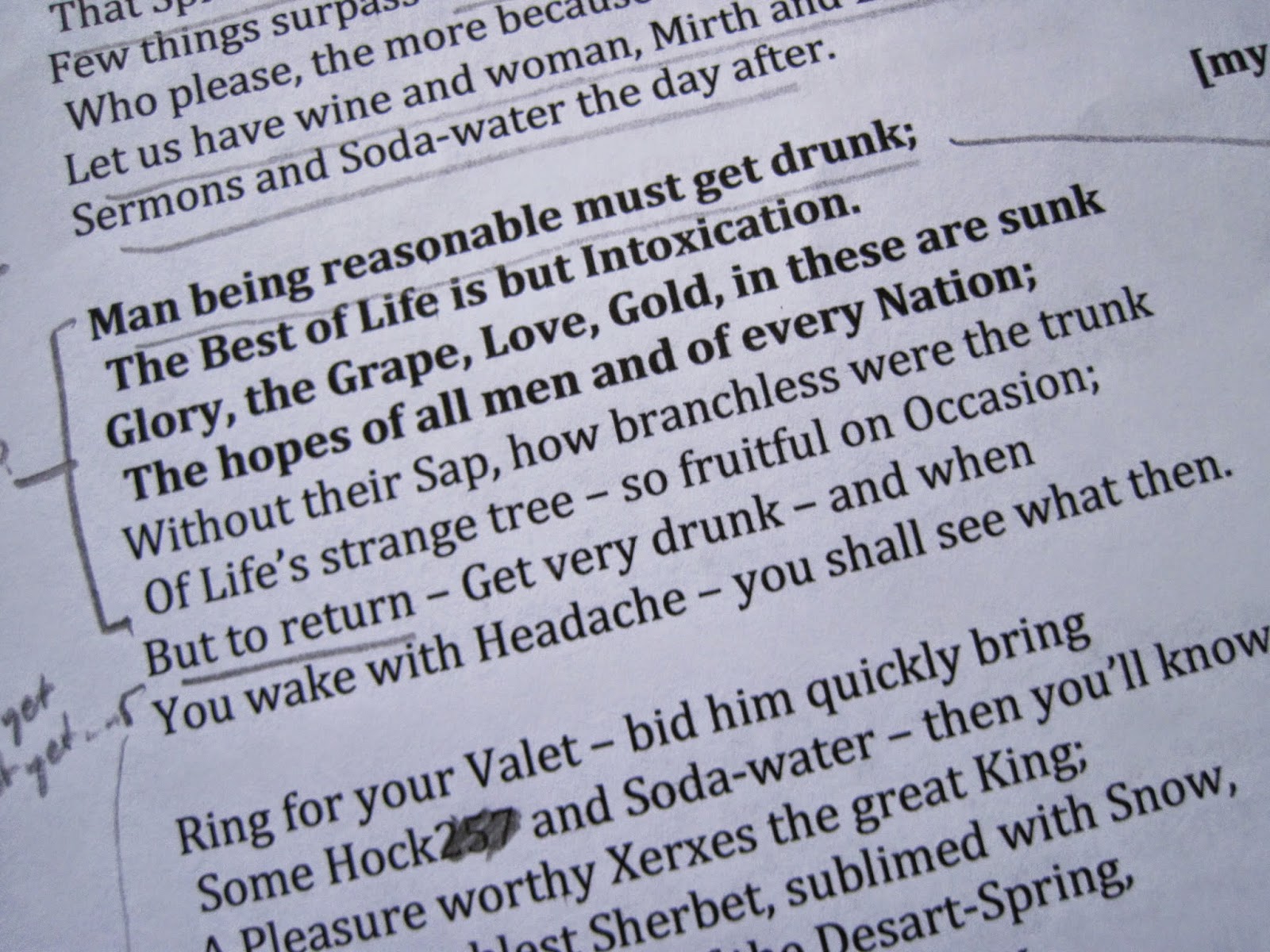
Glimpses: Or, Lecture Notes
Labels:
Byron,
Civilization,
Coast,
Coffee,
Couplets,
Don Juan,
Gin,
Heroic,
Lock,
Narrators,
Neo-Classic,
Notes,
Octava Rima,
Perspective,
Poetry,
Pope,
Romantic,
Savage
Thursday, December 20, 2012
Sunday, November 4, 2012
Wordsworth and Byron: "The After-Vacancy"
Action is transitory,--a step, a blow,
The motion of a muscle--this way or that--
'Tis done, and in the after-vacancy
We wonder at ourselves like men betrayed:
Suffering is permanent, obscure, and dark,
And shares the nature of infinity.
--William Wordsworth,
headnote to "The White Doe of Rhylstone"
(originally a bit of speech
from the suppressed drama The Borderers)
The world is full of orphans: firstly, those
Who are so in the strict sense of the phrase
(But many a lonely tree the loftier grows
Than others crowded in the forest's maze);
The next are such as are not doomed to lose
There tender parents in their budding days,
But merely their parental tenderness,
Which leaves them orphans of the heart no less.
--Lord Byron,
the opening stanza to the final -- and unfinished -- canto of Don Juan
I am not sure why I am putting these two passages together, but they rise up in my mind that way, often. Of course, both pieces concern emotional loss and absence, concern consequence: "after-vacancy" As an exercise in grad school, I'd often ponder how one poet would speak another poet's words, how one poet would cast the same thought into different words, but I must said that I always felt that Lord Byron would have ended up with phrasing quite close to Wordsworth's original "Action is transitory" and so forth; that was an invigorating insight since I'd mostly approached these two poets as poles in an agon, as antagonists in the Romantic Battle-Royal. Much of Cantos III and IV of Childe Harold's Pilgrimage reveals Wordsworthian themes, Byronized (of course) . . . .
Labels:
Action,
Agon,
Betrayal,
Byron,
Consequence,
Growth,
Heart,
Muscles,
Orphans,
Parents,
Poetry,
Romantic,
Suffering,
Tenderness,
Transitory,
Wordsworth
Friday, November 2, 2012
Reprise: "And If I Laugh At Any Mortal Thing"
I
Nothing so difficult as a beginning
In poesy, unless perhaps the end;
For oftentimes when Pegasus seems winning
The race, he sprains a wing, and down we tend,
Like Lucifer when hurl'd from heaven for sinning;
Our sin the same, and hard as his to mend,
Being pride, which leads the mind to soar too far,
Till our own weakness shows us what we are.
II
But Time, which brings all beings to their level,
And sharp Adversity, will teach at last
Man, -- and, as we would hope, -- perhaps the devil,
That neither of their intellects are vast:
While youth's hot wishes in our red veins revel,
We know not this -- the blood flows on too fast;
But as the torrent widens towards the ocean,
We ponder deeply on each past emotion.
III
As boy, I thought myself a clever fellow,
And wish'd that others held the same opinion;
They took it up when my days grew more mellow,
And other minds acknowledged my dominion:
Now my sere fancy "falls into the yellow
Leaf," and Imagination droops her pinion,
And the sad truth which hovers o'er my desk
Turns what was once romantic to burlesque.
IV
And if I laugh at any mortal thing,
'Tis that I may not weep; and if I weep,
'Tis that our nature cannot always bring
Itself to apathy, for we must steep
Our hearts first in the depths of Lethe's spring,
Ere what we least wish to behold will sleep:
Thetis baptized her mortal son in Styx;
A mortal mother would on Lethe fix.
V
Some have accused me of a strange design
Against the creed and morals of the land,
And trace it in this poem every line:
I don't pretend that I quite understand
My own meaning when I would be very fine;
But the fact is that I have nothing plann'd,
Unless it were to be a moment merry,
A novel word in my vocabulary.
VI
To the kind reader of our sober clime
This way of writing will appear exotic;
Pulci was sire of the half-serious rhyme,
Who sang when chivalry was more Quixotic,
And revell'd in the fancies of the time,
True knights, chaste dames, huge giants, kings despotic:
But all these, save the last, being obsolete,
I chose a modern subject as more meet.
VII
How I have treated it, I do not know;
Perhaps no better than they have treated me
Who have imputed such designs as show
Not what they saw, but what they wish'd to see:
But if it gives them pleasure, be it so;
This is a liberal age, and thoughts are free:
Meantime Apollo plucks me by the ear,
And tells me to resume my story here.
--Lord Byron,
the opening stanzas of the fourth canto of Don Juan
I've posted these lines before, but that's fine. That's what reprise is for.
Nothing so difficult as a beginning
In poesy, unless perhaps the end;
For oftentimes when Pegasus seems winning
The race, he sprains a wing, and down we tend,
Like Lucifer when hurl'd from heaven for sinning;
Our sin the same, and hard as his to mend,
Being pride, which leads the mind to soar too far,
Till our own weakness shows us what we are.
II
But Time, which brings all beings to their level,
And sharp Adversity, will teach at last
Man, -- and, as we would hope, -- perhaps the devil,
That neither of their intellects are vast:
While youth's hot wishes in our red veins revel,
We know not this -- the blood flows on too fast;
But as the torrent widens towards the ocean,
We ponder deeply on each past emotion.
III
As boy, I thought myself a clever fellow,
And wish'd that others held the same opinion;
They took it up when my days grew more mellow,
And other minds acknowledged my dominion:
Now my sere fancy "falls into the yellow
Leaf," and Imagination droops her pinion,
And the sad truth which hovers o'er my desk
Turns what was once romantic to burlesque.
IV
And if I laugh at any mortal thing,
'Tis that I may not weep; and if I weep,
'Tis that our nature cannot always bring
Itself to apathy, for we must steep
Our hearts first in the depths of Lethe's spring,
Ere what we least wish to behold will sleep:
Thetis baptized her mortal son in Styx;
A mortal mother would on Lethe fix.
V
Some have accused me of a strange design
Against the creed and morals of the land,
And trace it in this poem every line:
I don't pretend that I quite understand
My own meaning when I would be very fine;
But the fact is that I have nothing plann'd,
Unless it were to be a moment merry,
A novel word in my vocabulary.
VI
To the kind reader of our sober clime
This way of writing will appear exotic;
Pulci was sire of the half-serious rhyme,
Who sang when chivalry was more Quixotic,
And revell'd in the fancies of the time,
True knights, chaste dames, huge giants, kings despotic:
But all these, save the last, being obsolete,
I chose a modern subject as more meet.
VII
How I have treated it, I do not know;
Perhaps no better than they have treated me
Who have imputed such designs as show
Not what they saw, but what they wish'd to see:
But if it gives them pleasure, be it so;
This is a liberal age, and thoughts are free:
Meantime Apollo plucks me by the ear,
And tells me to resume my story here.
--Lord Byron,
the opening stanzas of the fourth canto of Don Juan
I've posted these lines before, but that's fine. That's what reprise is for.
Saturday, April 28, 2012
Roman Holidays?
Or, CLASSICAL DOGGEREL (circa 1995)
And "doggerel" means fairly bad poetry, or wannabe poetry, or something that looks a bit like poetry, but isn't quite. I've written my share of sea-doggerel. Here's a piece of classical doggerel from an old notebook . . . though at the bottom of the blog-entry, there's a chorus from a really cool dysfunctional would-be love-song: "Rome Fell."
NOR SWIMS*
Neither reads
A fool the old
Roman gibe
But Caesar
Swam, wrote
Books, scrolls
Historical, political
Who knew
The Rubicon, the die
Once only, but cowards
Cleopatra loved
Egyptian grain
Against odds
King Nicomedes
Too, but after
Laurels, bald
Truths too few
Posterity, can't
Plan for it:
Paine's idea,
Burke agreed.
Julius, wily
Julius: he
Flourished
For a while.
--I just found this doggerel in an old notebook from grad school, the notebook itself entitled "Dioscuri" and dated "1995." I've lightly edited this piece, something that had grown out of my reading in Julius Caesar, of course, but Byron too--however unnamed--as well as Shakespeare, Talbot Mundy, English Romantic era political theory, and Roman history. Barton's Sorrows of the Ancient Romans is probably the source of the Roman proverb, the Roman definition of a fool*--He neither reads nor swims--which I've presented previously here.
About that time I also wrote a song called "Rome Fell," but I can't quite recall nor find those old lyrics.
I can sing the chorus for you:
ROME FELL
Like I fell for you
ROME FELL
You can walk through the ruins
ROME FELL
Empires never last
ROME FELL
Who cares about the past?
(REPEAT!)
(REPEAT!)
And "doggerel" means fairly bad poetry, or wannabe poetry, or something that looks a bit like poetry, but isn't quite. I've written my share of sea-doggerel. Here's a piece of classical doggerel from an old notebook . . . though at the bottom of the blog-entry, there's a chorus from a really cool dysfunctional would-be love-song: "Rome Fell."
NOR SWIMS*
Neither reads
A fool the old
Roman gibe
But Caesar
Swam, wrote
Books, scrolls
Historical, political
Who knew
The Rubicon, the die
Once only, but cowards
Cleopatra loved
Egyptian grain
Against odds
King Nicomedes
Too, but after
Laurels, bald
Truths too few
Posterity, can't
Plan for it:
Paine's idea,
Burke agreed.
Julius, wily
Julius: he
Flourished
For a while.
--I just found this doggerel in an old notebook from grad school, the notebook itself entitled "Dioscuri" and dated "1995." I've lightly edited this piece, something that had grown out of my reading in Julius Caesar, of course, but Byron too--however unnamed--as well as Shakespeare, Talbot Mundy, English Romantic era political theory, and Roman history. Barton's Sorrows of the Ancient Romans is probably the source of the Roman proverb, the Roman definition of a fool*--He neither reads nor swims--which I've presented previously here.
About that time I also wrote a song called "Rome Fell," but I can't quite recall nor find those old lyrics.
I can sing the chorus for you:
ROME FELL
Like I fell for you
ROME FELL
You can walk through the ruins
ROME FELL
Empires never last
ROME FELL
Who cares about the past?
(REPEAT!)
(REPEAT!)
Labels:
Cleopatra,
doggeral,
Fool,
Graduate School,
Julius Caesar,
Poetry,
Reading,
Romans,
Romantic,
Swimming
Saturday, April 21, 2012
Talking About Byron
"I Leave The Thing a Problem, Like All Things":
The Example of Byron
A suggestive, representative introduction to the life, the work, the letters, and the irrepressible voice of George Gordon, Lord Byron--with reference to certain enduring critical problems and promising perspectives that ought to arise when you delve deeply into the English Romantic Period's Most Popular, Most Topical, and Greatest Poet.
That's the talk I gave yesterday afternoon.
An "overstuffed yakfest" is how I summed it up later, but I think a good time was had by most, if not all. I hope so. I had a great audience, certainly, and I provided visual aids, thick handouts, enthusiasm, and as much humor as I could pack in between quotations. While quoting, I can let Byron provide the humor, the satire, or the pathos--and sometimes all three in the same line.
Of course, giving a talk often shows you the better, more focused talk you should have given, but that's for next time. (I should make those notes on focal points and put them in the file . . . .)
Here's the quotation I meant to put up on the board as part of that better focus:
But words are things, and a small drop of ink,
Falling like dew upon a thought, produces
That which makes thousands, perhaps millions, think.
---------Lord Byron,
from Don Juan, Canto III, stanza 88
Monday, November 15, 2010
Passages: Pegasus "Sprains a Wing"? Not Hardly
Here is the opening to Lord Byron's fourth canto of his marvelous, seemingly miscellaneous masterpiece Don Juan. I love the narrative voice; the ease of speech, allusion, and rhyming; and the deceptive defense, hardly--and yet completely--serious. Playing games in earnest: that's my Lord Byron.
Canto IV
Nothing so difficult as a beginning
In poesy, unless perhaps the end;
For oftentimes when Pegasus seems winning
The race, he sprains a wing and down we tend,
Like Lucifer when hurled from heaven for sinning.
Our sin the same, and hard as his to mend,
Being pride, which leads the mind to soar too far,
Till our own weakness shows us what we are.
But time, which brings all beings to their level,
And sharp adversity will teach at last
Man and as we would hope, perhaps the devil
That neither of their intellects are vast.
While youth's hot wishes in our red veins revel,
We know not this--the blood flows on too fast;
But as the torrent widens towards the ocean,
We ponder deeply on each past emotion.
As boy, I thought myself a clever fellow
And wished that others held the same opinion;
They took it up when my days grew more mellow,
And other minds acknowledged my dominion.
Now my sere fancy 'falls into the yellow
Leaf', and imagination droops her pinion;
And the sad truth which hovers o'er my desk
Turns what was once romantic to burlesque.
And if I laugh at any mortal thing,
'Tis that I may not weep; and if I weep,
'Tis that our nature cannot always bring
Itself to apathy, for we must steep
Our hearts first in the depth of Lethe's spring,
Ere what we least wish to behold will sleep.
Thetis baptized her mortal son in Styx;
A mortal mother would on Lethe fix.
Some have accused me of a strange design
Against the creed and morals of the land
And trace it in this poem every line.
I don't pretend that I quite understand
My own meaning when I would be very fine;
But the fact is that I have nothing planned,
Unless it were to be a moment merry,
A novel word in my vocabulary.
To the kind reader of our sober clime
This way of writing will appear exotic.
Pulci was sire of the half-serious rhyme,
Who sang when chivalry was more quixotic,
And revelled in the fancies of the time--
True knights, chaste dames, huge giants, kings despotic.
But these, save the last, being obsolete,
I chose a modern subject as more meet.
How I have treated it, I do not know;
Perhaps no better than they have treated me
Who have imputed such designs as show
Not what they saw, but what they wished to see.
But if it gives them pleasure, be it so;
This is a liberal age, and thoughts are free.
Meantime Apollo plucks me by the ear
And tells me to resume my story here.
And resume his story he does.
I hope I have awakened some curiosity or have reminded some of you what a joy--what an absolute and absolutely resonant joy--Byron's poetry can be.
Canto IV
Nothing so difficult as a beginning
In poesy, unless perhaps the end;
For oftentimes when Pegasus seems winning
The race, he sprains a wing and down we tend,
Like Lucifer when hurled from heaven for sinning.
Our sin the same, and hard as his to mend,
Being pride, which leads the mind to soar too far,
Till our own weakness shows us what we are.
But time, which brings all beings to their level,
And sharp adversity will teach at last
Man and as we would hope, perhaps the devil
That neither of their intellects are vast.
While youth's hot wishes in our red veins revel,
We know not this--the blood flows on too fast;
But as the torrent widens towards the ocean,
We ponder deeply on each past emotion.
As boy, I thought myself a clever fellow
And wished that others held the same opinion;
They took it up when my days grew more mellow,
And other minds acknowledged my dominion.
Now my sere fancy 'falls into the yellow
Leaf', and imagination droops her pinion;
And the sad truth which hovers o'er my desk
Turns what was once romantic to burlesque.
And if I laugh at any mortal thing,
'Tis that I may not weep; and if I weep,
'Tis that our nature cannot always bring
Itself to apathy, for we must steep
Our hearts first in the depth of Lethe's spring,
Ere what we least wish to behold will sleep.
Thetis baptized her mortal son in Styx;
A mortal mother would on Lethe fix.
Some have accused me of a strange design
Against the creed and morals of the land
And trace it in this poem every line.
I don't pretend that I quite understand
My own meaning when I would be very fine;
But the fact is that I have nothing planned,
Unless it were to be a moment merry,
A novel word in my vocabulary.
To the kind reader of our sober clime
This way of writing will appear exotic.
Pulci was sire of the half-serious rhyme,
Who sang when chivalry was more quixotic,
And revelled in the fancies of the time--
True knights, chaste dames, huge giants, kings despotic.
But these, save the last, being obsolete,
I chose a modern subject as more meet.
How I have treated it, I do not know;
Perhaps no better than they have treated me
Who have imputed such designs as show
Not what they saw, but what they wished to see.
But if it gives them pleasure, be it so;
This is a liberal age, and thoughts are free.
Meantime Apollo plucks me by the ear
And tells me to resume my story here.
And resume his story he does.
I hope I have awakened some curiosity or have reminded some of you what a joy--what an absolute and absolutely resonant joy--Byron's poetry can be.
Subscribe to:
Posts (Atom)