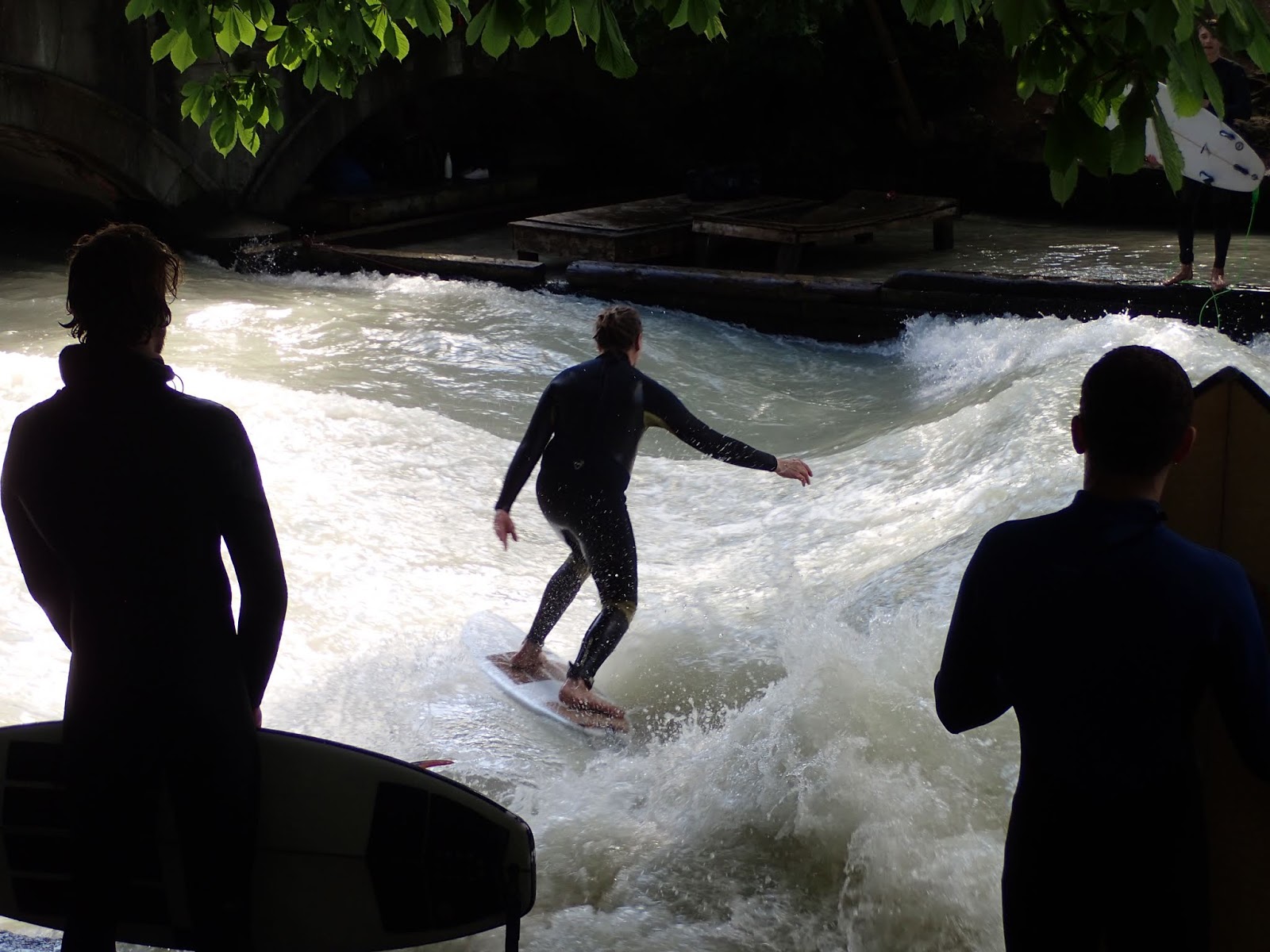
River surfing.
Showing posts with label River. Show all posts
Thursday, June 20, 2019
Sunday, June 9, 2019
Saturday, April 21, 2018
Tuesday, December 22, 2015
The Winding and Unwinding
THE WINDING AND UNWINDING
The shape of your thought
Entices me
Quite as much as
The thought of your shape.
Clay-minded,
Bloody-brained,
Fickle as a stick in water:
I swim towards you.
I reach for you
Again and again and again
In thought, in force,
Not withholding aught
Save what wyrd demands
From each of us.
The winding and unwinding
Of time and tide,
Again releasing,
Again embracing,
Tasting and chasing,
Like river-otters sliding
Down the sloped bank.
The winding and unwinding
Of time and tide:
The rounded lift and heft,
The nipple’s assertion,
The twinned-blood rising
Like the swift pull
Of the river’s pulse
And penetration --
Flowing,
Falling,
Following –-
That shared current
Streaming just past the shore,
Stranding us between
Just enough
And quite enough.
___
Coda:
Laughing lips sip --
Swallow -- another draft.
Glasses, glances,
Clash and chime,
Toasting the new year.
Harken to the hearty
Admonition:
Draft, not drift.
--Matthew Duckworth
Monday, November 12, 2012
Barry Lopez: "River Notes" and Questing
I have been crippled by my age, by what I have known, as well as by my youth, by what I have yet to learn, in all these inquiries. It has taken me years, which might have been spent (by someone else) seeking something greater, in some other place. I have sought only you. Enough. I wish to know you, and you will not speak.
--Barry Lopez,
from River Notes: The Dance of Herons
I can't say enough how much this slim volume mattered, how much it made complex, made even more emotional and even more intricately verbal my relationship with nature and story, when I first discovered River Notes in Moe's Books of Berkeley, CA, so long ago in 1980.
On this recent rereading -- and River Notes is a book I reread more or less each year, haphazardly, piece by piece over all the months of the year -- I realized how much his chapter "The Salmon" prepared me for the art and artistry of Andy Goldsworthy and for so many of my own efforts in clay amidst sea and creek.
I've witnessed this writer giving a talk and reading one of his stories at least once --"The Mappist," at the Donna Seager Gallery in San Rafael -- and I took this rather intimate opportunity (such a small venue, a somewhat select gathering) to thank Barry Lopez for his body of work. I'm glad I overcame my natural diffidence to do so.
The passage above spoke to me when I was a mere youth, not even 20, and speaks to me now, a bit over 50. I like the appositive defining of age in terms of knowing, in terms of what we don't understand and of what we do, as well as the sad, even bitter tone. Loss breathes through the passage, through most of the book, and Lopez's voicing of that theme, that truth, caught my ear, and the ear of my soul (if you will), even if I didn't--perhaps, still don't--truly understand wherein that sense of loss resides, takes form. Recently, I have read an interview with Barry Lopez in which he reveals that the writing of River Notes, though a sequence of fictional narratives, was deeply informed by the death of his mother.
The book takes us from the seaside, the mouth of the river, upstream until we reach the headwaters, the source. The last chapter, be warned, is entitled "Drought." I'll hold off saying more, for I'd rather awaken curiosity and intimate mystery. I have taught two chapters in particular a dozen times, I think: "The Bend" and "The Rapids." Here's another passage from "The Salmon":
There is never, he reflected, a moment of certainty, only the illusion. And as he worked among the rocks in the middle of the river he thought on this deeply, so deeply that had his movements not been automatic he would have fallen off the rocks and into the river and been borne away.
In the summer light, even with the coolness of the water welling up around him in the air, thinking was all he was capable of; and this distraction left him exhausted and unbalanced so that at the end of the day the physical exhaustion he felt was something he lowered himself into, as into a hot bath. He pondered gentleness often. And he tried to pry (hefting the stones, conscious of the resonance between the idea in his mind and the work of his hands) into mysteries which remained as implacable as the faces of the stones.
Thank you, again, Barry Holstun Lopez.
River Notes: The Dance of Herons
A Bard Book / Avon Books: New York, November, 1980.
Voyage-charm: sculpture mix; floating blue glazing; matte finish.
Sunday, October 2, 2011
Neo-Classic: Playing with Clay
I'm thinking about--but ignoring--Denham's lines on the Thames right about now.
I'd been reading one of Martha Grimes' Richard Jury novels, and that character made me think of Virgil, which made me think of Roman river gods, which made me recall the 18th-century poets I've been reading around in too.
None of which matters really, other than to say "I am playing with clay," and that's a good thing. Oh, and to recommend Grimes' Deer Leap, say, or Five Bells and Bladebone.
The next step is to let that mask sit and harden enough to work the features more fully, more appropriately. I've got the basic set, but I haven't decided on the expression quite yet. There's a slight smile at present, but that came second; at first, I was channeling my anger and unease at the world today, but that's not why I pick up the clay. I need to feel my way into this figure, this character. What is he trying to tell me? This is a river god, so I want to listen. I can't quite hear him yet.
"In progress" is a healthy phrase.
Sunday, August 28, 2011
Seamus Heaney's "Reed Music"
GIFTS OF RAIN
I
Cloudburst and steady downpour now
for days.
Still mammal,
straw-footed on the mud,
he begins to sense weather
by his skin.
A nimble snout of flood
licks over stepping stones
and goes uprooting.
He fords
his life by soundings.
Soundings.
II.
A man wading lost fields
breaks the pane of flood:
a flower of mud-
water blooms up to his reflection
like a cut swaying
its red spoors through a basin.
His hands grub
where the spade has uncastled
sunken drills, an atlantis
he depends on. So
he is hooped to where he planted
and sky and ground
are running naturally among his arms
that grope the cropping land.
III.
When rains were gathering
there would be an all-night
roaring off the ford.
Their world-schooled ear
could monitor the usual
confabulations, the race
slabbering past the gable,
the Moyola harping on
its gravel beds:
all spouts by daylight
brimmed with their own airs
and overflowed each barrel
in long tresses.
I cock my ear
at an absence--
in the shared calling of blood
arrives my need
for antediluvian lore.
Soft voices of the dead
are whispering by the shore
that I would question
(and for my children's sake)
about crops rotted, river mud
glazing the baked clay floor.
IV.
The tawny guttural water
spells itself: Moyola
is its own score and consort,
bedding the locale
in the utterance,
reed music, an old chanter
breathing its mists
through vowels and history.
A swollen river,
a mating call of sound
rises to pleasure me, Dives,
hoarder of common ground.
--Seamus Heaney
from his volume Wintering Out (1972)
Note: I came upon this poem and its music of water, geography, and sensibility by chance last night. I was "reading around," picking up this volume and that, this poetry, that novel, the other bit of non-fiction, and so forth. I was thinking of the storm hitting the East Coast and the friends who live there, even as I was listening to Dougie Maclean's fine voice and compositions (The Essential Dougie Maclean, in this case).
This poem held me, so I typed up part of it. Let the poem linger in my mind overnight. Now, as I sit here, having typed up the whole of it, I'm reminded how often in the past, especially as an undergraduate and then graduate student, I would write out whole poems, type out whole poems, to get the writer's flow into my head. I used to do this with my own essays if I were working from draft to draft, writing out the polished opening paragraphs from that very first word to put me into the voice of the essay, to put me into the flow of thoughts and feelings and verbiage, the foliage of language, for continuity's sake.
I recommend this practice: write it out. Write out--however that makes sense to you--a poem (or short story!) from start to finish. Don't analyze as you write it out. Enter the flow of words as you would a river. Later, you'll be a better navigator of that river. With "Gifts of Rain," for example, only the "writing out" of this poem led me to notice the deliberate variations in versification, the shift in stanza-patterns from portion to portion. There's purposeful composition there, and listening for the music came in part because I allowed myself, made myself, pay attention stanza by stanza, line by line, word by word.
Maybe I should have noticed those things just from reading. Maybe. But I'd rather emphasize how the act of writing out this whole poem led to more and better than to play the blame game. Find a poem that tugs on you just a bit--not a favorite poem, no--and see what happens when you ride that river.
Subscribe to:
Posts (Atom)