Showing posts with label Charms. Show all posts
Friday, August 7, 2020
Tuesday, July 7, 2020
Saturday, December 2, 2017
Saturday, January 23, 2016
Saturday, October 24, 2015
Wednesday, August 14, 2013
Thursday, March 7, 2013
Sunday, February 24, 2013
Saturday, December 8, 2012
Nicolson's "Sea Room" -- Gaelic and Norse
(Freyja is Nicolson's trusty boat.)
Freyja does at least belong to that world. I hold her tiller and she is my link to a chain that stretches over five hundred miles and a thousand years to the coast of Norway. Because there is no timber on the Outer Hebrides, the commercial connection with the Baltic has remained alive. Until no more than a generation ago, Baltic traders brought Finnish tar, timber and pitch directly to Stornoway and Tarbert in Harris. Although Freyja's own timber comes from the mainland of Scotland, her waterproofing below the water-line is known as 'Stockholm tar': a wood tar, distilled from pine and imported from the Baltic at least since the Middle Ages. Until well into the nineteenth century, kit boats in marked parts came imported fro Norway to the Hebrides, travelling in the hold of merchant ships, and assembled by boat builders in any notch or loch along the Harris or Lewis coast. In 1828, Lord Teignmouth, the ex-Governor-General of India, friend of Wilberforce, came out to the Shiants in the company of Alexander Stewart, the farmer at Valamus on Pairc, who had tenancy of the islands. They launched forth in this gentleman's boat, a small skiff or yawl built in Norway, long, narrow, peaked at both ends, extremely light, floating like a feather upon the water, and when properly managed, with the buoyancy and almost the security of a sea-bird on its native wave.
The British Imperialist, the liberal evangelical, member of the Clapham Sect, travels in a Viking boat on a Viking sea. I nearly called Freyja 'Fulmar' because of that phrase of Teignmouth's. No bird is more different on the wing than on the nest and in flight the fulmar is the most effortless of all sea birds. It was that untroubled buoyancy in wind and water that I was after. But Freyja's fatness was what settled it.
Almost everything in her and the world now around her, if described in modern Gaelic, would be understood by a Viking. The words used here for boats and sea all come from Old Norse and the same descriptions have been on people's lips for a millennium. If I say, in Gaelic, 'windward of the sunken rock', 'the seaweed in the narrow creek', 'fasten the buoy', 'steer with the helm towards the shingle beach', 'prop the boat on an even keel', 'put the cod, the ling, the saithe and the coaley in the wicker basket', 'use the oar as a roller to launch the boat', 'put a wedge in the joint between the planking in the stern', 'set the sea chest on the frames amidships', 'the tide is running around the skerry', 'the cormorant and the gannet are above the surf', 'haul in the sheet', 'tighten the back stay', 'use the oar as a steerboard', or say of a man, 'that man is a hero, a stout man, the man who belongs at the stem of a boat', every single one of those terms has been transmitted directly from the language which the Norse spoke into modern Gaelic. It is a kind of linguistic DNA, persistent across thirty or forty generations.
Sometimes the words have survived unchanged. Oatmeal mixed with cold water, ocean food, is stappa in NOrse, stapag in Gaelic, although stapag is now made with sugar and cream. With many, there has been a little rubbing down of the forms in the millennium that they have been used. A tear in a sail is riab in Gaelic, rifa in Old Norse. The smock worn by fisherman is sguird in Gaelic, skirta in Old Norse. Sgaireag is the Gaelic for 'seaman', skari the Norse word. And occasionally, there is a strange and suggestive transformation. The Gaelic for a hen roost is the Norse word for hammock. Norse for 'strong' becomes Gaelic for 'fat'. The Norse word for rough ground becomes peat moss in Gaelic. A hook or a barb turns into an antler. To creep -- that mobile, subtle movement -- translates into Gaelic as 'to crouch': more still, more rooted to the place. A water meadow in Norway, fit, becomes fidean: grass covered at high tide. 'To drip' becomes 'to melt'. A Norse framework, whether of a house, a boat or a basket, becomes a Gaelic creel.
But it is the human qualities for which Gaelic borrowed the Viking words that are most intriguingly and intimately suggestive of the life lived around these seas a thousand years ago. There is a cluster of borrowings around the ideas of oddity and suspicion. Gaelic itself, if it had not taken from the invaders, would have no word for a quirk (for which it borrowed the Old Norse word meaning 'a trap'), nor for 'strife', nor 'a faint resemblance' -- the word it took was svip, the Norse for 'glimpse'. The Gaelic from 'lullaby' is taladh, from the Norse tal, meaning 'allurement', 'seduction'.
The vocabulary for contempt and wariness suddenly vivifies that ancient moment. Gaelic borrowed Norse revulsion wholesale. Noisy boasting, to blether, a coward, cowardice, surliness, an insult, mockery, a servant, disgust, anything shrivelled or shrunken (sgrogag from the Old Norse skrukka, an old shrimp,) a bald head, a slouch, a good-for-nothing, a dandy, a fop, a short, fat, stumpy woman (staga from stakka, the stump of a tree), a sneak (stig/stygg), a wanderer -- all this was something new, and had arrived with the longships. Fear and ridicule, the uncomfortable presence of the distrusted other, the ugly cross-currents of two worlds, the broken and disturbing sea where those tides met: all this could only be expressed in the odd new language the strangers brought with them.
Almost everything in her and the world now around her, if described in modern Gaelic, would be understood by a Viking. The words used here for boats and sea all come from Old Norse and the same descriptions have been on people's lips for a millennium. If I say, in Gaelic, 'windward of the sunken rock', 'the seaweed in the narrow creek', 'fasten the buoy', 'steer with the helm towards the shingle beach', 'prop the boat on an even keel', 'put the cod, the ling, the saithe and the coaley in the wicker basket', 'use the oar as a roller to launch the boat', 'put a wedge in the joint between the planking in the stern', 'set the sea chest on the frames amidships', 'the tide is running around the skerry', 'the cormorant and the gannet are above the surf', 'haul in the sheet', 'tighten the back stay', 'use the oar as a steerboard', or say of a man, 'that man is a hero, a stout man, the man who belongs at the stem of a boat', every single one of those terms has been transmitted directly from the language which the Norse spoke into modern Gaelic. It is a kind of linguistic DNA, persistent across thirty or forty generations.
Sometimes the words have survived unchanged. Oatmeal mixed with cold water, ocean food, is stappa in NOrse, stapag in Gaelic, although stapag is now made with sugar and cream. With many, there has been a little rubbing down of the forms in the millennium that they have been used. A tear in a sail is riab in Gaelic, rifa in Old Norse. The smock worn by fisherman is sguird in Gaelic, skirta in Old Norse. Sgaireag is the Gaelic for 'seaman', skari the Norse word. And occasionally, there is a strange and suggestive transformation. The Gaelic for a hen roost is the Norse word for hammock. Norse for 'strong' becomes Gaelic for 'fat'. The Norse word for rough ground becomes peat moss in Gaelic. A hook or a barb turns into an antler. To creep -- that mobile, subtle movement -- translates into Gaelic as 'to crouch': more still, more rooted to the place. A water meadow in Norway, fit, becomes fidean: grass covered at high tide. 'To drip' becomes 'to melt'. A Norse framework, whether of a house, a boat or a basket, becomes a Gaelic creel.
But it is the human qualities for which Gaelic borrowed the Viking words that are most intriguingly and intimately suggestive of the life lived around these seas a thousand years ago. There is a cluster of borrowings around the ideas of oddity and suspicion. Gaelic itself, if it had not taken from the invaders, would have no word for a quirk (for which it borrowed the Old Norse word meaning 'a trap'), nor for 'strife', nor 'a faint resemblance' -- the word it took was svip, the Norse for 'glimpse'. The Gaelic from 'lullaby' is taladh, from the Norse tal, meaning 'allurement', 'seduction'.
The vocabulary for contempt and wariness suddenly vivifies that ancient moment. Gaelic borrowed Norse revulsion wholesale. Noisy boasting, to blether, a coward, cowardice, surliness, an insult, mockery, a servant, disgust, anything shrivelled or shrunken (sgrogag from the Old Norse skrukka, an old shrimp,) a bald head, a slouch, a good-for-nothing, a dandy, a fop, a short, fat, stumpy woman (staga from stakka, the stump of a tree), a sneak (stig/stygg), a wanderer -- all this was something new, and had arrived with the longships. Fear and ridicule, the uncomfortable presence of the distrusted other, the ugly cross-currents of two worlds, the broken and disturbing sea where those tides met: all this could only be expressed in the odd new language the strangers brought with them.
--Adam Nicolson
Sea Room: An Island Life in the Hebrides,
North Point Press: New York,
2001
I've quoted from pages 30-33.
Monday, November 12, 2012
Barry Lopez: "River Notes" and Questing
I have been crippled by my age, by what I have known, as well as by my youth, by what I have yet to learn, in all these inquiries. It has taken me years, which might have been spent (by someone else) seeking something greater, in some other place. I have sought only you. Enough. I wish to know you, and you will not speak.
--Barry Lopez,
from River Notes: The Dance of Herons
I can't say enough how much this slim volume mattered, how much it made complex, made even more emotional and even more intricately verbal my relationship with nature and story, when I first discovered River Notes in Moe's Books of Berkeley, CA, so long ago in 1980.
On this recent rereading -- and River Notes is a book I reread more or less each year, haphazardly, piece by piece over all the months of the year -- I realized how much his chapter "The Salmon" prepared me for the art and artistry of Andy Goldsworthy and for so many of my own efforts in clay amidst sea and creek.
I've witnessed this writer giving a talk and reading one of his stories at least once --"The Mappist," at the Donna Seager Gallery in San Rafael -- and I took this rather intimate opportunity (such a small venue, a somewhat select gathering) to thank Barry Lopez for his body of work. I'm glad I overcame my natural diffidence to do so.
The passage above spoke to me when I was a mere youth, not even 20, and speaks to me now, a bit over 50. I like the appositive defining of age in terms of knowing, in terms of what we don't understand and of what we do, as well as the sad, even bitter tone. Loss breathes through the passage, through most of the book, and Lopez's voicing of that theme, that truth, caught my ear, and the ear of my soul (if you will), even if I didn't--perhaps, still don't--truly understand wherein that sense of loss resides, takes form. Recently, I have read an interview with Barry Lopez in which he reveals that the writing of River Notes, though a sequence of fictional narratives, was deeply informed by the death of his mother.
The book takes us from the seaside, the mouth of the river, upstream until we reach the headwaters, the source. The last chapter, be warned, is entitled "Drought." I'll hold off saying more, for I'd rather awaken curiosity and intimate mystery. I have taught two chapters in particular a dozen times, I think: "The Bend" and "The Rapids." Here's another passage from "The Salmon":
There is never, he reflected, a moment of certainty, only the illusion. And as he worked among the rocks in the middle of the river he thought on this deeply, so deeply that had his movements not been automatic he would have fallen off the rocks and into the river and been borne away.
In the summer light, even with the coolness of the water welling up around him in the air, thinking was all he was capable of; and this distraction left him exhausted and unbalanced so that at the end of the day the physical exhaustion he felt was something he lowered himself into, as into a hot bath. He pondered gentleness often. And he tried to pry (hefting the stones, conscious of the resonance between the idea in his mind and the work of his hands) into mysteries which remained as implacable as the faces of the stones.
Thank you, again, Barry Holstun Lopez.
River Notes: The Dance of Herons
A Bard Book / Avon Books: New York, November, 1980.
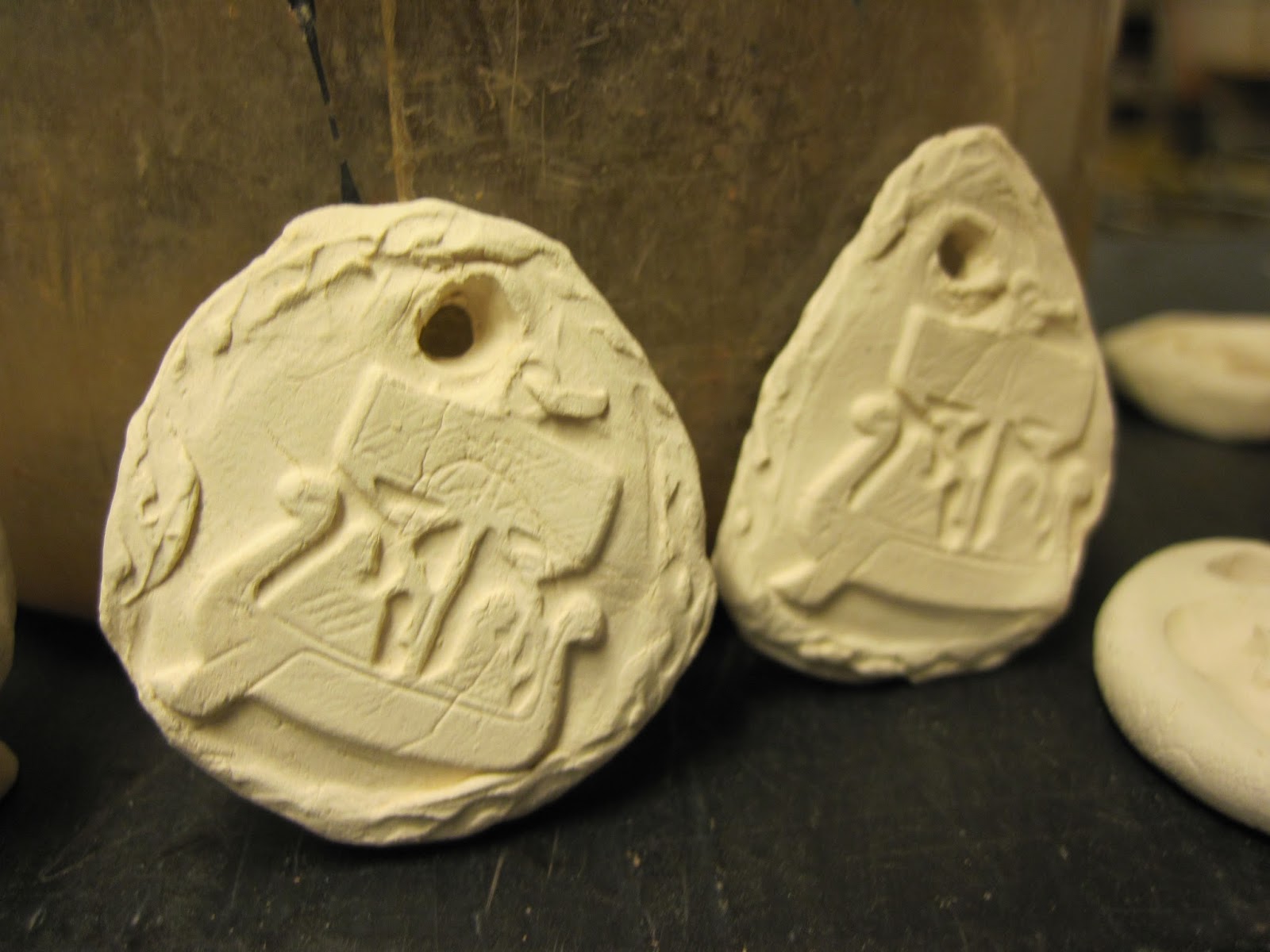
Voyage-charm: sculpture mix; floating blue glazing; matte finish.
Wednesday, November 7, 2012
Keepsakes and Conjurations
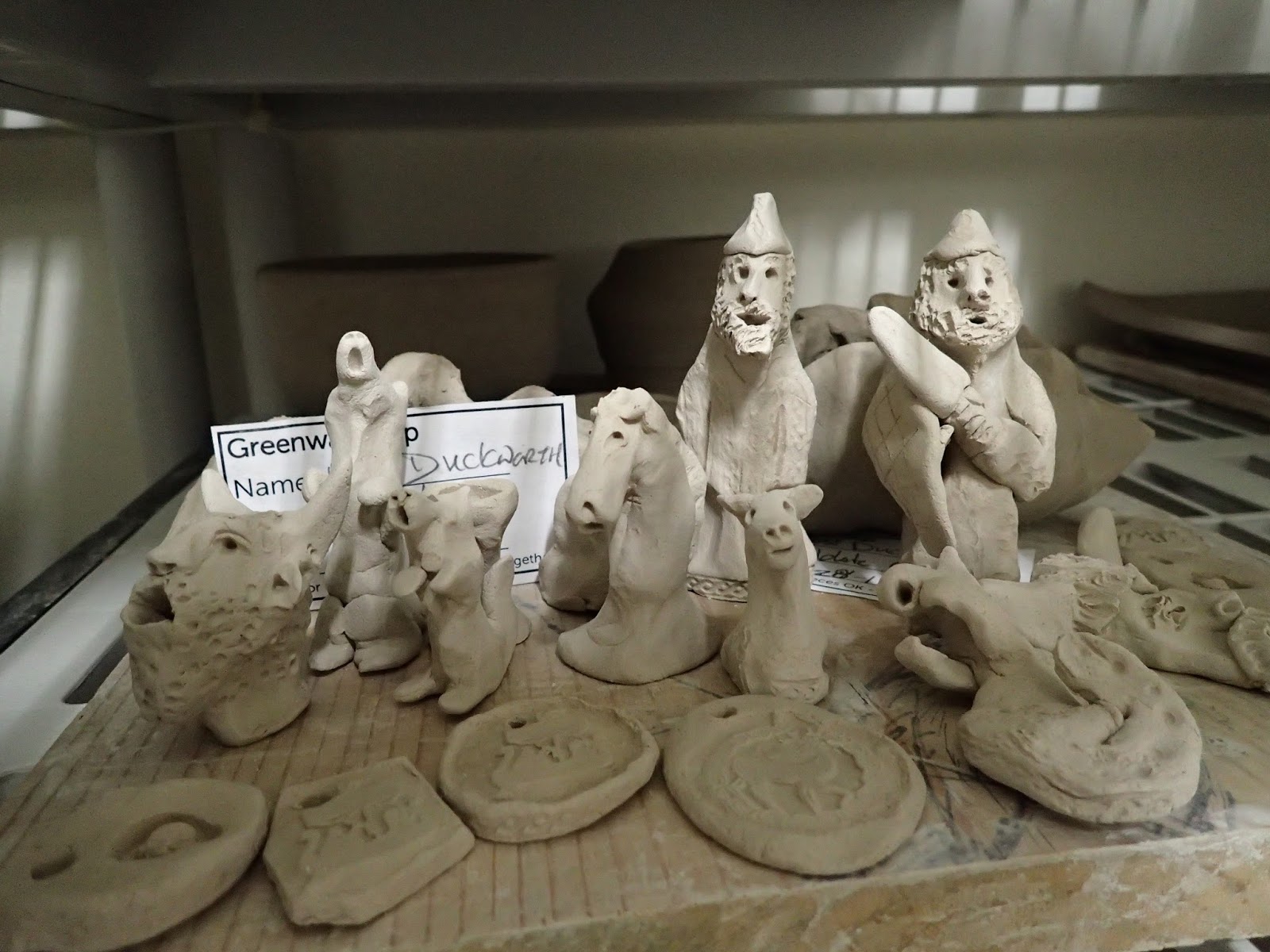
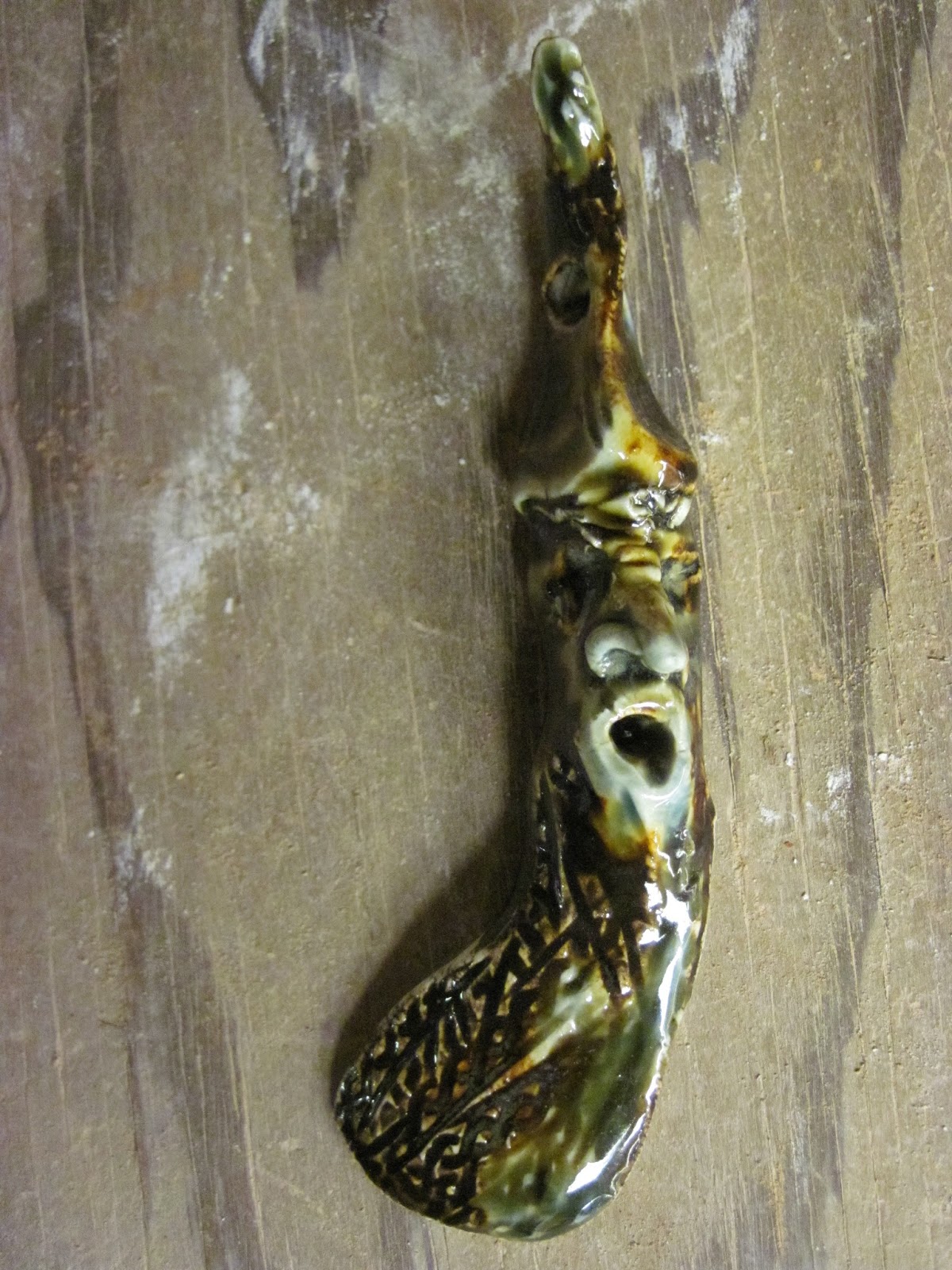
Charms: sculpture mix; blue, green, brown glazing (items dipped and rubbed away, mostly).
Ancient designs for the Viking ships; Jen Delyth's Celtic deer design also.
I'm not entirely happy with the way the glazing has been turning out. Too much water in the mix, perhaps. I'd envisioned slightly different outcomes, as they say in my field.
Ancient designs for the Viking ships; Jen Delyth's Celtic deer design also.
I'm not entirely happy with the way the glazing has been turning out. Too much water in the mix, perhaps. I'd envisioned slightly different outcomes, as they say in my field.
Saturday, November 3, 2012
Clay and Stone: A Miscellany
Rob.
Sir Patrick Spence: Three ships sailing? Ballad measures.
The journey of many miles . . . is easier when the Vikings are navigating.
"Dear deer, come here."
Tuesday, October 30, 2012
Shall I Pour For You Too?
Labels:
Charms,
Clay,
Fish,
Kraken,
Mask,
Point Reyes,
Rocks,
Shells,
Shot glasses,
Whiskey
Saturday, October 20, 2012
Charming
Wednesday, October 3, 2012
Charm: Fare Far, Fare Well
"May you have a good voyage, where'er you fare, here and hereafter."
Subscribe to:
Posts (Atom)