I've been reading around again in Louise Bogan's The Blue Estuaries: Poems 1923- 1968--The Noonday Press: New York, 1968--and I have four more poems I'd like to share.
I've quoted four other poems by Louise Bogan here.
Read aloud, please, and listen:
MAN ALONE
It is yourself you seek
In a long rage,
Scanning through light and darkness
Mirrors, the page,
Where should reflected be
Those eyes and that thick hair,
That passionate look, that laughter.
You should appear
Within the book, or doubled,
Freed, in the silvered glass;
Into all other bodies
Yourself should pass.
The glass does not dissolve;
Like walls the mirrors stand;
The printed page gives back
Words by another hand.
And your infatuate eye
Meets not itself below:
Strangers lie in your arms
As I lie now.
BAROQUE COMMENT
From loud sound and still chance;
From mindless earth, wet with a dead million leaves;
From the forest, the empty desert, the tearing beasts,
The kelp-disordered beaches;
Coincident with the lie, anger, lust, oppression and death in many forms:
Ornamental structures, continents apart, separated by seas;
Fitted marble, swung bells; fruit in garlands as well as on the branch;
The flower at last in bronze, stretched backward, or curled within;
Stone in various shapes: beyond the pyramid, the contrived arch and the buttress;
The named constellations;
Crown and vesture; palm and laurel chosen as noble and enduring;
Speech proud in sound; death considered sacrifice;
Mask, weapon, urn; the ordered strings;
Fountains; foreheads, under weather-bleached hair;
The wreath, the oar, the tool,
The prow;
The turned eyes and the opened mouth of love.
PACKET OF LETTERS
In the shut drawer, even now, they rave and grieve--
To be approached at times with the frightened tear;
Their cold to be drawn away from, as one, at nightfall,
Draws the cloak closer against the cold of the marsh.
There, there, the thugs of the heart did murder.
There, still in the murderers' guise, two stand embraced, embalmed.
SOLITARY OBSERVATION BROUGHT
BACK FROM A SOJOURN IN HELL
At midnight tears
Run into your ears.
Showing posts with label Oar. Show all posts
Showing posts with label Oar. Show all posts
Thursday, June 28, 2012
"The Wake Of The Rudder": Seferis' Argonauts
IV. ARGONAUTS
And for the soul
If it is to know itself
It is into a soul
That it must look.
The stranger and enemy, we have seen him in the mirror.
They were good lads, the comrades. They did not grumble
Because of weariness or because of thirst or because of frost.
They had the manner of trees and the manner of waves
That accept the wind and the rain,
Accept the night and the sun,
And in the midst of change they do not change.
They were good lads. Day after day with downcast eyes,
When we passed the desert island with the Arabian figs,
Towards the setting of the sun, beyond the cape
Of dogs that howl.
If it is to know itself, they used to say,
It is into a soul it must look, they used to say.
And the oars beat on the gold of the sea
In the middle of sunset.
Many the capes we passed, many the islands, the sea
Which brings the other sea, sea-gulls and seals.
There were times wheen unfortunate women with lamentations
Cried out for their children gone,
And others with wild faces looked for Great-Alexander
And glories sunken in the depths of Asia.
We anchored by shores steeped in nocturnal perfumes
Among the singing of birds, waters that left on the hands
The recollection of a great good fortune.
But there was never an end to the journeys.
Their souls became one with the oars and the rowlocks,
With the severe figurehead at the prow,
With the wake of the rudder,
With the water that fractured the image of their faces.
One after another the comrades died
With downcast eyes. Their oars
Indicate the places where they sleep on the shore.
There is none to remember them, and the word is Justice.
--George Seferis,
From "Mythistorema"
George Seferis, Poems: Translated from the Greek by Rex Warner,
Little, Brown and Company: Boston and Toronto, 1964

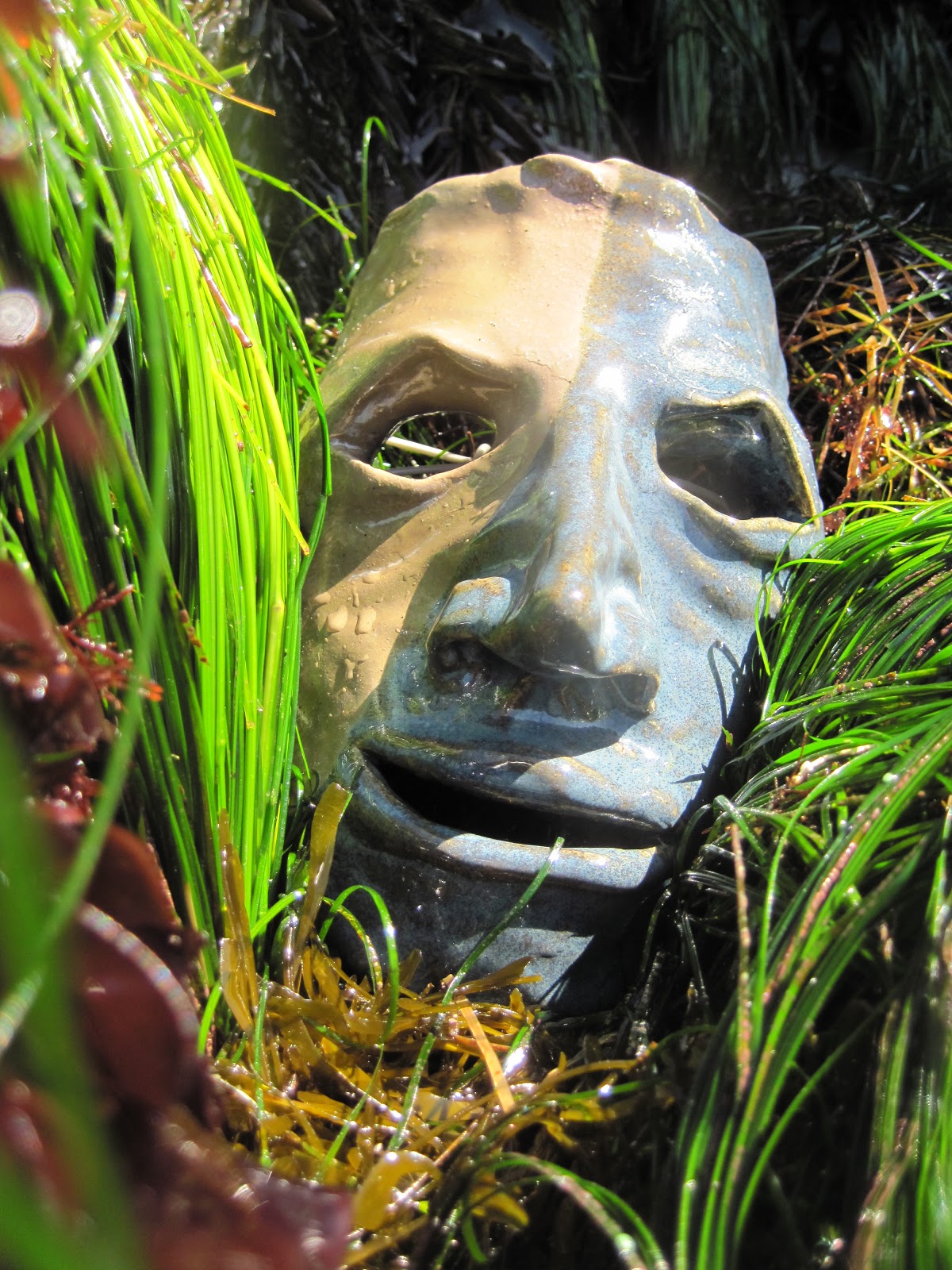
Mask: Triton, sculpture mix, tan and blue glazing, layered.
In the poem above, the voice would seem to be that of Jason, captain of the Argo, leader of these Argonauts. What roles can we see here? What relationships between this captain and this crew? And what of the final epitaph? Or, is that last line only comprehensible in terms of the opening reflections on soul?
Dramatic monologues, after all, offer skewed and resonant visions dependent upon the character and experience of the speaker in the moment of speaking. Where are you, Jason? When are you? Has Medea killed your children yet for the mistakes you (will) make? Have you lost your gamble for kingship again? Have you been looking into the mirror too long? Why "we", really?
And where is Medea in all this? But that and she may belong to another poem, another musing.

Friday, April 6, 2012
Moya Cannon: "'Taom'" and "Hazelnuts"
'TAOM'
The unexpected tide,
the great wave,
uncontained, breasts the rock,
overwhelms the heart, in spring or winter.
Surfacing from a fading language,
the word comes when needed.
A dark sound surges and ebbs,
its accuracy steadying the heart.
Certain kernals of sound
reverberate like seasoned timber,
unmuted truths of a people's winters
stirrings of a thousand different springs.
There are small unassailable words
that diminish caesars;
territories of the voice
that intimate across death and generation
how a secret was imparted--
that first articulation,
when a vowel was caught
between a strong and a tender consonant;
when someone, in anguish
made a new and mortal sound
that lived until now,
a testimony
to waves succumbed to
and survived.
*'Taom' is an Irish word which means "an overwhelming wave of emotion"
--Moya Cannon,
from Oar,
Salmon Publishing, Bridge Mills, Galway, Ireland.
1994.
HAZELNUTS
I thought that I knew what they meant
when they said that wisdom is a hazelnut.
You have to search the scrub
for hazel thickets,
gather the ripened nuts,
crack the hard shells,
and only then taste the sweetness at wisdom's kernel.
But perhaps it is simpler.
Perhaps it is we who wait in thickets
for fate to find us
and break us between its teeth
before we can start to know anything.
--Moya Cannon,
from The Parchment Boat,
The Gallery Press, Loughcrew, Oldcastle, County Meath, Ireland.
1997.

Subscribe to:
Posts (Atom)