Showing posts with label Fergus. Show all posts

Sunday, December 21, 2014

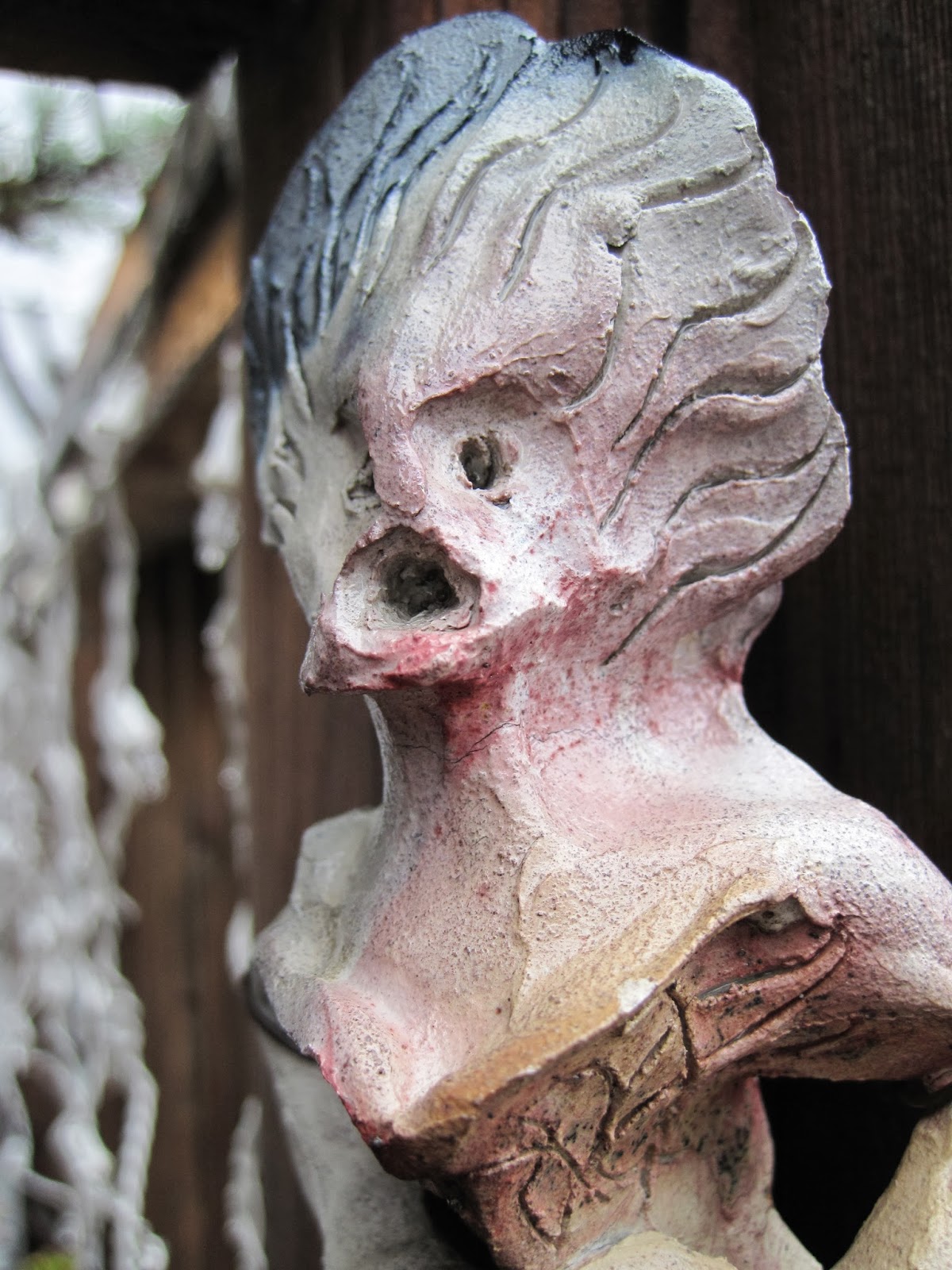
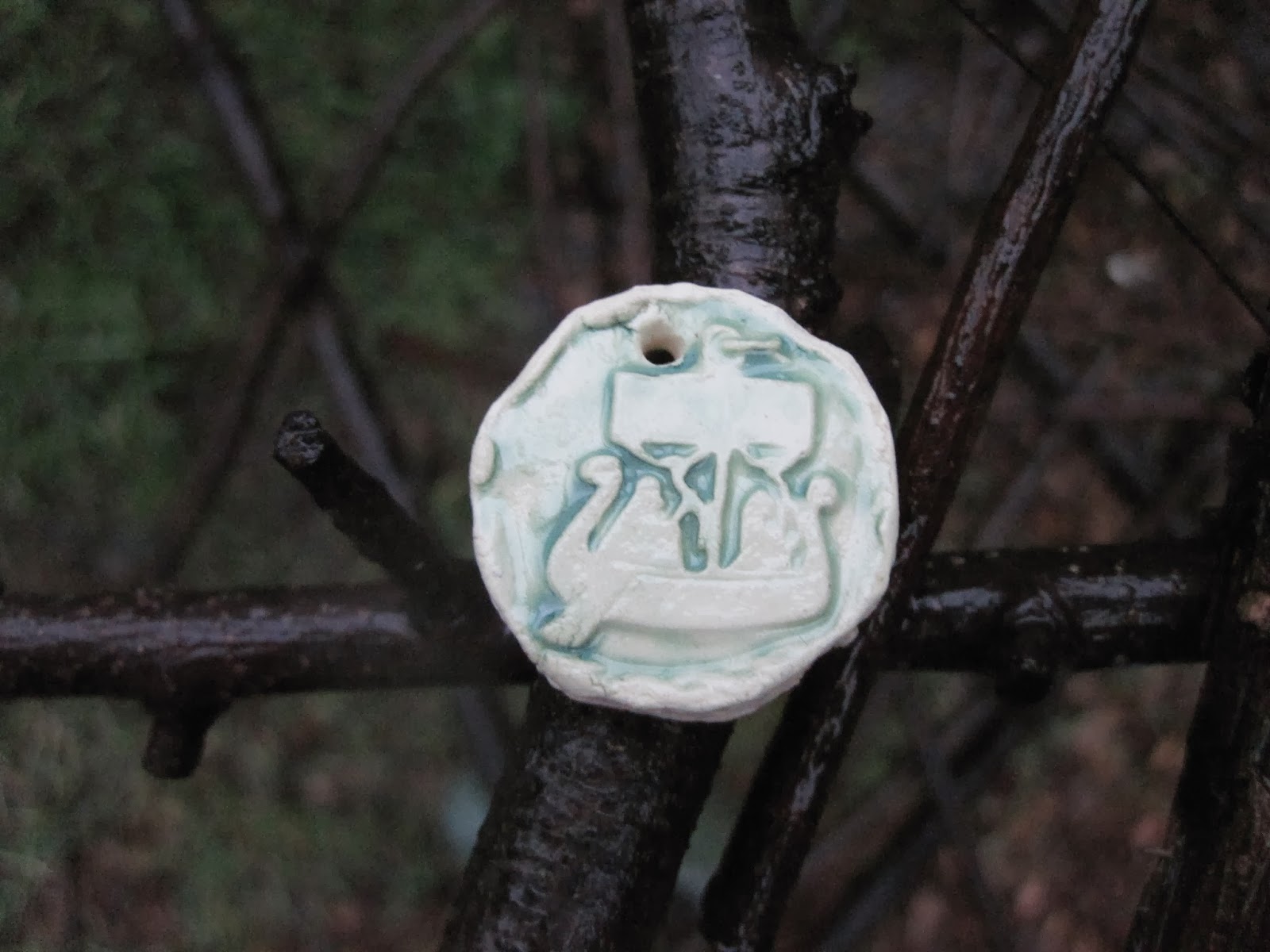
Green Men: Cyrano, Sir Bertilak, Fergus, Amleth, Treece, and Company

Cyrano de Bergerac: A Mask
(sculpture mix; sea-foam glazing)

Sir Bertilak; Or, The Green Knight
(sculpture mix; green house paint)


Fergus: a Celtic Head

Henry Treece's fine historical novel The Green Man
a version of Hamlet drawing upon Saxo Grammaticus' tale of Amleth the Dane


Mytho-heroic.

Self-Portrait #53 (wood-kerne and clay).

Sunday, February 9, 2014

Saturday, February 2, 2013

Mermaid Sky


Amazon Mermaid, With Rocks: 
stoneware; blue and clear glazing; 
copper wire, varying thicknesses; beach pebbles.


Wednesday, December 26, 2012

Heaney: Beowulf Takes His Trophy


from Seamus Heaney's translation of the Old English Beowulf, a favorite passage of mine.  But then most of the poem qualifies as such.


A light appeared and the place brightened
the way the sky does when heaven's candle
is shining clearly.  He inspected the vault:
with sword held high, its hilt raised
to guard and threaten, Hygelac's thane
scouted along the wall in Grendel's wake.
Now the weapon was to prove its worth.
The warrior determined to take revenge
for every gross act Grendel had committed --
and not only for that one occasion
when he'd come to slaughter the sleeping troops,
fifteen of Hrothgar's house-guards
surprised on their benches and ruthlessly devoured,
and as many again carried away,
a brutal plunder.  Beowulf in his fury
now settled that score: he saw the monster
in his resting-place, war-weary and wrecked,
a lifeless corpse, a casualty
of the battle in Heorot.  The body gaped
at the stroke dealt to it after death:
Beowulf cut the corpse's head off.

Immediately the counsellors keeping a lookout
with Hrothgar, watching the lake water,
saw a heave-up and surge of waves
and blood in the backwash.  They bowed grey heads,
spoke in their sage, experienced way
about the good warrior, how they never again
expected to see that prince returning
in triumph to their king.  It was clear to many
that the wolf of the deep had destroyed him forever.

The ninth hour of the day arrived.
The brave Shieldings abandoned the cliff-top
and the king went home; but sick at heart,
staring at the mere, the strangers held on.
They wished, without hope, to behold their lord,
Beowulf himself.

                     Meanwhile, the sword
began to wilt into gory icicles,
to slather and thaw.  It was a wonderful thing,
the way it melted as ice melts
when the Father eases the fetters off the frost
and unravels the water-ropes, He who wields power
over time and tide: he is the true lord.

The Geat captain saw treasure in abundance
But carried no spoils from those quarters
except for the head and the inlaid sword-hilt
embossed with jewels; its blade had melted
and the scrollwork on it burnt, so scalding was the blood
of the poisonous fiend who had perished there.
Then away he swam, the one who had survived
the fall of his enemies, flailing to the surface.
The wide water, the waves and pools,
were no longer infested once the wandering fiend
let go of her life and this unreliable world.
The seafarers' leader made for land,
resolutely swimming, delighted with his prize,
the mighty load he was lugging to the surface.
His thanes advanced in a troop to meet him,
thanking God and taking great delight
in seeing their prince back safe and sound.
Quickly the hero's helmet and mail-shirt
were loosed and unlaced.  The lake settled,
clouds darkened above the bloodshot depths.


Seamus Heaney, translator:
Beowulf: A New Translation,
Faber and Faber, Ltd: London, 1999:
pages 51-53.

Thursday, September 20, 2012

Reprise: Fergus


Fergus: stoneware; brown glazing, layered; copper wire.
      --a Talking Head, as it were, in the Celtic tradition.

Saturday, October 1, 2011

Thursday, November 11, 2010

Passages: Auden's "O Where Are You Going"

O WHERE ARE YOU GOING?

"O where are you going?" said reader to rider,
"That valley is fatal when furnaces burn,
Yonder's the midden whose odours will madden,
That gap is the grave where the tall return."

"O do you imagine," said fearer to farer,
"That dusk will delay on your path to the pass,
Your diligent looking discover the lacking
Your footsteps feel from granite to grass?"

"O what was that bird," said horror to hearer,
"Did you see that shape in the twisted trees?
Behind you swiftly the figure comes softly,
The spot on your skin is a shocking disease."

"Out of this house," said rider to reader,
"Yours never will," said farer to fearer,
"They're looking for you," said hearer to horror,
As he left them there, as he left them there.

-- W. H. Auden

"O Where Are You Going" is one of my favorite heroic poems; I love the theme, the characterizations, and the alliteration. (Hear the music; feel the beat.) The Anglo-Saxon Beowulf, "The Battle of Maldon," "The Wanderer," and "The Seafarer" stand behind this poem, though perhaps through the workings of William Morris, G. M. Hopkins, and Ezra Pound. (Some research just might settle that question.) Likewise, later medieval allegories and mystery plays invigorate the Modernist invocations of personae and praxis. Mostly, I appreciate how the poem partakes of ancient, traditional cadences without sounding like pastiche, without merely deriving from those past patterns. In short, the poem lives.

Auden also used an alternative title for this piece--"The Three Companions"--which reminds me of Job's "comforters." Passive versus active; stuck versus steady. The companions: reader, fearer, and horror. The hero: rider/farer/hearer. I love how the last verse pulls together all that comes before as our hero gets the last word with each nay-sayer. "As he left them there, as he left them there."

Monday, September 20, 2010

Passages: W. B. Yeats' Mythic Yearning

Here are two of my favorite poems by William Butler Yeats, early and particularly Celtic poems. The Irish poet strums the mythic harpstrings here, his melodies bright and piercing. I've always felt a bit haunted by Fergus' chariot and Niamh's calling.


WHO GOES WITH FERGUS?

Who will go drive with Fergus now,
And pierce the deep wood's woven shade,
And dance upon the level shore?
Young man, lift up your russet brow,
And lift your tender eyelids, maid,
And brood on hopes and fear no more.

And no more turn aside and brood
Upon love's bitter mystery;
For Fergus rules the brazen cars,
And rules the shadows of the wood,
And the white breast of the dim sea,
And all dishevelled wandering stars.


THE HOSTING OF THE SIDHE

The host is riding from Knocknarea
And over the grave of Clooth-na-bare;
Caoilte tossing his burning hair,
And Niamh calling Away, come away;
Empty your heart of its mortal dream.
The winds awaken, the leaves whirl round,
Our cheeks are pale, our hair is unbound,
Our breasts are heaving, our eyes are agleam,
Our arms are waving, our lips are apart;
And if any gaze on our rushing band,
We come between him and the deed of his hand,
We come between him and the hope of his heart.
The host is rushing 'twixt night and day,
And where is there hope or deed as fair?
Caoilte tossing his burning hair,
And Niamh calling Away, come away.

P.S. If you feel you need more, well, Yeats' poetry, prose, and dramas are easy to find. "The Stolen Child" is your best next step.