Showing posts with label Crime novels. Show all posts

Tuesday, July 21, 2020

Travis McGee Deserves A Statue


Salvage expert.
Formative influence:
Thank you, John D. McDonald.


Wednesday, June 12, 2019

Le Carre's "A Perfect Spy" is a Perfect Novel


Le Carre's A Perfect Spy is, I hazard to claim, a perfect novel.  It carries the adult thesis that the crucial shapings of character are emotional rather than rational, and it dramatizes such a range of humanity, such a range of response, in its pages.  I recently reread this novel -- while traveling in Germany, Austria, and Swizterland, very appropriately -- that I heartily endorse and recommend, and for some the trappings of espionage will be a feature, but I hope for others it will only be a mere distraction.


Le Carre's novel is both an excellent spy novel and a classic work of literature precisely because Le Carre is such a good watcher of humanity and such a good reporter of humane responses.  It's a thriller too.

Here's a passage that matters:

As for Pym, he was gazing on the glories of the kingdom he had dreamed of so long.  The German muse had no particular draw for him, then or later, for all his loud enthusiasm.  If she had been Chinese or Polish or Indian, it would have made no earthly odds.  The point was, she supplied Pym with the means, for the first time, to regard himself intellectually as a gentleman.  And for that Pym was eternally grateful to her.

As a first generation college student, I connect with this passage.  Studying English Literature at UC Berkeley enabled me to regard myself, intellectually, as a gentleman.  And that mattered.

Thursday, March 28, 2019

Restless Rereading


Much of my reading falls into the category of rereading, for I've been a serious reader for a long time.  I'm teaching Homer's Iliad this term and how many times, how many translations, have I read?  Many.  And yet I must reread to be there with my students, to know the text intimately, to be a reader.  And so I do; I reread.

When I am relaxing at home, I read, which often means rereading.  For I read as others listen to music.  Seriously.  And, so, I often reread restlessly, as I think of it.  I don't quite want to read the whole book, but I do want to live in the music of that book.  So, I read a chapter here in one book and a chapter there in another book and even glance into a third.  That's when rereading becomes restless.  Still good.

You can see such from the photo above: four books that offered different music, compelling music.  A heroic fantasy, a literary novel about deep swimming, a thriller with sailboats, and a crime novel with a compelling protagonist and a compelling antagonist and a compelling setting, the mountainous area of Montana.  Different tunes; different music.

All good; all appropriate; all wonderful.  I just wanted a bit of each.

What music am I listening to, reading from, now?


Monday, March 25, 2019

Don Winslow's "The Border"


Winslow's new novel The Border picks up the storyline from The Power of the Dog and The Cartel, carrying the reader through the whole War on Drugs in a well-researched and well-imagined fashion.  This is high level novel-writing in the best sense, by which I mean that Winslow creates compelling characters even as he presents very deeply researched truths about human actions and societal developments that speak to the worst and best of humanity, often the worst.  Still, reading The Border has made me wanting to be better, to act better, to speak better about what needs to be said, and to vote better, for voting and holding our elected representives accountable is at the heart of this novel.

Friday, July 6, 2018

Notes: Of Reading and Rereading


I read the way most folks listen to music, so there's an awful lot of rereading.  Often, a book deserves a second try or even multiple readings.  Or, I'm not the same man, not the same reader, that I was twenty or thirty years ago.  And, who listens to a great song and never listens again, right?

I have been thinking about the books I have reread again and again, and I think they fall into four or five categories.

No, I'm simpler than that: two or three.

Distraction, direction, and devotion.

I reread to be taken away from current events, current pressures, or I want background "music".

I reread for traction and to carry myself forward, to motivate myself, to pump up or to shake it all loose.

I reread as an act of prayer, as homage to great craft and vision and story.  I reread as a commitment to what the word can do beyond any other media.  I reread to explore and to embrace, to be exposed and to expose myself--all the nerve endings of mind and heart and soul--to story and character and action in the best senses.  I don't really have words myself for what I'm seeking, but it is a sacrament I seek daily, hourly, constantly.  Or, if not sacrament, at least immersion.  I reread to dive deeper, to swim beneath the surface of things, and to drown--if need be--in story.  (I hold my breath well, I must add.)

Background, motivation, and/or concentration.  Exposure.  Immersion.  Perhaps, an addiction?

All joy in various measures.

All fun in multifarious modes.

I read and reread the way most folks listen to music.  The way I listen to music.  The way I'll bet you listen to music.

Why don't you join me, if you don't already?


P.S.  Can something read be both distraction and devotion?
Sometimes, it can.  That's the magic.

Thursday, March 22, 2018

Burning to Learn


Great literary capture of the burning desire to learn?

Don Winslow’s “California Fire and Life”: Chapters 10-15.  

I will excerpt that section for a college class someday.  

When I asked Winslow if he’d mind, he seemed damned delighted.


Tuesday, September 13, 2016

McIlvanney: "The Language of My Living"

Here's a passage from one of William McIlvanney's novels that I've always liked.  The juxtaposition of humility and arrogance, the mix of what others think versus what the narrator knows, has stuck with me, has resonated over the years.  I recall giving this passage to a colleague, for I felt that the passage conveyed both his affect and his self-understanding, but he just smiled as he read, so I wasn't given a full commentary.  I relate and don't quite relate to what's voiced here, but it always resonates.

Here, read for yourself:

'Well,' she said.  'I'd better be going.'

I looked at her and nodded.  She smiled and pointed to the ground behind the cars.  There were tread-marks on the grass.

'Those,' she said.  'They'll always remind me of Scott.  Him and me here.  I wonder how long they'll last.  What is all this about for you really?  I mean.  What is it you're doing exactly?'

'I don't know exactly.  I suppose I'm trying to make my own peace with Scott's death.  I suppose this is how I do it.'

'How do I do it?'

She started suddenly to cry.

'Damn,' she said.  'Will you hold me one time for him?'

I crossed and held her.  It was a small, chaste ceremony of mutual loss.  Her hair in my face gave off a melancholy sweetness.  Clenched to her, I felt the tremors of her body, how the edifice of beauty was undermined from within with deep forebodings.  In the embrace I experienced our shared nature--so much questionable confidence containing so much undeniable panic.  That was me, too.  Some of my colleagues and bosses liked to say I was completely arrogant.  They misunderstood the language of my living.  Arrogance should be comparative.  Humility was total.  Faced with simplistic responses to life that tried to fit my living into themselves, I was arrogant.  I seemed to meet them every day and I knew I was more than they said I was.  But when I sat down inside myself in the darkness of a night, I knew nothing but my smallness.  I knew it now and shared it with hers.

--William McIlvanney,
Strange Loyalties,
A Harvest Book,
Harcourt Brace and Company,
1991

This is the third Laidlaw book, and the other two are worth looking for.  This one shifts the narration from third-person to first-person (and for excellent reasons).

Sunday, August 21, 2016

Understory

What do you see?
What's happening?
How does the shot feel to you?

___

Or, is this is a crime scene photograph?
If so, what's the crime?
What happened?
Or, is it about to happen?

-------

Story-thoughts always make me happy.

-------

"Why do you think in terms of crime, Matt, especially crime stories?" a friend asks.

Family tradition?

Literary tradition?

Even Homer's epics are crime stories, if you want to take that angle . . . .

Tuesday, April 28, 2015

Touchstone: from Kirk Russell's "Redback"


Here’s a passage that matters to me, a passage that truly evokes emotion and thought, from the fourth John Marquez eco-thriller by Kirk Russell:

At dawn it was quite cold and he made coffee, ate bread, cheese, and dates, and then walked down to the lake and filtered enough water for the hike up.  He slid the water bottles into the pack.  He slipped the pack on and started up with an ice axe in his right hand.

There was no trail or any real need of a trail.  The weather was fine and he could see ahead and knew his route.  It was steep and long and jumbled with granite and talus, and then he climbed on snow.  It was steep, and there were places where you wouldn’t want to fall, but nowhere did he need a rope.   On the saddle between Banner and Ritter he drank half his water and cleaned his sunglasses before starting up again.  Here, the snowfield steepened and he kicked the toe of his boot in harder and used the ice axe.

When he summitted Mount Banner just before noon he could hear Brad’s voice in his head.  On top, it was cold and clear.  Over the Minarets the sky was dark blue.  He caught his breath sitting on a rock looking down at Lake Ediza, small and beautiful below, and at Thousand Island Lake and east toward the desert, and then down the long reach of the Sierras.  This was a place Brad loved and Marquez walked the summit looking for a spot, then climbed down between rocks and found a place to tuck in Brad’s good luck talisman.

We do things to say good bye that defy rational explanation.  You take what you remember and loved in a human being and you hold it in your heart, but still at times you need a photo or a ring or a piece of clothing, something you can touch, a tombstone to visit where you can talk.  Marquez knew from time to time he’d come back to this mountain.  When he could no longer climb it, the mountain would still be here, and if part of Alvarez’s spirit lingered with it, and if the talisman held any good luck, the mountain would be safer for those that climbed.  What better spirit to guard climbers than Brad?

--Kirk Russell, Redback,
Severn House Publishers Ltd,
Great Britain, 2010/ USA, 2011
(pages 94-95)

Friday, November 29, 2013

Prepping For Class

Kem Nunn's first novel, Tapping the Source; Bushmills; and the Eelfish.

In between chapters, I'm contemplating Point Molate and a quick kayak-run in the Bay this weekend.

Sunday, March 24, 2013

Treasure Hunting

I took these photographs March 30, 2011, a couple weeks after returning from Alaska and the memorial for my friend Keith.  I was attempting to find comfort, frankly, looking to old magazines and books, especially the ones pictured here that day.  I'd talked with Keith at various times about the books I wanted to write, that I haven't yet written.  A crime novel with diving and sunken wrecks; a historical-fantasy of the aftermath of the fall of Troy, also with diving and sunken wrecks; among others. With both of those projects, I have found inspiration in that particular issue of National Geographic and in Kirk Russell's eco-thriller regarding abalone-poaching, Shell Games.  The Surfers Journal is just good fun, good reportage, history, and photographic illustration of watery lives.  

Solace.  Inspiration.  Reminders of debts owed.

I still owe you at least one good book, Keith.  I'm working on it.  Slowly.  


Saturday, January 26, 2013

Ian Rankin and Jackie Leven

Ian Rankin is a funny, thoughtful, and gracious man. Approachable and genuine; very cool.  He works a room well, which he told me had to do with practice over time.

Here is a link with a few words from Ian Rankin on the newest Rebus novel and singer Jackie Leven, a welcome discovery for me.


Tuesday, April 10, 2012

Style Tips from Kirk Russell

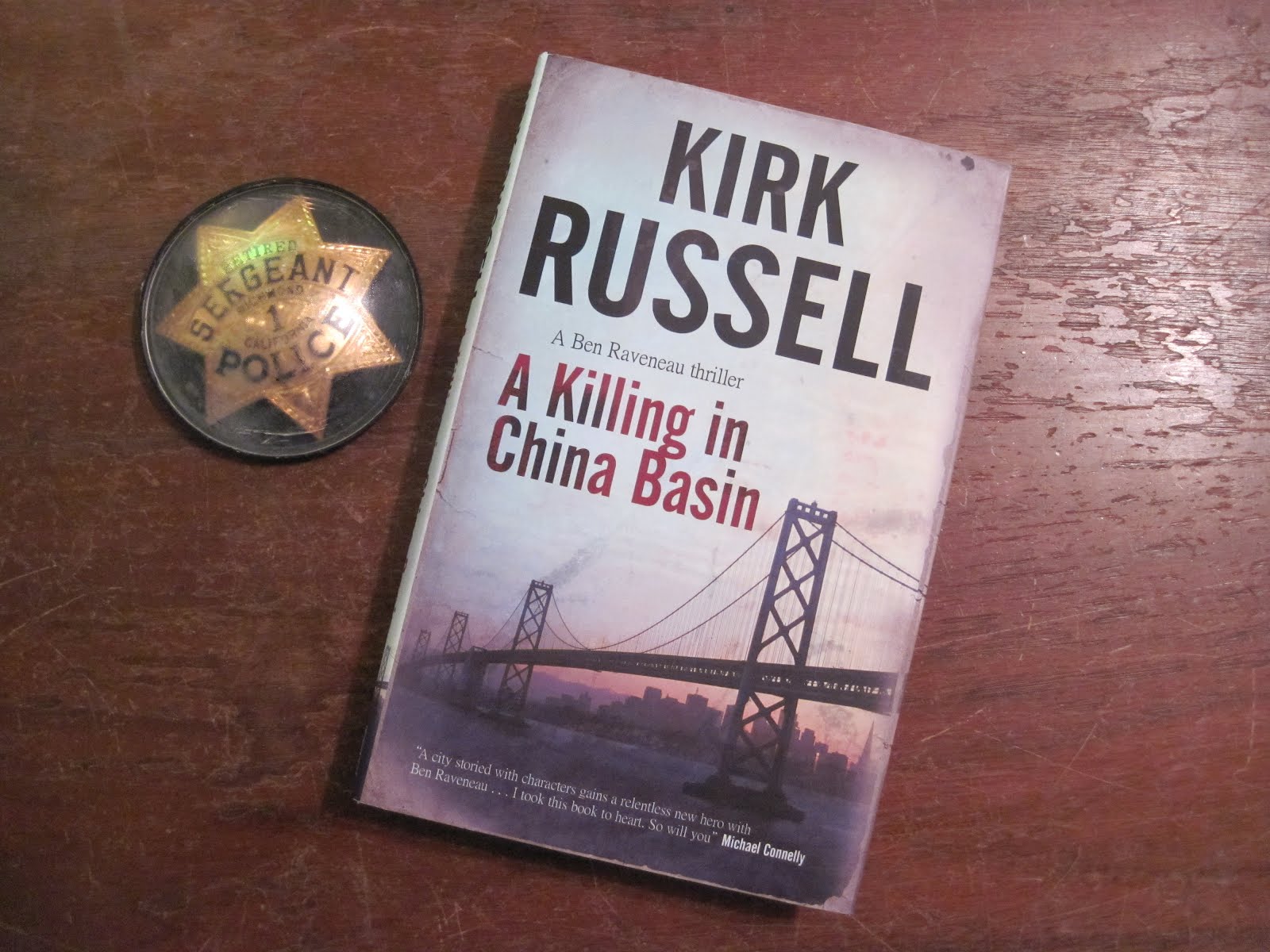
Kirk Russell's A Killing in China Basin is a fairly recent crime novel set in San Francisco, and I'd like to recommend it to you. There's an engaging central character--veteran homicide inspector Ben Raveneau--compelling supporting characters, a handful of suspects, and the City By The Bay. There are many crime novels and mysteries set in San Francisco, but this one has Inspector Raveneau and, significantly, an unassuming energy that builds and builds, a steady relentlessness that should engage and provoke you to read further and further.

Rather than offer a summary or even a teaser about the central concerns of the novel, I am going to share a taste, a sense of the texture. With this second reading of Russell's novel, I'm most struck by the rich characterization; the spare, focused descriptions; and the interplay between the characters, captured in dialogue and in silence, in what's unsaid. This passage, however, offers an entry into the main character's evolving sense of self and humility through a reflection on clothing, on what to wear to work.

(La Rosa is Raveneau's new partner, a much younger rising star in the department.)


Like a true cop, La Rosa read the arrest article first, and he made coffee. Though it was Saturday and the office empty but for one interview underway, la Rosa had dressed in a coffee-colored suit and shoes to match. Maybe that was for an anticipated meeting with Lafaye, but who knew whether Lafaye was even in town. He got the impression from the website and everything else that popped up on Google that Lafaye traveled a lot. Seeing her nice clothes reminded him of a period of several years when he'd worn nice suits every day and told people that it was out of respect for the dead.

But that respect for the dead had also coincided with when he was most full of himself. Looking back now, he figured he'd known a few very good inspectors and some very bad ones and the clothing hadn't made anyone better or worse. Some of the bad inspectors had dressed immaculately yet couldn't find a soldier on an army base.

The good ones connected to some pulse running through everyone. One of the very best had taken him aside at a retirement party and walked him out into a warm May night on a patio to tell him, 'Dump the expensive suits, you don't need them. I've been watching you and you're the real deal, but you're missing details because you're spending too much time trying to keep coffee off your tie.'

At some point after trying to live larger than he was, Raveneau had figured it out. He sipped the coffee now . . . .


Kirk Russell, A Killing in China Basin, Severn House Publishers, Ltd: Sutton, Surrey, England, 2011--from pages 77-78.

I've just ordered the second Ben Raveneau thriller: Counterfeit Road.

Kirk Russell is also the author of four John Marquez eco-crime novels, and I recommend those books highly. In fact, Shell Games is a particular favorite; that novel begins with murder and abalone poaching on the northern California coast . . . .

Postscript:

The badge isn't quite right to fit the story, as it's a sergeant's badge, #1, for the City of Richmond, not an inspector's badge, not for San Francisco. That's my dad's badge, the retirement version earned through thirty years of service.

This Thursday will be the eighth anniversary of his death. Rest easy, Dad, rest easy.

Saturday, March 10, 2012

Possession

I have always admired Martin Cruz Smith's novels, particularly his series treating Russian investigator Arkady Renko. As a grad student at UC Berkeley, I once taught Gorky Park in conjunction with Dostoevsky's Crime and Punishment, Lessing's The Good Terrorist, and Shakespeare's Macbeth. I may have thrown in some tales of ratiocination from Edgar Allan Poe as well.

Here, I'd like to share a section of Martin Cruz Smith's Havana Bay. Arkady is in Cuba, following up on an obscure call for aid, feeling his way into a volatile situation with no knowledge of the language or culture. Haunting the investigator is the recent death of his beloved Irina, killed accidentally, negligently, in a Moscow clinic. I'll stop the plot summary, but I am drawn to the following passage because it exemplifies one of the writer's real strengths: portraying undercurrents in and between characters.

Here is the final section of Chapter 13 from Havana Bay, an exchange between Arkady and the PNR detective Ofelia Osorio (whose original assessment of this Russian investigator is quite succinct: "idiota"). The two characters are talking together late in the evening on a balcony above a Havana street busy with couples and commerce. Detective Ofelia Osorio's ostensible reason for spending time on that balcony is to protect Renko, if necessary, from being attacked or even killed before she can put him on a plane back to Moscow.


"We don't have to talk about it," Arkady said.

"It was the way you asked."

"I sounded smug? It's just my ignorance. I apologize."

"We will not talk about religions."

"God knows."

From the radio in the portal rose the deep beat of a drum that Ofelia knew had to be a tall iya with a dark red center on the skin, accompanied by the grinding rhythm of a belly-shaped gourd. A single horn insinuated itself, the way a man asked a woman to dance.

"Anyway, it's not a bad thing to be possessed," Ofelia said.

"Well, I have an unimaginative Russian mind, I don't think it's going to happen to me. What is it like?"

"Theoretically?" She watched him for the slightest hint of condescension.

"Theoretically."

"As a child, you must have spread your arms and put your head back and danced in the rain. You are drenched and clean and dizzy. If you are possessed, it's like that."

"Afterwards?"

"Your mind still spins."

An abwe, the poor man's triangle, joined in from below. It was nothing more than a hoe blade played with a stick of iron, but an abwe could sound like the ticking in the mind when a man's strong hand reached around your waist. As the saxophone tried to wrap around it, the gourd trembled, the drum stopped and started like a heart. These were the snares set for silly girls who lingered in shadows. Not Ofelia. She visualized a clear mind.

She looked toward his arm, the one she had found the bruises on. "You're sounding better. You were not in a healthy mood when you came here."

"I am now. I am curious about Pribluda and Rufo and Luna. I have a new purpose in life, so to speak."

"But why did you want to hurt yourself?"

She half expected contemptuous dismissal, but Renko said, "You have it backwards."

Ofelia sensed the next question so strongly she asked before she checked herself, "Did you lose someone? Not here. In Moscow?"

"I lose people all the time." He lit one cigarette from the other. "Most boats that go on the rocks really don't intend to go there. It's not a mood, it's just exhaustion. Exhaustion from self-pity." He added, "You're with someone and for some reason with them you feel more alive, on another level. Taste has taste and color has color. You both think the same thing at the same time and you're doubly alive. And if you manage to lose them in some gruesomely irrevocable way, then strange things happen. You wander around looking for a car to hit you so you don't have to go home in the evening. So this incident with Rufo is interesting to me because I don't mind a car hitting me, but I do mind a driver trying to hit me. A fine distinction, but there you are."

In the night Ofelia woke to find lovers gone, the moon becalmed. In the very lack of breeze she detected a faint scent, a perfume she traced to Renko's soft black coat, to the sleeve of a man who claimed he'd never been possessed.

--Martin Cruz Smith, Havana Bay.

Saturday, September 24, 2011

Passages: Charon's Steamboat

"During the firefight, I saw a steamboat down by the mouth of the river."

"You mean a floating casino?"

"That's not what it was. I've seen it before. On Bayou Teche."

"I don't know if I want to hear this."

"I thought that was where I was going. I thought they were waiting for me."

"Who?"

"The people on board."

"Don't talk like that."

"You're the best, Cletus."

"No, we're the best. One is no good without the other. The Bobbsey Twins from Homicide had one agenda only. We make the dirtbags want to crawl back in their mothers' wombs. We're gonna hunt down the cleaners or whatever they are and salt their hides and nail them to the barn door."

"You've already said it for both of us. It's only rock and roll."

"That because I was ninety-proof. You don't have permission to die." He grabbed my shirt. "You hearing me on this?"

"I was just telling you what I saw. Who else am I going to tell?"

I cupped my hand on the back of his neck as we walked to the car. I could feel the hardness in his tendons and the heat and oil of his skin. I could feel his heartbeat and the fury and mire of his blood in his veins, and in his intelligent green eyes I could see the misty shine that my words would not make go away.


--James Lee Burke, from The Glass Rainbow.

Dave Robicheaux and Clete Purcell's friendship is one of the glories of Burke's novels featuring these two characters.

Friday, September 2, 2011

Passages: Kodak Moment?

"Every picture tells a story--don't it?" That's Rod Stewart singing, but today I'm thinking of how pictures work standing alone, as history, and in that difficult, turbulent territory that exists between subjective history and pure image.


Richard Ford is a writer I admire, both in his novels and in his short stories. I read him avidly, and I've taught his short stories to my students. The Ultimate Good Luck is Ford's second novel, a sort of detective-story-without-a-detective, a wonderfully tense excursion that has Hemingway's short stories, Robert Stone's Dog Soldiers, and Tim O'Brien's Going After Cacciato in its bloodlines. (I don't know the truth of those possible influences, but that's what I thought when I first read the book in 1986, and I still do).


There are so many moments I could quote for you, but today I want to pull out one moment. This passage concerns the way a picture can tell different stories to different people, concerns how a picture may be worth a thousand words, but we just may need those thousand words to properly appreciate the picture (or the real life of the picture), and concerns the manner in which the character Quinn just may be too susceptible to what the character Rae thinks and wants. (And Rae matters to him, though he'd better figure out how to make that work and be okay with it; happiness would just be a bit too much to ask for--themes of the larger novel.)


Anyway, here's the part of one paragraph from a tense, action-oriented, reflective novel that held my attention today. And, as I have been telling my students, writing that holds my attention is writing I value:


There was a picture taken nearly that long ago that showed him standing alone on the sand beach on Mackinac Island, staring gloomily into the camera as though into a dark thundercloud that threatened to ruin his day. Rae said he looked saturnine and didn't like the pose. But the truth was that he had just fucked a big Finnish girl from Ludington, whom he'd met on the boat from St. Ignace, and who had wide Finnish blue eyes and dusty skin and was older than he was. And he was, he thought, in the best spirits of his life, and had gone back in fact, the very next moment, and found the girl and fucked her again. But in his mind, over time, he had defeated the facts, become convinced that he was sour and out of sorts, and he didn't like to look at the picture and kept it in his footlocker where he never saw it.


--Richard Ford,

from The Ultimate Good Luck

Saturday, August 13, 2011

Kirk Russell's "Dead Game": Read It!


Coffee break after the photo session. What do you expect from merfolk, anyway?

Kirk Russell's Dead Game, the book pictured above, is one of the best crime novels I know. It's about sturgeon poaching in California, but it's a real novel, so it's also about a lot more than that. Great qualities: major characters, minor characters, landscape, plot, and pacing. This is the third of Russell's John Marquez crime novels, and while I love all of them (with a particular appreciation for the first, Shell Games, about abalone poaching), Dead Game shows Russell at his best.

This novel moves, my friends; it has momentum, a quiet momentum that builds continually and surprisingly. The novel carried me along, and yet caught me off guard too. It's thorough and thoughtful, yet in an energetic, constantly pressing way. It has Russian gangsters, sure, but it's not a "Russian gangster thriller." It's better than that. Russell is better than easy generalizations or formulas. So many crime novels bluster, but this one doesn't. I'm not sure how to put the best effects into words, but I've been rereading this novel once or twice a year since it was published in 2005. The great American novelist Richard Ford is on record how he learned much about narrative transitions, about getting from scene to scene, from F. Scott Fitzgerald in his The Great Gatsby; anyone can learn about narrative economy from Kirk Russell.

My copy happens to be autographed by the author. (I am happy that I've been able to tell him personally that I admire and appreciate his work. Others would care more about that John Hancock enhancing the market value of a first edition; I read and wear out worthy books, first edition or not.)

Dead Game opens with the murder of a fish, though you may not realize that's what he's giving us. Eventually, you have to see the crime. The book also opens with the apparent abduction or murder of an informant into the sturgeon poaching and illegal caviar processing . . . so there's plenty of action from the start. Russell's main character John Marquez, the leader of a Fish and Game undercover team, rewards your attention as we watch how he handles both the criminal investigations and his personal relationships with his wife and stepdaughter. Marquez's character enables Russell to explore the themes of integrity, commitment, and friendship.

Kirk Russell understands the evil and the frailty as well as the courage and strength in humanity. He also understands the vitality of life beyond the human sphere, and yet the human responsibility towards such life, those creatures. Aren't those qualities you want in a novelist?

Dead Game: check it out. Check out his other novels as well. Learn more here.

P.S. I'm looking forward to his non-fiction writing too.