Wednesday, May 27, 2009

Annotations: W. Hodding Carter

Carter, W. Hodding. Off the Deep End: The Probably Insane Idea That I Could Swim My Way Through a Midlife Crisis--And Qualify for the Olympics. Chapel Hill, NC: Algonquin, 2008.

The title really does tell you what you'll get, but Carter isn't quite as insane as his goal may seem. On the one hand, a classic midlife crisis in action, and on the other, a great how-to for training to swim at an Olympic level, this book takes you for a ride. Carter has an engaging (or annoying, for some) lack of embarrassment as he documents some truly stupid behavior. Mostly, he offers a model of crisis, self-assessment, positive response, frailty and partial failure, and finally, actual progress in self-awareness, commitment and performance. (As a 47-year-old male, I like watching someone else go through the rough stuff and emerge at least somewhat victorious, even if chastened.)

P.S. What's the name of the 40-something swimmer who did reach the Olympic Games this past year? Well, not Hodding Carter, but still . . . .

---. A Viking Voyage: In Which an Unlikely Crew of Adventurers Attempts an Epic Voyage to the New World. New York: Simon & Schuster, 2000.

The first book by Carter I'd read. Here, he presents a potentially silly obsession that he manages to take from an idle thought (and he has a boatload of those) to serious completion, struggling and straggling all the way. One part how-to-build-a-viking-boat and another part friendships-are-built-on-shared-adversity, the book is a model of having a goal and getting to the goal-line. Very humorous too.

Annotations: Rachel Carson

Carson, Rachel.  The Edge of the Sea.  Boston: Houghton Mifflin, 1955.

While The Sea Around Us is the better known volume, I prefer The Edge of the Sea because I prefer . . . the edge of the sea, the intertidal zone, the rocky shores, sandy beaches, and even the mudflats.  Here, Carson walks us through the different types of shores, of creatures, and of plants.  I was happy to reread this volume for this project.  I'd forgotten how well Carson presents the material; the book is academic without the mere dryness of most academic texts.


---.  The Sea Around Us. Revd. Ed.  New York: Signet, 1961.

Carson's book is a classic, and it is still relevant.  Her accurate and practical descriptions of the ocean and of ocean processes are presented in a style that can only be described as poetic and philosophical.  Grounded in reality, the book still soars.  I am always cheered up by reading even a few pages of this book.

Friday, May 8, 2009

Touchstone: The Testament of Daedalus

Consider this quotation from Michael Ayrton's The Testament of Daedalus:

What there is in me of poesis rests in my fingertips and in my eyes, but because the poem exists in the thing I make, and not in me, it comes to me in the act of discovery. I make votives of one sort and another and celebrate possibilities in gold and bronze and other materials. In the making of things and especially in the making of images, lies an act of conquest which is sufficient exercise of power for a proper man.

I put this passage next to Seamus Heaney's "The Diviner" (and next to various parts of Mary Renault's The King Must Die and The Mask of Apollo) when I think about teaching, about art, about craft, and about ambition. The books I haven't written yet; the stories I tell, have told, will tell.

Ayrton, Michael. The Testament of Daedalus. London: Robin Clark, 1991.
Renault, Mary.  The King Must Die.  New York: Pocket Books, 1965.
---.  The Mask of Apollo.   New York: Pantheon, 1966.

Sunday, May 3, 2009

Annotations: Broad, Carey, Carr

Broad, William J. The Universe Below: Discovering the Secrets of the Deep Sea. New York: Simon & Schuster, 1997.

Broad is a Pulitzer-Prize-winning science writer, who had two books on Stars Wars Weapons Systems under his belt before he shifted from sky-high to ocean-deep. The deep sea is one of the last territories on Earth to be explored, and Broad brings us up to date (into the 90s, anyway) through interviews, explanations, and some adventuring of his own. My favorite chapter, which I could excerpt for English 1A or for an aquatic-literary elective, is "Canyon," an in-depth look at the vast submarine canyon in our nearby Monterey Bay. The Packard family and MBARI, the Monterey Bay Aquarium Research Institute, are the stars for this epic descent.


Carey, Robin. Baja Journey: Reveries of a Sea-Kayaker. College Station, TX: Texas A & M UP, 1989.

Carey is an English professor from the Pacific Northwest, on vacation in the waters of Baja Mexico, full of thoughts of Shakespeare, the local scenes, and human frailty: philosophical, but with groundedness, despite being all about the water.

After reading this book, I rented a kayak and explored Monterey Bay for a few hours. Yes, I spent a little thought on Shakespeare and I considered how much colder it was off Monterey than off Cabo San Lucas, but mostly I thought how getting closer to the surface of nature really can get you closer to yourself, in the best ways possible.


Carr, Archie. So Excellent a Fishe: A Natural History of Sea-Turtles. New York: Anchor, 1972.

Carr's book is the Bible for sea turtle science, at least for many people. My wife is now reading this book in preparation for her own trip to Costa Rica and to the specific turtle station in Tortuguero. Carr sets the bar high with this in-depth study. He also walks the reader through the developing body of knowledge as he and other researchers work to answer the questions that beset them. How do turtles know how to navigate? Must they return to the same beaches they were hatched on? Where do the turtles go while developing from hatchlings to young adults, since no one seems to know: And further questions. Carr reports what he learns, and he includes us in the learning process, which makes the book and enjoyable and worthy model for thinking and discovering the things of the world.
P.S. Since Carr's book was published in 1972, obviously there are more up-to-date treatments, but So Excellent a Fishe is foundational. If all you want is information, then pick a more recent book. Indeed you should--I should--read current material too. Carr's book takes you on the journey, and that's a compelling consideration, I hope. (As a further note, the more recent reprints reverse the subtitle and title, making the book easier to discover when looking for sea turtle material: A Natural History of Sea-Turtles.)

Tuesday, April 28, 2009

Postcard: Saltwater Reflection

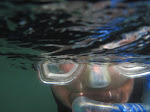
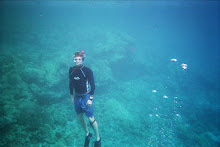
I was very fortunate with the disposable camera this day in Monterey Bay. Fortunate with the light and the angle too.


I was free diving just northwest of Lover's Point, out from the parking lot at Otter Cove. I should check my notes for that day. I tend to write up my dives while enjoying the basic bacon & eggs at the Lighthouse Cafe in Pacific Grove, but I don't have a standard dive journal to hold all such notes. I use whatever is at hand: teaching notebook, napkin, postcard, blank pages or spaces in the book I'm reading. (You'd think I'd be more systematic, but then you wouldn't know me very well, would you?) I like the loose approach. I like writing up my notes wherever and however, and the writing matters more than the cataloging or rereading.

Except in a case like this one.

Where are my notes from . . . 2006?

What book was I reading that trip? Whom would I have written a postcard to that day? Was I carrying one of the usual Moleskines? I'm pretty sure I shot a much poorer picture of a bat ray that day also, so where's the rest of the roll?

By the way, all of the water-photos I've posted so far have been taken with your basic disposable "waterproof" 35 mm cameras. I have been lucky so far, though I plan to upgrade my equipment soon. With better equipment, I just may get luckier more often, more predictably, in the best sense.

And, what's Jack Johnson's line about moving like a jellyfish?

Monday, April 13, 2009

Turtle Power: Grace Ascending

A question for my English 93 students this term:
What would Rell Sunn tell us about this turtle?

Monday, April 6, 2009

Annotations: Birkett, Blossom, Blum

As part of a research project, I have produced an annotated bibliography of 129 nonfiction texts, all associated with aquatic subjects.

Here are three more entries:

Birkett, Dea. Serpent in Paradise. New York: Anchor, 1998.

This is an annoying book that I finished more to find out about Pitcairn Island, the most isolated inhabited island on the Earth, than to discover anything more about the author. Generally, I like such a mix of autobiography, obsession, history, sociology, and adventure, but in Birkett's hands, the narrative becomes a spiteful, depressing pile of gossip and innuendo at the expense of the Pitcairn Islanders who were good enough to welcome Birkett to their very small island. Still, worth reading once to find out what has been happening to the Pitcairn Islanders since Fletcher Christian and his crew of mutineers began to populate this refuge after the Mutiny on the Bounty. Or, barely worth reading? I'm still debating that one.

Blossom, Laurel, Ed. Splash: Great Writing about Swimming. Hopewell, NJ: Ecco, 1996.

Blossom's anthology is a mix of fiction and nonfiction, actually. It's a fine collection that brings together classic short pieces (Cheever's "The Swimmer" and Updike's "The Lifeguard") with a full array of poetry and practical nonfiction all on the theme of swimming. I wish that Ben Franklin's lessons on how to swim were included also, but I know where to find that piece anyway.

Blum, Mark. Beneath the Sea in 3-D. San Francisco: Chronicle, 1997.

I love this photographic wonder: just as the title says. Whenever I teach essays regarding the ocean or fish or even just looking closely to discover truly, I bring this book and pass it around. Chronicle Books has a winner here.