Thursday, January 21, 2010

Brecca the Bull


A figure of fun, but no Unferth. This is my small envisioning of Brecca, Beowulf's opponent/companion in that swimming competition amidst the rough waves and rougher monsters of the North Sea. Troublemaker Unferth brings up the competition, claiming that Beowulf lost, but the Mighty Geat sets the story straight and sends Unferth into retreat by a well-placed personal jab. According to Beowulf, Brecca couldn't swim away from him, and he choose not to outswim Brecca just yet. The two men spent days swimming, swords in hand, until a storm on the fifth night separated the two men, and then Beowulf was beset by nicors, nine of which he slew, before coming ashore in Finland, I believe. I always wondered what happened to his swimming companion. And I always wanted to hear Brecca's version of the story.

If Beowulf may figure as the Bee-Wolf or the Bear (aren't kennings fun?), then Brecca ought to figure as a Ram, Boar, or Bull, some stubborn beast. The Breaker figured in my mind, finally, as Bull. I'd meant to form a complete set, a chess set, of such figures from Northern myth and legend, but I don't play chess . . . .

Stoneware; glazed with seafoam. I like how the glaze broke well, filling in the hollows with a rich light blue and revealing the contours just the way I wanted. Art-luck.

By the way, reading the Anglo-Saxon epic in the original Old English showed me just how powerful Beowulf is with words. Translating for myself, I could feel fully how this character is articulate, weighing words as well as deeds. In fact, he's diplomatic and devastating, whatever's needed, and no mere muscleman. Seamus Heaney's translation is my definite favorite, the one I turn to again and again, but the old E. Talbot Donaldson prose translation is the real deal too, a plain-style gem for accuracy and Northern European understatement, just like the original.

Monday, January 11, 2010

The Head of Odysseus

Who knew the ancient Greek hero, the ancient Greek scoundrel, would be so bald, so happy, so old? And yet, here he is: the aged, ancient Homeric figure.

Sculpture mix; unglazed as yet. My first head, formed in 2001 or so. I worked on the piece for a whole summer, not sure how to proceed or how to stop. Trisha K., my art teacher, was wonderfully supportive.

Sunday, January 10, 2010

Postcard: Pt. Lobos in January

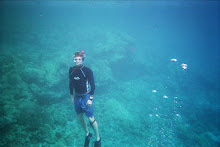
Pt. Lobos, January 2010: I'm standing with Kathie, one of Jim Grass's diving partners. Frank K. took and provided the photo. Kathie and Tom (not pictured) let Frank and myself tag along with them. Everyone that I've met through Dr. James Grass has been especially welcoming and helpful.

Note that I'm still wearing half my wetsuit in anticipation of a second dive. (Actually, the first dive was so good, so long, and so cold that--uncharacteristically--there was no second dive for me. I traded that potential water-time for lunch with Frank. Kathie and Tom went back underwater to shoot photos; Frank and I headed for Phat Burger in Seaside. And, the burger, a bacon cheeseburger actually, was really, really good.)

Chilly, yet mild for January; wool helped, still. Surge, sure, but not so bad. Good visibility: 35-40 feet. A fine diving-day.

Morning Light Before Diving

Whaler's Cove, Pt. Lobos State Park, Carmel, CA.

We headed out of this cove for our dive, seeking greater depths and better visibility than we'd have found here. I'm told the leopard sharks would have been gathering in the shallows, so exploration could have paid off. (There were two highlights of the actual dive for me. A cormorant kept swimming down by us at 60 feet and picking snails off the kelp. That bird was so relaxed and capable at depth. And, a sizable lingcod just lounged about, watching us watch him; you had to smile.)

Mnemonic Devices: What Eliot Said About Fragments

What are those lines from "The Wasteland" so dear to the heart of every English major? Something like "with these fragments I have shored up my ruins"?

Quoting from memory: a sin and a pleasure.

Driftwood: wood, water, salt; shaped by oceanic forces, marine creatures, and time; collected at either Monastery Beach, Carmel, or Goat Head Beach, Jenner. Octopus: sculpture mix, glazed with transparent brown and celadon; salvaged.

Wednesday, December 30, 2009

Kayaking with Sofia


Sofia is my kayak: an Ocean Kayak Scrambler 11.

The day was quite rough and cold, though these photos don't quite show those aspects. The dive-master had even cancelled our two days of diving due to the high swells. Here I'd watched, waited, and made my move in what I hoped would be a lull. The sit-on-top works well across rough water, but she's beamy and offers a lot of surface area to breaking waves; I'm often pushed back ("punched" may be a better word) if I don't time the entry just so. But then that's part of the fun.

Here, the fun was getting right out through the waves. I had witnesses to impress (or not to falter or fail in front of). I cruised about for only 40 minutes or so, I think. The day was bright enough, but cold. Since I was solo, I held back from braving the surf breaking along the south edge and straight out from the beach past the third set of rocks. Later, I felt I should have pushed myself more. Still, good exercise, and I felt quite secure in the rough water in Sofia, though I will say I put on my fins once I was beyond the shore break just in case of capsizing. I wanted to be able to catch and remount my kayak quickly and easily.

Van Damme State Park, just south of Mendocino.
Late November, 2009.

Saturday, December 26, 2009

Dorothy Dunnett's King Hereafter: A Descriptive Sample


I love this book, this novel, about the historical Macbeth, Thorfinn of Orkney. Dunnett's lively mind and comprehensive research provide a dense, demanding, rewarding reading experience. I've read and reread this book so many times that I enjoy dipping into it anywhere, which almost always draws me into rereading from the very first page. I always falter at finding the right words to describe this novel of action and intellect, force and cunning, passion and compassion. History as life, as a dynamic force or field, and thinking --mindfulness, thought undivorced from physicality and action--are the two house-pillars upon which this word-hall is built. The book is intelligent, often gorgeous, often brutal. Thorfinn is a Viking, after all.

Anyway, here's just one paragraph, selected almost at random, that I feel catches Dunnett's lively, observant, worldly style in a few sentences. Here, the people of Orkney are awaiting word of the war in Norway and they gather on the strand as the first ship with news approaches. Dorothy Dunnett's day-job, as it were, was as a portrait painter, and I think you can see some of that artistry even here in a minor paragraph from page 62.

"Instead of a clean half-moon of blue pebbles, the beach was thick as a bere-field with heads: the cloth-bound heads of married women and the shining cloak-fall of hair of young girls, as well as the cloth and leather caps, the untrimmed hair and beards of the farmers, and the smooth chins and snake-moustaches of those who had travelled and fought and fancied a foreign style would make them sound wittier. The roar of talk, as the longship's prow, sixty feet high, cut towards them, grew to a storm, pushing back the kindly sound, the surfing lap of the waves."