Flat out: I'm a diver, not a surfer. It's been at least two years since I last had my board out, and when I take that board out, I'm a kook. But I'm a respectful kook. I know my limitations, and I respect and follow basic water etiquette. I'll take a beating from the wave before (knowingly) getting in a surfer's way.
I'm also respectful because I love surfing's stories. The history, the personalities, the motions, the emotions, and the images. I've been a student of surfing for quite a while, and I've taught a few books about the surfing experience and a few documentary films in my English classes . . . from the perspective of a definite water-guy and respectful rookie.

Normally, I prefer to attempt surf photography from out in the surf. This day, however, was dreary and cold, I was feeling a bit too lazy, and so I shot from the beach. I need the practice, so here are some draft-shots, some work-in-progress shots.

I should have got right into the water, but I spent time on the beach and let myself get cold, despite sweatshirts, fleeces, jackets, and hats ready in the truck. I was focused on the water and on the flotsam and jetsam at the water's edge, not on the wind chill. I'm feeling guilty about not getting in, so next time . . .
jump right in!

I also couldn't decide if I was shooting the water or the surfers, and that's a rookie mistake, of course.

I like the landscape shot above, though it's more seascape, I guess. The textures in the water are what caught my attention. I decided on the Bird Island backdrop since these sorts of shots taken straight out to sea just don't work as well.

I like watching how surfers handle the oncoming wave almost as much as watching a successful ride. Maybe because I'm more likely to need multiple evade-and-bail techniques at present, still.

Above: That was a decent
wipeout, but I missed the moment. I have to work on that.

I am not the only one practicing. That wave is already over, but he's going to make it. I need to practice like that, over and over, as well as everything else.


One duck-diver, one boogie-boarder, and one surfer prepping if the wave pans out.


Above: Pushing through. I was thinking he should have duck-dived (duck-dove?), but his way worked.
What do I know?
Odd shot, but I like it.

Caught inside!

I like watching the surfers and their moves, but I like watching the water even more. Here comes a wave, and the flex and roll of the water's surface always hold my attention.

This one's mine. I actually thought this one would run up the rocks and drench me. That would have been okay, would have been proper chastisement for not getting wet already.


 My father often called a quarter "two bits." This is a rather small mermaid.


 With this last shot, I was surprised to see the goose. I'd been expecting a gull.
 Normally, I prefer to attempt surf photography from out in the surf. This day, however, was dreary and cold, I was feeling a bit too lazy, and so I shot from the beach. I need the practice, so here are some draft-shots, some work-in-progress shots.
  I should have got right into the water, but I spent time on the beach and let myself get cold, despite sweatshirts, fleeces, jackets, and hats ready in the truck. I was focused on the water and on the flotsam and jetsam at the water's edge, not on the wind chill. I'm feeling guilty about not getting in, so next time . . . jump right in!
 I also couldn't decide if I was shooting the water or the surfers, and that's a rookie mistake, of course.
 I like the landscape shot above, though it's more seascape, I guess. The textures in the water are what caught my attention. I decided on the Bird Island backdrop since these sorts of shots taken straight out to sea just don't work as well.
 I like watching how surfers handle the oncoming wave almost as much as watching a successful ride. Maybe because I'm more likely to need multiple evade-and-bail techniques at present, still.
 Above: That was a decent wipeout, but I missed the moment. I have to work on that.
 I am not the only one practicing. That wave is already over, but he's going to make it. I need to practice like that, over and over, as well as everything else.
 Above: Pushing through. I was thinking he should have duck-dived (duck-dove?), but his way worked. What do I know?
 Odd shot, but I like it.
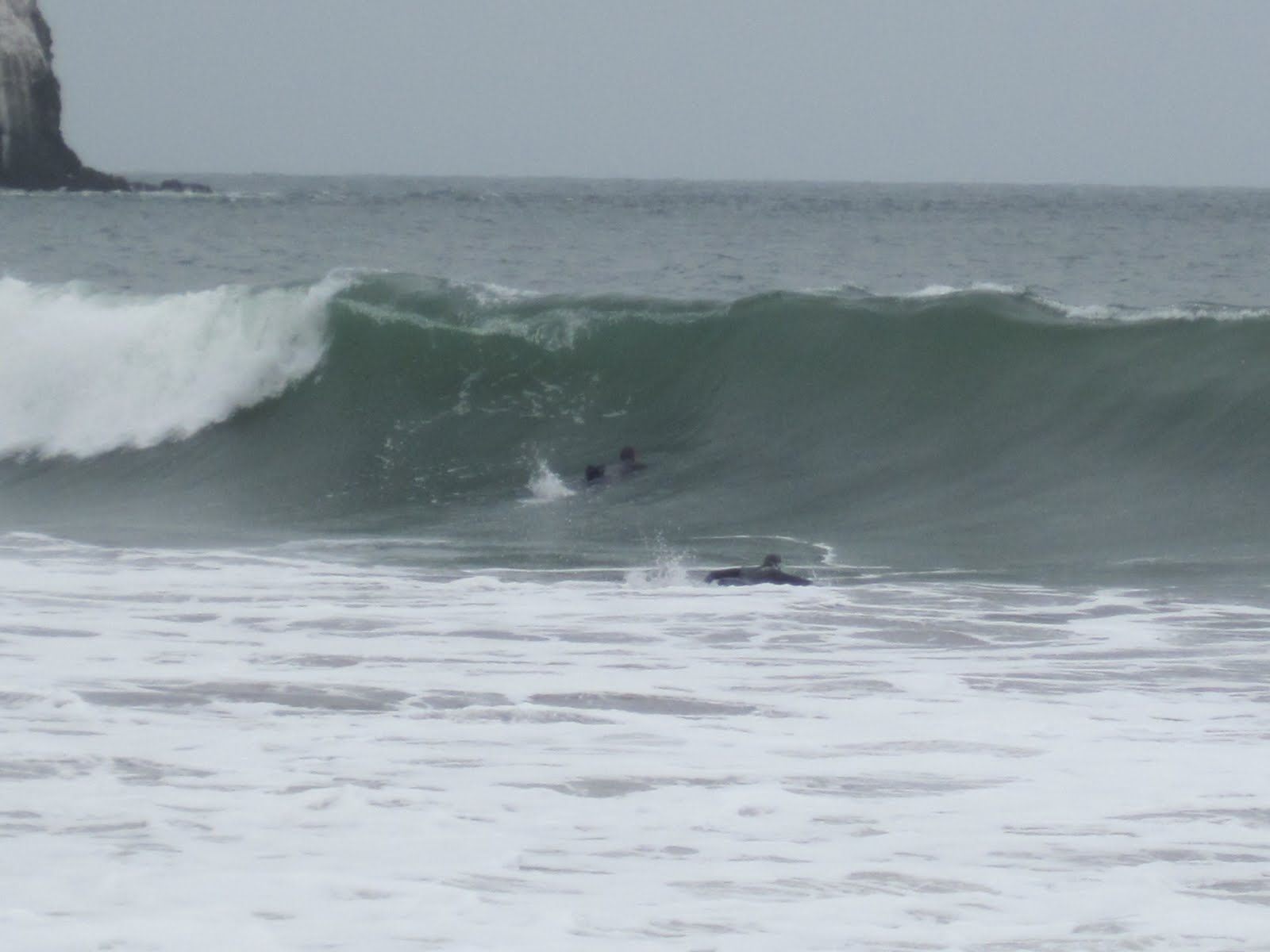 Caught inside!
 I like watching the surfers and their moves, but I like watching the water even more. Here comes a wave, and the flex and roll of the water's surface always hold my attention.
 This one's mine. I actually thought this one would run up the rocks and drench me. That would have been okay, would have been proper chastisement for not getting wet already.