IV. ARGONAUTS
And for the soul
If it is to know itself
It is into a soul
That it must look.
The stranger and enemy, we have seen him in the mirror.
They were good lads, the comrades. They did not grumble
Because of weariness or because of thirst or because of frost.
They had the manner of trees and the manner of waves
That accept the wind and the rain,
Accept the night and the sun,
And in the midst of change they do not change.
They were good lads. Day after day with downcast eyes,
When we passed the desert island with the Arabian figs,
Towards the setting of the sun, beyond the cape
Of dogs that howl.
If it is to know itself, they used to say,
It is into a soul it must look, they used to say.
And the oars beat on the gold of the sea
In the middle of sunset.
Many the capes we passed, many the islands, the sea
Which brings the other sea, sea-gulls and seals.
There were times wheen unfortunate women with lamentations
Cried out for their children gone,
And others with wild faces looked for Great-Alexander
And glories sunken in the depths of Asia.
We anchored by shores steeped in nocturnal perfumes
Among the singing of birds, waters that left on the hands
The recollection of a great good fortune.
But there was never an end to the journeys.
Their souls became one with the oars and the rowlocks,
With the severe figurehead at the prow,
With the wake of the rudder,
With the water that fractured the image of their faces.
One after another the comrades died
With downcast eyes. Their oars
Indicate the places where they sleep on the shore.
There is none to remember them, and the word is Justice.
--George Seferis,
From "Mythistorema"
George Seferis, Poems: Translated from the Greek by Rex Warner,
Little, Brown and Company: Boston and Toronto, 1964

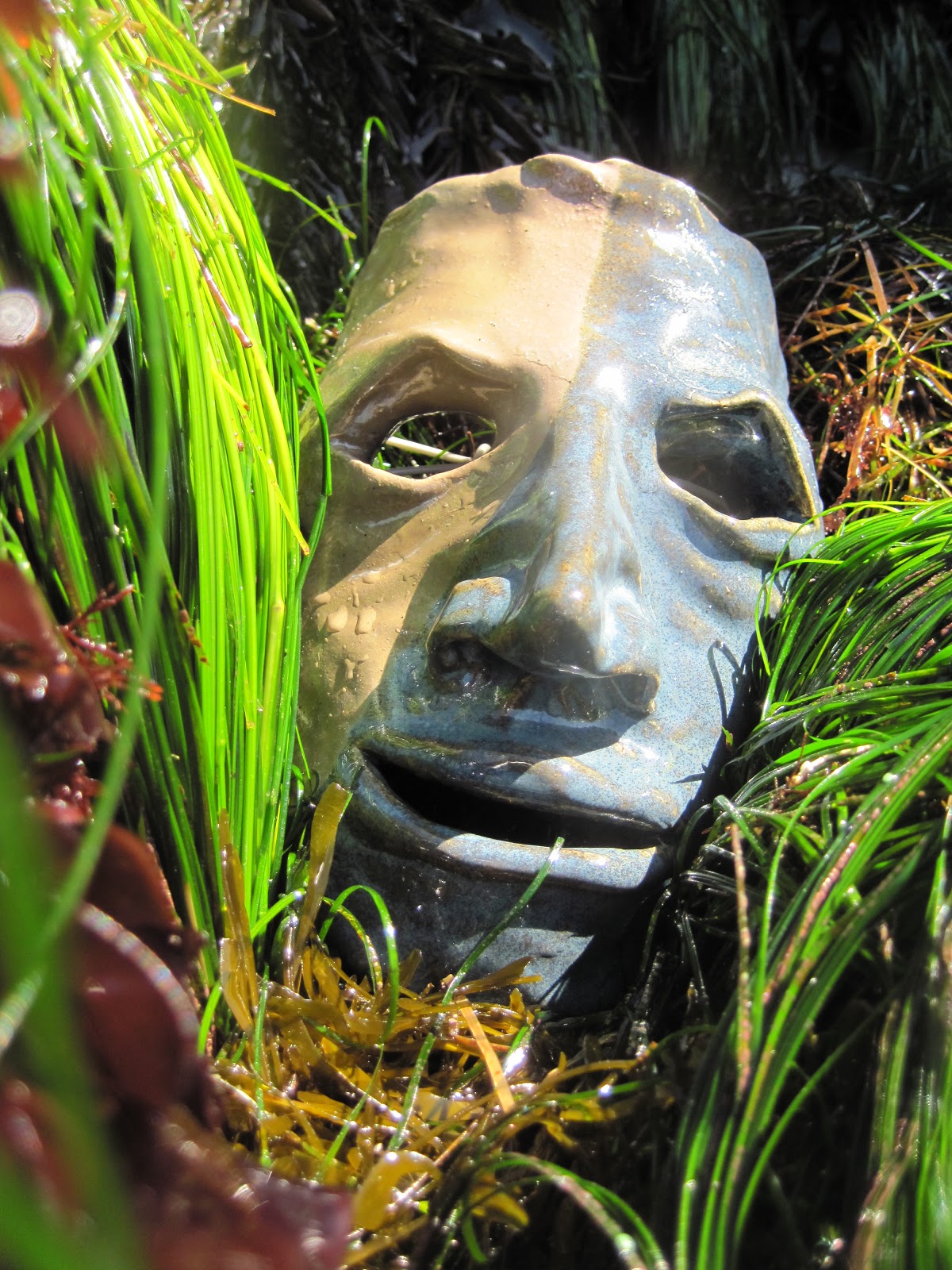
Mask: Triton, sculpture mix, tan and blue glazing, layered.
In the poem above, the voice would seem to be that of Jason, captain of the Argo, leader of these Argonauts. What roles can we see here? What relationships between this captain and this crew? And what of the final epitaph? Or, is that last line only comprehensible in terms of the opening reflections on soul?
Dramatic monologues, after all, offer skewed and resonant visions dependent upon the character and experience of the speaker in the moment of speaking. Where are you, Jason? When are you? Has Medea killed your children yet for the mistakes you (will) make? Have you lost your gamble for kingship again? Have you been looking into the mirror too long? Why "we", really?
And where is Medea in all this? But that and she may belong to another poem, another musing.